

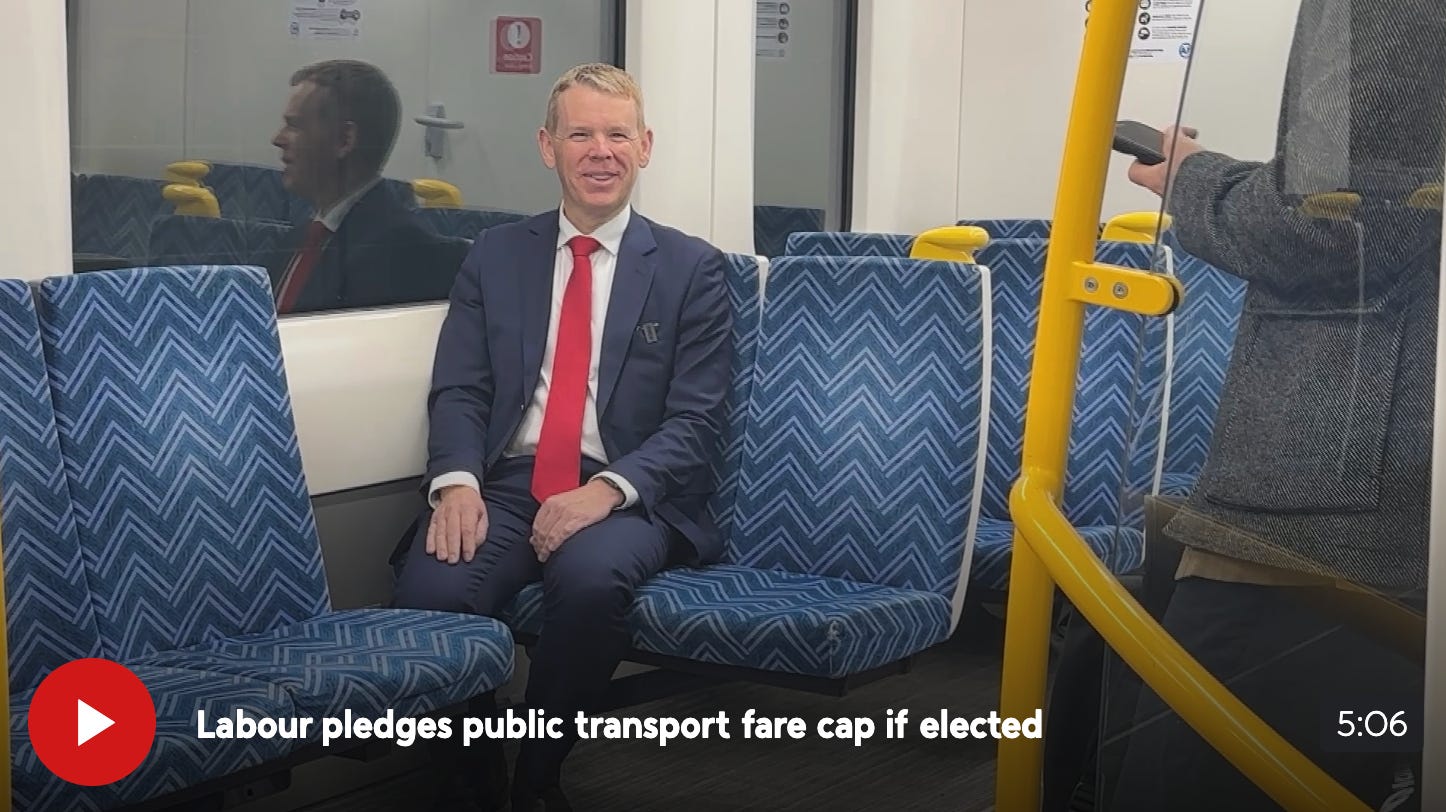
Labour picked Auckland’s Waitematā Station to launch its new public transport policy on Wednesday, and the venue nearly upstaged the message. Chris Hipkins’ promise of cheaper fares was repeatedly interrupted by the deafening arrival of the very trains he was promoting — at one point forcing him to stop mid-answer. “I’ll wait for the train to pass by,” he offered. The Spinoff’s Hayden Donnell recorded the aftermath: Hipkins headed off to film campaign content on board a train, only to find the next one was 17 minutes away.
And Newsroom’s Tim Murphy spotted the day’s neatest irony: by the afternoon, Labour was asking its supporters to donate $20, precisely the figure of the fare cap it had just unveiled. As Donnell put it, “that’s the thing about Auckland’s transport system. Even when it’s working well, it can be a little dicey at times.”
Labour’s policy itself is simple, which is the point. Under a Labour government, weekly public transport fares would be capped at $20 in Auckland, Wellington and Christchurch, and $10 everywhere else, from 1 July 2027. Once a user reaches the cap, any further travel that week costs nothing. Labour says it will cost $65 million a year from the National Land Transport Fund and save the average user about $25 a week. “This is real cost-of-living relief,” Hipkins said. “It means cheaper commutes, more money left at the end of the week, and a public transport system that works for everyone.”
It is a likeable little policy. But it opens a window onto a much bigger problem: a government transport funding system that is fiscally fictional, run by both major parties on numbers they refuse to show the public, while the one party with a genuinely different transport vision said nothing all week. I’ll explain all this below.
The end of Labour’s policy drought
The first thing the announcement tells us is about Labour’s election strategy. This was the party’s first policy in six months, after a long period in which Hipkins insisted everyone wait for the Budget. Tim Murphy in Newsroom captured the mood: “The Labour Party’s long-stalled election policy train finally pulled away from the platform today, first stop an ambitiously costed $20 cap on weekly public transport fares in the three main cities.” When reporters asked if he was relieved to finally have something to announce, Hipkins replied “Oh, plenty more to come”, which doubled as a promise about the campaign ahead.
Lyric Waiwiri-Smith of the Spinoff put her finger on what’s most revealing about it: “its most notable feature is how meticulously moderate it is.” She locates the policy on the spectrum herself, as gentler than the Greens’ free-fares ambitions and more interventionist than a National Party reluctant to meddle. Then she lands her best line: this is “not nanny state Labour, but more distant aunt Labour: happy to watch the kids every now and then, but not too keen on doing much to raise them.” Her conclusion: “At least now, the train has arrived. Destination? Middle of the road.”
The electoral targeting is shrewd. Henry Cooke, in his Politically Correct newsletter at the Post today, points out that MMP makes it perfectly rational to aim policy at the three big cities, home to about half the population, and identifies the real beneficiaries: commuters in places like Petone and New Lynn, with frequent services and $50 weekly fares, who “would save $30 a week from such a measure, and feel that any of their weekend trips were ‘free’. This is far from the full population of these cities, but it is a belt of people who traditionally switch votes between elections.” This is strong distributive politics. Luke Malpass at the Post called it “a decidedly retail start,” noting that $65m is “not even a rounding error in the Government accounts.”
Hipkins even welcomed the prospect of National copying it: “That’d be a good outcome for New Zealand consumers.” When an opposition leader is relaxed about the government adopting his flagship policy, you are watching what political scientists call “valence politics” — a contest over who seems more competent and more sympathetic on the cost of living, with ideology left at the station.
The cap also confirms the shape of Labour’s whole campaign: the small target. Hipkins has spent the year giving National as little as possible to shoot at, and a $65m fare cap is policy built to the same specification — popular, modest, and hard to caricature.
Matthew Hooton, in his Herald column on the policy today, ties the caution directly to the people at the top, describing a leadership wedded to “its small-target election strategy and its preference for holding office rather than exercising power.” It’s a barb that connects this week’s policy to this week’s defensive party list, and it raises the question that should worry Labour’s own supporters most: caution might win the election, but what exactly would it win it for?
The case for Labour’s cap
Labour’s new policy has genuine merit. Hayden Donnell makes the progressive case well: the cap “disproportionately helps poorer people who tend to live further away from city centres while still offering something to almost everyone,” and lets Labour deliver relief “while still wearing its financial hair shirt and professing fiscal rectitude.”
Kerre Woodham, no Labour cheerleader, read out a text from a low-income listener with a new baby who takes three buses each way to work: “at $20 it feels like a godsend.” Wellington mayor Andrew Little backs it, the Free Fares coalition of more than 100 community organisations welcomed it, and overseas equivalents are common — New South Wales runs a weekly cap of around NZ$50.
Cheaper buses obviously help the people who catch them. The real questions are whether Labour’s numbers are real, whether the fund it’s drawing on actually exists in any meaningful sense, and what the week tells us about the health of our political competition. Unfortunately, on all three counts the news is bad.
Show us the workings
Within a day, Labour’s $65m costing had been challenged from three separate directions — what David Farrar gleefully called “a triple fisking.” Auckland macroeconomics professor Robert MacCulloch, quoted on Kiwiblog, did the arithmetic on Labour’s own claims: average savings of $25 a week across the 135,000 census-recorded public transport commuters comes to $175m a year before induced demand. “Declaring that ‘hundreds of thousands of people’ benefit and the saving is ‘on average $25 a week’ does not add up to $65 million. It adds to at least three times that figure.”
The Taxpayers’ Union worked from public patronage data and arrived at a range of $141.7m to $182.5m for Auckland, Wellington and Canterbury before the rest of the country is even counted. And National’s campaign chair Simeon Brown noted that Labour’s three headline claims ($65m cost, $1,200 average annual saving, 1.36 million beneficiaries) “cannot all be true”.
Heather du Plessis-Allan put it more bluntly on Newstalk ZB: “They’re either fibbing about the cost, or they’re fibbing about the benefit. I think it’s a bit of both.”
Labour’s defence is that the $65m is a “net cost,” built on modelling Auckland Transport did in 2023 on a $20 cap (modelling AT itself never implemented), showing a 6% patronage lift, which Labour then extrapolated across the entire country. That is a single city’s three-year-old study stretched across the whole country.
Tim Murphy noted the calculations “appear based on an extra five million boardings.” The two sides cannot even agree what fraction of the fund the policy represents: Chris Bishop says $65m is more than 1% of a fund collecting “$4 to $5 billion per year”; Labour points to forecast 2026/27 revenue of $7.8b. When the alternative government and the actual government dispute the size of the denominator, voters have a problem.
The paywall now starts at halfway through all Democracy Project newsletters. Please take out a paid sub if you want to support this service and access the full content, including the following sections: “The $6 billion problem”, “Where are the Greens?”, “Can Labour even deliver it?”, and “What this all means”.
