

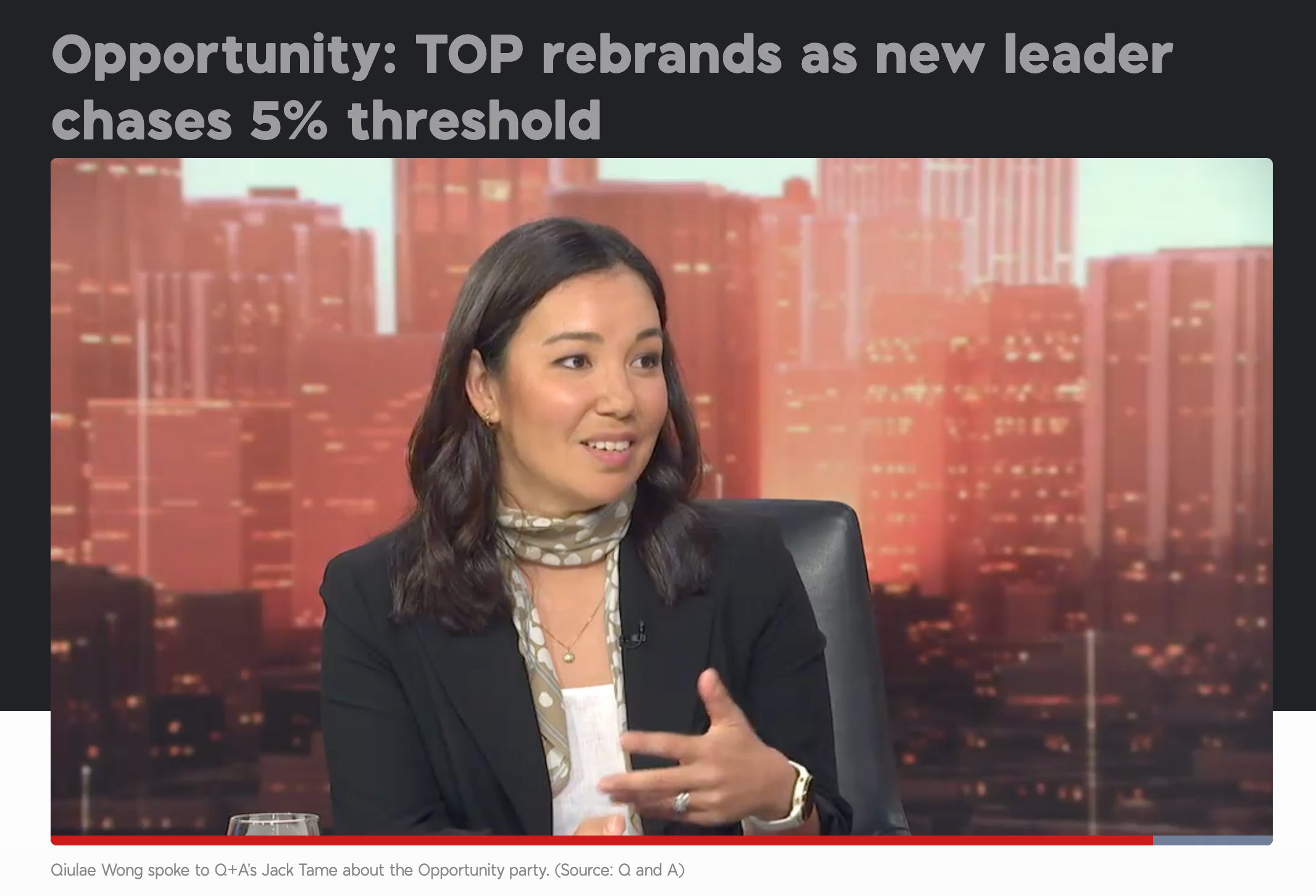
Are voters actually up for a political circuit-breaker this year, or are we stuck with the same stale options again? If a disruptive force is desired, 2026 might finally be the year for the Opportunity Party to break through.
Rebranded from “TOP” to simply “Opportunity,” the centrist party is now led by Qiulae Wong, a 37-year-old sustainability consultant who appears to have a better shot at getting into Parliament than any previous iteration of Gareth Morgan’s creation. When Morgan launched the party in 2017 it won 2.4% of the party vote, followed by 1.5% in 2020 and 2.2% in 2023. The 5% MMP threshold remains the mountain to climb. But the conditions around it are shifting.
The party is channelling a message of “disruption”, which seems well placed when discontent with incumbent politicians and the political system is at a high. Commentators are starting to take notice. And for a party that has always struggled to attract media attention, that alone is progress.
A Party system crying out for a shake-up
The blunt truth is that our party system has become moribund. No new party has made it into Parliament under MMP without a former MP who had split from a bigger party. Think Act with Richard Prebble or the Greens emerging from the Alliance. Opportunity is trying to do something that has never been done: get in purely on the strength of the party vote, with no parliamentary pedigree at all.
We badly need a refresh. If Opportunity climbs in the opinion polls, voters might gain the confidence to invest their party vote in a genuine alternative – one that could disrupt both the election campaign and the tired policy consensus in government.
Perhaps even more importantly, voters from across the political spectrum might come to see Opportunity as the centrist option that could prevent Winston Peters from once again being the post-election kingmaker.
The Environment is back – and nobody in Parliament owns it
There are plenty of reasons why the timing might finally be right. Opportunity has always been environmentally focused, but it is now more about the environment than ever before, with flagship policies to ban bottom trawling and invest heavily in renewable energy.
And the public appetite for action on environmental issues seems suddenly stronger than it has been in years. After a summer of extreme weather events and deadly landslides – including the Mount Maunganui tragedy in January that killed six – there is a clear revival of concern about climate change, adaptation, and pollution.
The current Government has been notably environmentally destructive. Danyl McLauchlan conveys this well in the latest Listener magazine out today, writing that “the members of our coalition government disagree about many things, but National, Act and New Zealand First all share a deep passion for mining, for burning fossil fuels, rolling back environmental regulations, indulging the most venal and depraved demands of the agribusiness lobby and defaulting on all our climate obligations.”
Winning votes from the left
Despite this revival in public concern, and the Government’s destructive stance, the current Opposition parties have been weirdly muted. Both Labour and the Greens have deprioritised climate change and environmentalism, leaving a big gap for voters looking for politicians who actually put the environment first.
McLauchlan, in a deliberately provocative passage, argues that the Greens could bleed support to Opportunity: “there’s a nagging doubt that if you vote the Greens into power because you care about endangered species, you might find yourself drafted into the army to storm the beaches of Tel Aviv. There are probably a few percentage points for Opportunity there.”
He paints Labour and the Greens as too caught up in culture wars and trivialities to connect with the public: “Labour and the Greens wasted hours last week denouncing [Peters’] pointless bill to establish English as an official language, instead of the many far more salient issues they could have been hammering the government on.”
More broadly, McLauchlan identifies a pool of “unhoused progressives” who “find Labour uninspiring and the Greens too weird.” As he puts it: “The nation feels as if it’s in a state of deterioration drifting into crisis, so Chris Hipkins’ pledge, that he’s not going to do much if he gets back into government, is less reassuring than he thinks it is.”
The Blues are losing the Teals
Opportunity is also pitching itself at “soft-National supporters” who, according to McLauchlan, are “socially liberal, fiscally moderate and concerned about conservation and climate.” In Australia, these “Teal” voters have already had a disruptive influence on politics, winning seats by combining environmentalism with fiscally moderate, pro-business platforms.
National once tried to appeal to such voters with its BlueGreens faction. In 2026, that faction has become something of an oxymoron. McLauchlan jokes it’s like “if Act had a group called Marxist-Leninists for David Seymour, or Te Pāti Māori hosted an Aryan Nations hui.”
The BlueGreens aren’t fooling anyone. This year, environmental groups rejected the annual invitations to attend the BlueGreens conference. Whereas the likes of Greenpeace previously came and contributed their views and feedback, this year, no one outside of National takes the group seriously anymore.
The Anti-Peters party
Winston Peters is positioned once again to be the kingmaker after this year’s election. It’s unlikely that either a National-led or Labour-led government will be able to form without his approval in some form – unless another centre party emerges. That’s possibly Opportunity’s most potent pitch.
McLauchlan writes that Opportunity hopes to recreate itself as the “anti-Peters party,” offering “a way out of the nation’s 30-year electoral routine in which the public votes then New Zealand First decides who the government is.”
The trick, he says, is to avoid getting dragged into culture-wars opposition to Peters (as the Greens do) and instead position as a genuine centrist rival: “Opportunity is presenting itself as an antithesis to New Zealand First. It is a centrist party that could enter coalition with either Labour or National and function as an accelerant to reform instead of Winston Peters’ vigorous handbrake.”
Capturing the Zeitgeist: corruption, lobbyists, and democratic decay
I’ve written many times before about how the current parliamentary parties are failing to capture the public desire to clean up New Zealand business and politics – taking on corruption, vested interests, and the low level of integrity in our political processes.
Could this historic task fall to Opportunity? The party has already adopted a number of democracy-enhancing policies, including a pledge to set up an anti-corruption unit, regulate professional lobbyists, introduce a register of beneficial interests, and clamp down on money in politics by limiting political donations and enforcing prosecution of illegal ones.
Chris Trotter believes that “if ever New Zealand needed a circuit-breaker party, a political force capable of extracting vitally needed reforms from the established political parties, it is now.” Writing recently in the Otago Daily Times, Trotter has argued that Opportunity could be “a political force dedicated to clearing away the accumulated corruption of 40 years and making genuine democratic change possible again.”
His advice to Wong is characteristically blunt: “Get the Opportunity Party up on its soapbox and promise to wash away all the muck piled up by New Zealand’s vast herds of unregulated lobbyists. Make it a crime for ex-cabinet ministers to walk out of Parliament and into the offices of a PR firm that’s promised to pay them double their present salary. Take a leaf out of the legislation governing charitable trusts and require all political parties to adopt the same rigorously democratic constitutional template. Fund parties out of the public purse and outlaw political donations. Make the withholding of official information a criminal offence and promise to send a few senior bureaucrats to jail.”
And on the issue of crony capitalism, would Opportunity help fix the broken markets like electricity, banking and supermarkets? Wong recently said: “If the Government needs to intervene in order to accelerate new technology or do something for the public good – like break up a monopoly – then it makes sense for the Government to get involved.”
Getting serious: money, people, and momentum
Does Opportunity have the support and resources to wage this fight? The party is no longer Gareth Morgan’s plaything. A new generation of people with real political experience has moved in.
The General Manager is Iain Lees-Galloway, the former Labour Cabinet Minister. He’s switched parties entirely, arguing that real reform lies with Opportunity rather than Labour.
The party is also attracting serious money. Phillip Mills, the Les Mills gym managing director and regular donor to Labour and the Greens, donated $50,000 to Opportunity in January – the largest single donation the party has received since at least 2017. Mills told the Herald he had considered backing TOP in 2023 but didn’t believe they could hit the 5% threshold. This year is different. “What we’ve seen from the current coalition Government is some really environmentally destructive stuff… there are just a lot of people that are really pissed off about it, a lot of my National-voting friends… this has turned them off.” His preferred outcome: “a partnership of Labour and Greens and Opportunity, that would be a great thing for New Zealand.”
Mills is betting on a “Teal moment” for New Zealand: “My pick is that you will see them get across the line and they will reflect what happened with the teals in Aussie… I think it will surprise us all.”
But can they actually get to 5%?
Not everyone is convinced. The Herald’s Derek Cheng profiled the party last week, reporting that political pundits rate “the chances of Opportunity entering Parliament later this year at near-zero, if not zero.”
That’s not unreasonable, given the history. Under MMP, no new party has entered Parliament via the party vote alone. The 5% threshold is a huge psychological barrier. As McLauchlan puts it: “Opportunity is appealing to an educated and informed demographic, and these people hate wasting their vote. They’d rather give their support to a major party that will make it than a minor party that may not. Opportunity is stuck in a trap: to reach 5% it needs to have already reached 5%.”
The party is trapped in a classic electoral catch-22. And yet, some polls are giving the party a reason for cautious optimism. The Talbot-Mills poll put Opportunity on 3.2% in January – up from 2% when Wong became leader in November. The RNZ-Reid Research poll had them at 2.3%. But the most recent 1News-Verian poll had the party at just 1%, and the Taxpayers’ Union-Curia poll in February put them at 1.4%. The polling is patchy, and most of these results are within the margin of error for minor parties.
Cheng, however, concedes one crucial point: “There is a historically large cohort of voters currently uninspired with the two main parties.” Political commentator Ben Thomas agrees, noting that “huge swings of free-floating votes” in recent elections provide openings for a new entrant. The “jadedness” towards the main parties could advantage a new, likeable leader – someone who “can be a bit of a repository for people’s hopes and dreams.”
Qiulae Wong and the obstacles ahead
Wong herself is an interesting figure. Born in Fiji, of Chinese and Pākehā heritage, she grew up in Auckland and graduated from the University of Auckland with a double degree in law and politics. She’s a social liberal – supports abortion and gay marriage, would decriminalise cannabis, and is against the death penalty. She’s worked in sustainable business in London and New Zealand, including at KPMG and as the first country director for the B Corp movement.
Unsurprisingly, she strongly admires former Green co-leader James Shaw. She told the Herald’s Derek Cheng: “He’s probably one of the few politicians in New Zealand that I really feel like I align with, as an individual, if I was to vote for a person.” But she criticises the current Green Party for pursuing moral “shouting” rather than pragmatic engagement.
That’s the pitch, essentially: Opportunity is the home for environmentalists who liked James Shaw, and who are open to working with both left and right. Wong says the party would give the current coalition Government a “D” on climate action – and an “F” if it weakens the Zero Carbon Act. Would she turn down a place at the Cabinet table over inadequate climate policy? “Yeah, I think so,” she told the Herald.
The party plans to run about 30 electorate candidates, more than double the 13 it ran in 2023. Wong herself is standing in Mt Albert. But the party vote is the real game. And there remain fundamental questions about whether “teal” is a real constituency in New Zealand or just a theory imported from Australian politics.
And there’s a deeper issue that has haunted TOP through all of its incarnations: the party has never had a sharp, instinctive sense of who it exists for. As I’ve written before, successful political parties are built on identifiable cleavages in society. They champion a particular group, a particular grievance, a particular vision of the world. Opportunity is trying to appeal to at least three different pools of voters simultaneously: soft-National environmentalists, disaffected progressives, and anti-Peters centrists. Whether these add up to 5% of the electorate, and whether a single party can hold them together, will be highly consequential.
What is clear is that the political conditions are more favourable than they’ve ever been. The Government is deeply unpopular on the environment. The Opposition is uninspiring. NZ First’s kingmaker status is a source of genuine frustration. And the public mood – angry, exhausted, desperate for something different – is crying out for disruption. Whether they find those 150,000 votes might be the single biggest question of 2026.
Dr Bryce Edwards
Director of the Democracy Project
Further Reading:
