

New Zealand’s annual trust survey is out. The trust figures are not good. But this year, the most alarming finding in the 2026 Acumen Edelman Trust Barometer isn’t really about trust at all. It’s about hope.
Only 17% of New Zealanders believe the next generation will be better off than today. That’s a nine-point drop from last year, a sharp collapse in optimism, and it puts us among the most pessimistic countries in the developed world. Lower than Australia, lower than the US, lower even than the United Kingdom.
The survey asked respondents directly: compared to how things are today, will the state of things be better for the next generation? More than four in five said no, or weren’t sure. That’s a country that has effectively given up on the idea that the future will be better than the present. And in an election year, it’s political dynamite.
From Grievance to insularity
The Acumen Edelman Trust Barometer is an annual global survey, now in its 26th year, produced internationally by the Edelman PR firm and run locally by Wellington-based consultancy Acumen. This year’s theme is “Trust Amid Insularity,” which follows last year’s “Crisis of Grievance.”
The progression is revealing. In 2025, the data showed a country seething with resentment toward a system it believed was rigged. In 2026, it shows something arguably worse: a population that has stopped engaging with people who think differently. People aren’t just angry, they’re retreating into their shells.
The headline insularity figure is striking. Three in four New Zealanders (76%) are now hesitant or outright unwilling to trust someone whose values, beliefs, approach to problem-solving, or cultural background differs from their own. Only 23% remain “open.” New Zealand’s 76% sits well above the global average of 70%.
Edelman’s story about the last few years is simple enough: first division, then grievance, now withdrawal. People think the country is split, think the system is rigged, and end up trusting only their own kind.
Acumen chief executive Adelle Keely puts it diplomatically. New Zealand is seeing “a clear shift away from ‘we’ to ‘me’,” she says – “towards caution and selectivity in who and what we trust.” What Acumen politely calls caution looks more like atomisation.
A Society fragmenting
This fits a wider pattern. New Zealand is becoming more disconnected, and younger people seem to be feeling it most sharply. Outward Bound’s recent “Crisis of Confidence” survey report found that 57% of young New Zealanders think the world is declining, and more than a quarter of them (26%) believe they have no power to change themselves for the better. And one in four young men reported having no close friends at all. These are young people who feel, as RNZ reported, “isolated, disempowered and divided from their peers.”
Outward Bound CEO Malindi MacLean described the finding as confronting. Young people increasingly feel “the system is rigged against them,” she said, and a quarter of them have translated that into a sense that they can’t change anything. So why try?
Call it atomisation – individual withdrawal, not collective political anger. Not protest but resignation.
And, yes, political class tends to talk about young people as if the problem is just their “engagement”: get them voting, get them reading news, get them civics education. That’s all fine. But the more basic problem is that many of them don’t feel they belong to anything stable, and they don’t believe they have agency.
Distrust remains the baseline
New Zealand’s overall Trust Index score is 49 out of 100, up from 47 last year. On Edelman’s scale, anything below 50 is “distrust” territory. So we’ve improved, technically, but we’re still distrustful. We sit 25th out of 28 countries surveyed, level with Colombia, below every other English-speaking developed nation except the US. The global average is 57.
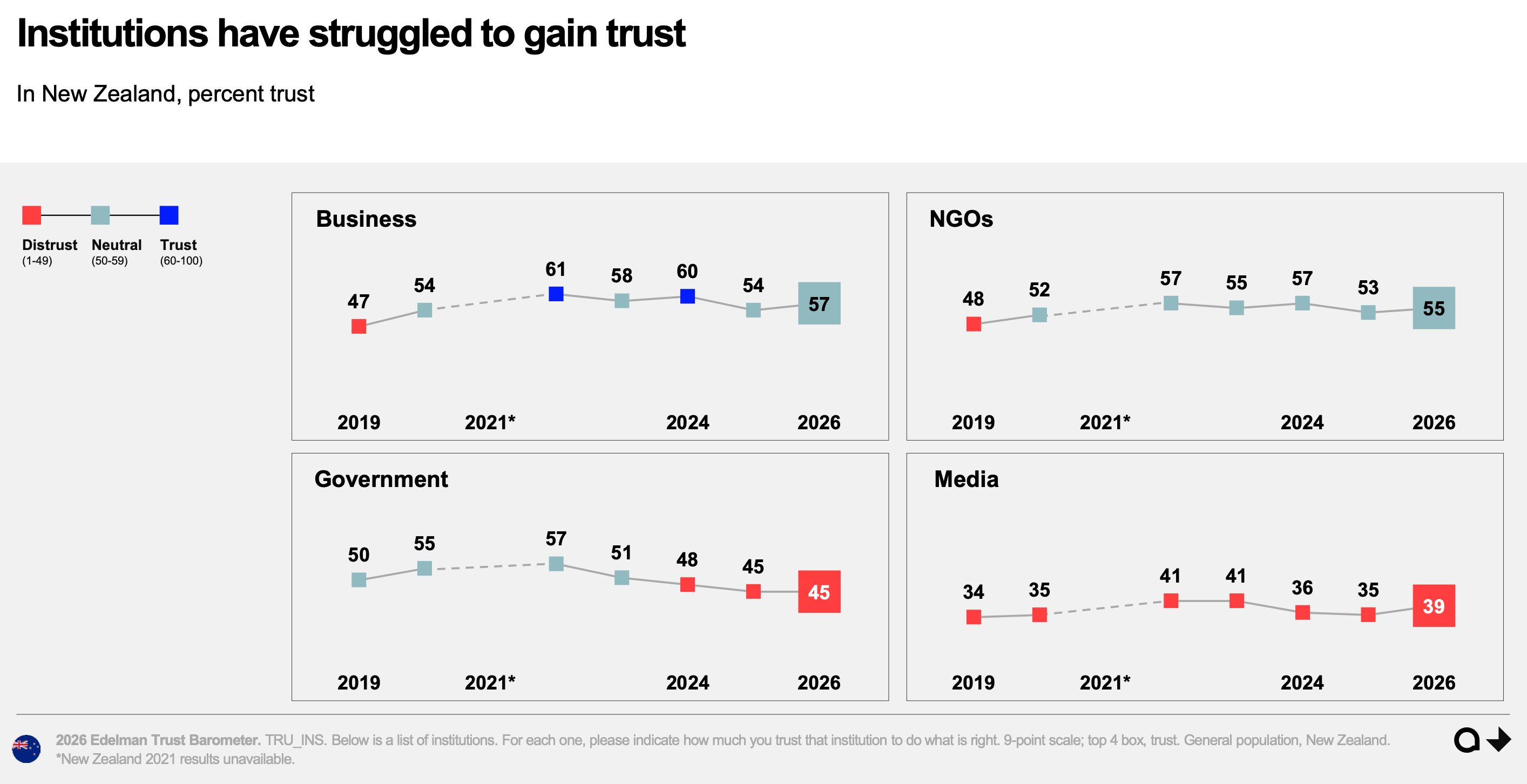
Looking at the results institution by institution, we can see that trust in government remains stuck at 45%, deep in distrust territory. Media has edged up from 35% to 39% – still the least trusted institution in the country. Business sits at 57%, NGOs at 55%.
Break it down by income and the picture sharpens. Among high-income New Zealanders (top 25%), trust is 56%. Among low-income earners (bottom 25%), it’s 43%. That gap matters. Better-off New Zealanders still have some residual faith in the system. Poorer New Zealanders much less so.
Government trust peaked at 57% during the pandemic years. It has been sliding ever since.
The Gap between expectation and delivery
The most politically devastating finding might be one that gets less attention than the headline figures. The survey asks whether institutions are doing a good job of bridging divides and facilitating trust-building between groups who distrust each other. It also asks whether those institutions have an obligation to do so.
In terms of government: 81% of New Zealanders say it has that obligation to bridge divides. Only 21% say it is doing the job well. That is a 60-point chasm between what people expect and what they see. For media, the gap is 45 points. For business, 32 points.
The public still seems to want institutions to hold the country together. What’s collapsing is confidence that the people running those institutions are capable of doing that. And 80% want politicians to stop using rhetoric that blames or vilifies particular groups. Seventy-nine per cent say politicians should be required to engage in civil discourse. These are not radical demands. The fact that overwhelming majorities feel the need to state them tells you how far the standard has fallen.
What it means for the election
In an election year, data like this should concentrate minds. It won’t, probably, but it should.
Once trust gets this low, the usual campaign talk stops working. Slogans like “Back on track”, “A brighter future”, “steady leadership”: it all starts sounding like wallpaper. The ground is there for anti-establishment disruption.
Danyl McLauchlan’s recent analysis of New Zealand’s five voter “tribes” – based on data from the 2023 New Zealand Election Study – is useful context here. Two of his tribes, the “Precarious Left” and “Alienated Conservatives”, together make up roughly 35% of the electorate. They score well below average on institutional trust. They are the most disaffected voters in the country, and they are the least well-served by the party system. Labour and the Greens have oriented themselves toward “Educated Progressives”. National and Act serve the “Establishment Right”. Both sides chase Middle New Zealand. The “Precarious Left” and the “Alienated Conservatives” get very little.
This is where anti-establishment politics can grow. And 68% of New Zealanders in the Edelman survey say that people with different views distrust each other so much they actively work against one another; 26% would support reducing the number of foreign companies even if it meant higher prices. These are significant sections of New Zealand embracing the kind of economic nationalism and anti-system sentiment that has already reshaped politics overseas.
New Zealand has so far avoided the sort of political blow-ups seen with Brexit, Trump, or the European hard right. MMP has helped, functioning as a pressure-release valve. But the underlying conditions are present and deepening. Matthew Hooton has argued that after a decade or two of economic drift under successive governments, New Zealand is falling steadily down international living-standards tables while both major parties paper over the decline with focus-grouped slogans. Josie Pagani writes that the country needs a cultural reset, and that voters in this election will back risk-takers who “tell it like it is.” The trust data supports both diagnoses.
Handle the framing with care
A caveat. The Edelman Trust Barometer is produced by the world’s largest PR firm, and Acumen is a communications consultancy. The report’s prescription – that businesses should lead on trust-building, that employers are the institution best placed to bridge divides – is not innocent of commercial interest. Recommending that corporates invest more in trust-building is the kind of advice that generates consulting revenue.
The numbers are useful. The framing is another matter. The survey shows people believe the system is rigged, that government serves the few, that the wealthy benefit unfairly. And then, predictably enough, the answer becomes workplace trust and better leadership. Maybe. But that lets the system off the hook. If inequality, insecurity and political failure are driving the distrust, no amount of managerial language will fix it.
The report is good at describing the symptoms. It is much less interested in the causes.
Dr Bryce Edwards
Director of the Democracy Project
Further Reading: