

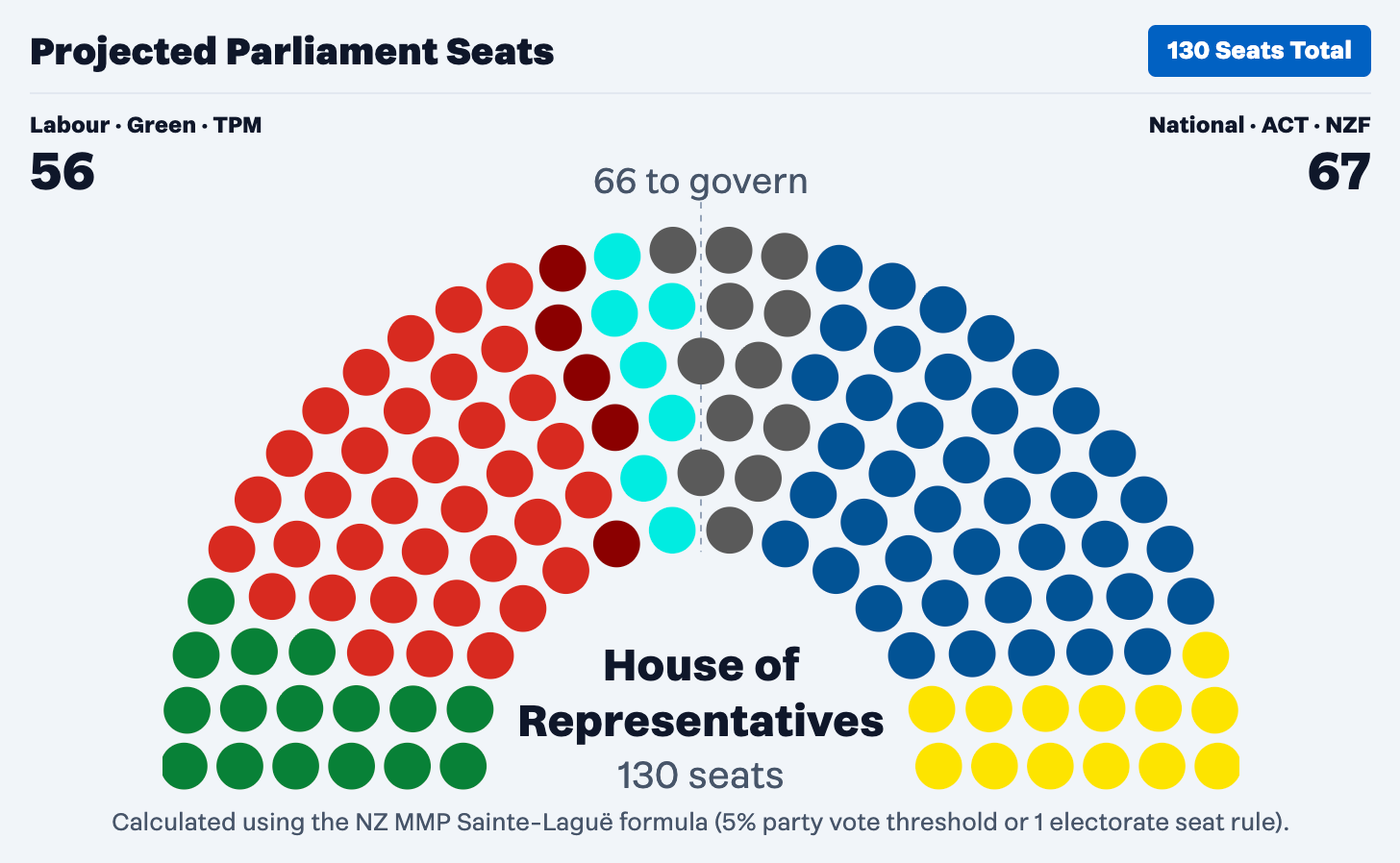
New Zealand voters have produced the most fragmented result of the MMP era, leaving the special votes, and electorate margins as thin as 155 votes in Mt Roskill, to decide who governs. With 90.6% of results counted, the National-led coalition held 66 seats in a Parliament enlarged to 129, one more than it needs. That majority rests heavily on electorate seats National won far beyond its share of the party vote, and it must now survive three weeks of special votes, which since 1999 have consistently moved seats to the left, according to a Herald analysis after the last election. If it fails, the balance of power passes to the Opportunity Party, which Christopher Luxon ruled out, and which may then have to choose between rescuing a government that rejected it and a deadlocked Parliament.
(In the Further Analysis section after this column, I set out what the special votes could do to the seat numbers, and what the main players said on election night.)
Both old parties below 30%
At the time of writing National had 29.34% of the party vote and Labour 29.13%. Neither of the parties that have led every New Zealand government since 1935 reached 30%, and their combined share of about 58.5% would be the lowest the two have recorded under MMP. National has lost almost nine points since 2023, yet Labour has recovered only about two points from its own 2023 low. The votes went instead to the smaller parties: the Greens, on 13.32%, and Act, on 11.01%, both have their best results, NZ First has climbed from 6% to nearly 10%, and Opportunity, on 5.94%, has crossed the threshold for the first time.
National’s overhang
On the Electoral Commission’s figures, National’s party vote entitled it to 36 MPs but it led in 41 electorates, while Te Pāti Māori, entitled to one seat on 0.56% of the party vote, led in five, so Parliament grows from 120 to 129. Earlier in the count, Henry Cooke calculated in the Post that National’s candidates were winning about 12.4 points more of the vote than their party, against a gap of 5.8 points in 2023. Jonathan Milne, writing in Newsroom when Labour briefly led the count yet trailed National by six seats, responded: “And they call this proportional representation.”
As I have argued in Democracy Briefings, an overhang could hand power to the side with fewer votes, but the three coalition parties had 50.2% of the party votes counted, against 43.0% for Labour, the Greens and Te Pāti Māori, so on election-night figures that has not happened. The overhang has instead inflated National’s lead over Labour and weakened the bargaining position of the nearly 6% who voted for Opportunity. Te Pāti Māori’s candidate-only strategy deserves the same criticism as the right’s split-vote campaign.
Willis, Goldsmith and Brownlee on the way out
Those electorate wins could help give Luxon a second term while leaving his Finance Minister outside Parliament, because National gets no list MPs. Nicola Willis, the deputy leader, arrived at National’s headquarters with Paul Goldsmith and conceded, as Newsroom’s Tim Murphy reported: “At this stage it is very unlikely that I will be returning to Parliament.” On the latest count Goldsmith trailed David Seymour by 1,798 votes in Epsom, Chris Bishop was 1,010 behind Labour’s Ginny Andersen in Hutt South, and the Speaker, Gerry Brownlee, also appeared to be out. Insofar as National supporters followed the split-vote campaigns and gave their party votes to Act and NZ First, they may have helped push Willis and Goldsmith out.
Why the specials matter more than usual
In 2023 the specials changed the leader in four electorates, and National fell from 50 seats to 48, losing its majority with Act. National has no list seats to lose this year, so a fall in its party vote would simply enlarge the overhang and the Parliament, raising the number of seats needed to govern, which could cost the coalition its majority without National losing an MP. On my rough calculations in the Further Analysis, a repeat of the 2023 swing would leave the coalition on 65 seats in a Parliament of 130, one short.
The marginal electorates could then settle it, because each one National wins or loses moves the coalition’s total directly. In Hamilton East, where the lead changed hands several times during the evening, National’s Ryan Hamilton was back in front by 503 votes with 95.8% counted. In Mt Roskill, Labour’s Michael Wood led National’s Carlos Cheung by 155, and in Wairarapa Labour’s Kieran McAnulty led by 342. A National win in either would add an overhang seat, while Labour wins there simply take seats its party vote already gives it. The official results are due on 27 November.
Opportunity and Luxon’s rule-out
On 5.94%, Opportunity may be the first party under MMP to break into Parliament on the party vote alone, without an electorate seat, and Jessica Hammond, a public servant who the Post reported has stood for the party at every election since Gareth Morgan founded it, was on her fourth attempt. Qiulae Wong told supporters at Eden Park, as RNZ reported: “You guys have voted for unity over division. You have voted to change New Zealand politics for good.” She told Newstalk ZB’s Mike Hosking she would talk first to the party with the most seats, and turn to Labour if Luxon held to his refusal.
She still had no text from Luxon when she spoke to the Herald’s Ryan Bridge, but the rule-out was already wobbling. Mark Mitchell would not repeat Luxon’s pledge, telling 1News that “we are operating in an MMP environment”, and Act’s leaders openly favoured a conversation with Opportunity. National’s Waimakariri MP Matt Doocey defended the rule-out on RNZ with the story of a lifestyle-block owner at the Rangiora A&P Show who had calculated they would pay an extra $11,000 a year under the land value tax, yet the tax is not among Opportunity’s five bottom lines. NZ First could prove a bigger obstacle, having ruled Opportunity out before polling day, according to 1News, and on election night its deputy leader, Shane Jones, said Winston Peters had ruled the party out, the Post’s Nick James reported.
For Wong to have a real choice of prime ministers, the count still has to move. With 90.6% counted, Labour, the Greens and Te Pāti Māori had 56 seats between them, so even with Opportunity’s seven, Chris Hipkins was two short of a majority. Unless the specials and the marginal seats both break against National, Opportunity may be able to deliver only a coalition majority, and that would need both Luxon and Peters to give ground.
A majority without a mandate
David Cunliffe, the former Labour leader, asked on Newsroom whether voters “will accept a result that may turn on rules most of them have never heard of?” The next government will hold a majority of seats, but on these numbers it will have a thin claim to a mandate and will owe its position partly to rules that distort proportionality.
The parties that benefit from an overhang have the weakest incentive to fix it, as the Herald’s Thomas Coughlan warned before polling day. If Opportunity holds the balance of power, its promise to change the way politics is done will be tested by whether it makes reform of the overhang rules, covering Te Pāti Māori’s overhang as well as National’s, a condition of its support. Luxon and Hipkins should be asked now whether they will back a change before 2029, while neither yet knows which of them the rule will help.
Dr Bryce Edwards
Director of the Democracy Project
Much can still change before 27 November. In the “Further Analysis” section after this column, I work through the scenarios for the special votes, the marginal electorates that could decide who governs, who is in and out of Parliament on the current numbers, and what the main players said on election night about Opportunity, the overhang and the legitimacy of the result.
Paid subscriptions fund this research.
