

New Zealand has a recurring problem with broken markets. Electricity, banking, supermarkets, insurance, building materials and housing are all dominated by a small number of large players. Governments investigate them, the Commerce Commission writes reports, ministers express concern, and remarkably little changes.
Part of the explanation doesn’t take much detective work. These are also the sectors with the strongest lobbying operations in Wellington. While the Commerce Commission was running its grocery market study, the PR firm SenateSHJ was working from inside the Commission, on Commission email addresses and Commission computers, at a time when it also held clients in the grocery sector. It was paid more than $300,000 across two years. Whether any of that shaped the outcome is unknowable, which is rather the point. Nobody outside had a way of finding out at the time.
New Zealand places almost no rules around that activity. There is no compulsory register of lobbyists, and no requirement to disclose who is paying whom to influence ministers. A minister or senior Beehive staffer can leave office and start work for an industry they were dealing with the week before, with no stand-down at all. Political donations are regulated, however imperfectly; nothing comparable applies to the business of getting in front of a minister in the first place.
So if we want to understand why governments can identify obvious market failures and still struggle to act against powerful incumbents, lobbying deserves much more attention than it gets.
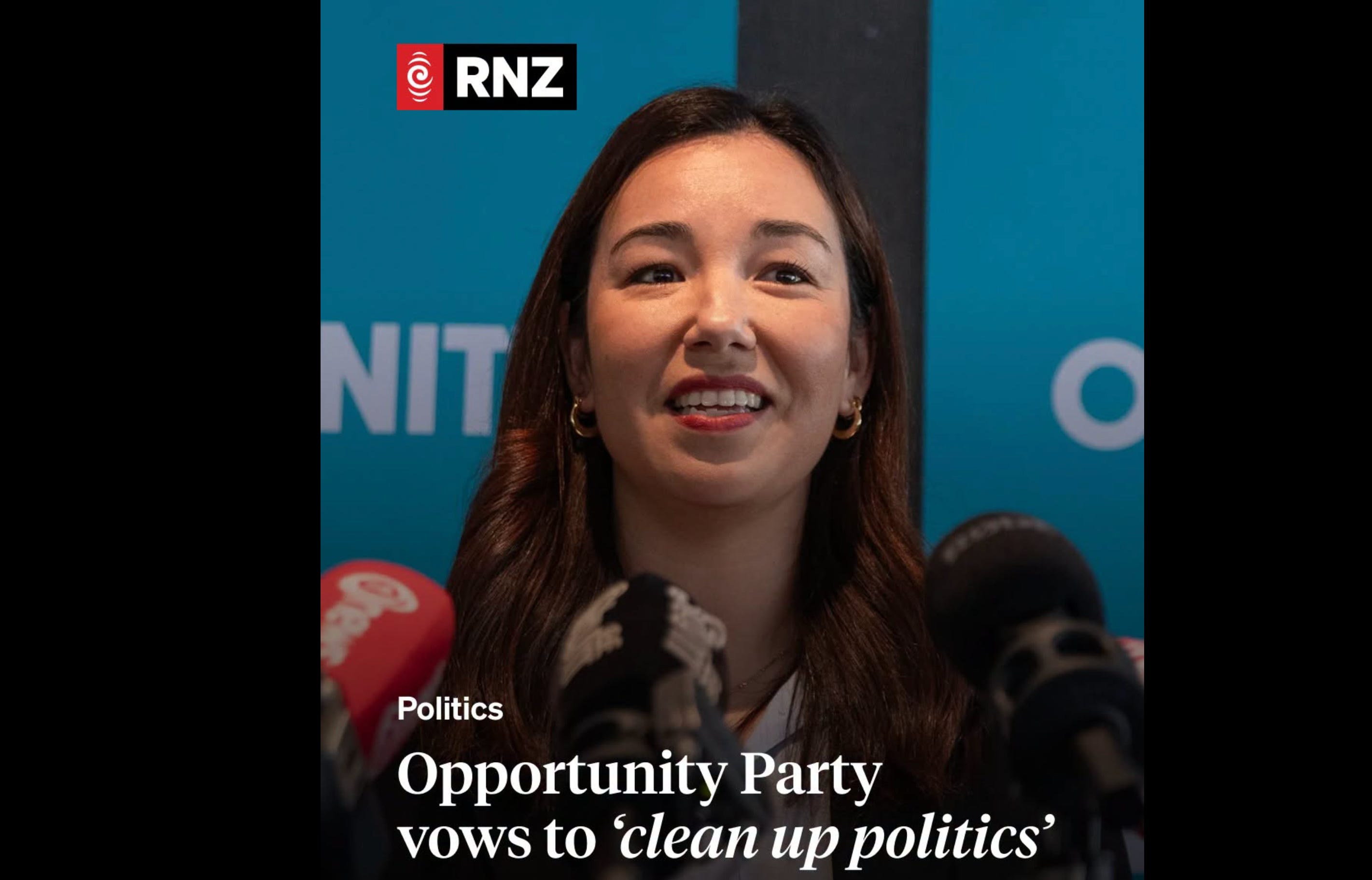
On Sunday, the Opportunity Party put forward the most substantial attempt so far this election to do something about it. Its “Clean Up Politics” package would regulate lobbying, cap political donations and establish an independent anti-corruption body with significant investigative powers.
The announcement was quickly overwhelmed by accusations of hypocrisy over Opportunity’s own donors. Some of those questions are legitimate, and I will come to them. But they should not obscure the larger development. I can’t remember another party with a plausible shot at post-election leverage putting forward an integrity package this ambitious.
The OECD gives New Zealand a zero on lobbying
The OECD’s new Anti-Corruption and Integrity Outlook 2026 has recently assessed the safeguards member countries have against corruption and undue influence. On lobbying, its assessment of New Zealand runs to a single sentence: “New Zealand does not have a regulatory framework or implementing measures for managing risks around lobbying.”
Behind that sentence is a finding of essentially nothing: no legal definition of lobbying, no register, and no regulator with anything to enforce. On the scorecard, New Zealand gets “zero” for both the rules and their implementation.
It isn’t that New Zealand is incapable of regulating political activity. The OECD gives us respectable marks on political finance, access to official information and integrity strategy, which makes lobbying an odd hole in an otherwise reasonable set of arrangements. Canada, France, Estonia, the United Kingdom, Germany, Ireland, Australia and the United States all have some formal machinery for monitoring lobbying, and we have none of it. We regulate political money but not political access.
Danyl McLauchlan reaches much the same conclusion in his Listener feature this week, giving New Zealand’s lobbying guardrails a “zero” as well, having got there by a completely different route.
Opportunity’s lobbying law
The register is the part of Opportunity’s package that would do most of the work. Paid lobbyists would have to name their clients and file quarterly returns setting out which ministers and officials they had approached and what they were pushing for. Ministers, senior political staff and public sector chief executives would face a one-year stand-down before moving into lobbying work. A statutory code of conduct would allow sanctions for lobbyists who conceal clients or conflicts of interest, with penalties running from public censure to fines and deregistration.
The provision I’d single out is the ban on contingency fees for policy changes, which has had almost no attention. Paying a lobbyist only if they successfully secure a government decision is about as close to a price list for political influence as you can get without printing one.
Opportunity would also require lobbying communications with ministers to go through official systems, making them more likely to fall within reach of the Official Information Act. If somebody is being paid to influence government, the rest of us should have a reasonable chance of finding out who they work for and what they want.
The timid parts
Some of the package could be stronger. The revolving door is the clearest case. Opportunity proposes a one-year stand-down before ministers, senior staff and officials can move into lobbying, which sounds like progress only if you measure it against the nothing we have now. Australia imposes 18 months on former ministers and Britain two years. Canada, at the far end, goes to five. Facing Up To Our Future, the Helen Clark Foundation’s new book, settles on three.
More awkwardly for Opportunity, the party itself campaigned in 2023 under Raf Manji for an 18-month stand-down. Its new policy has gone backwards, and it would be useful to hear Qiulae Wong explain why.
Quarterly disclosure is also too slow. Three months is a long time in politics, and a lobbying campaign around a live bill, a major procurement decision or a regulatory change could be over before the public knew it had begun. Monthly disclosure would be better, and in particularly sensitive cases disclosure within days should be on the table.
Immediately after its criticism of New Zealand’s lobbying regime, the OECD points out that we lack a public beneficial-ownership register showing who ultimately owns and controls companies. Helen Clark essentially makes the same point in McLauchlan’s Listener feature: “Where does the money really come from, and who benefits from government decisions?”
A lobbying register is of limited use if the company hiring the lobbyist can still conceal who ultimately owns it, and the same problem arises with political donations. Opportunity has left beneficial ownership alone, which is a strange gap in a package otherwise built around following the money.