

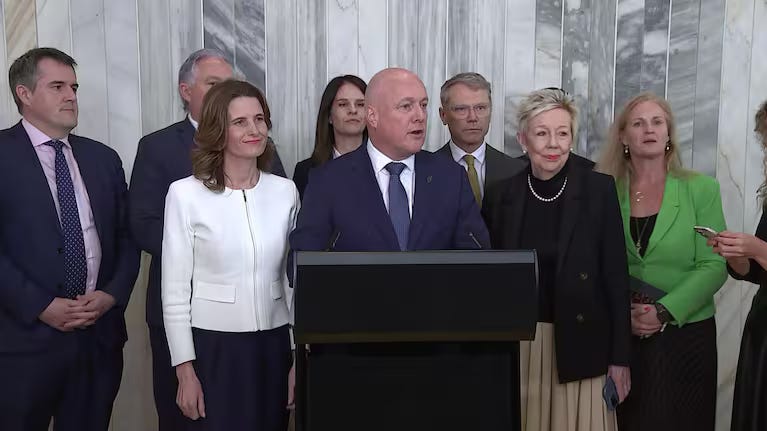
A day after Christopher Luxon survived the latest attempt to remove him as Prime Minister, we are finally getting a clearer idea of what happened. It is still murky. There are competing accounts of what occurred inside National’s three-hour caucus meeting, and almost everyone involved now has an incentive to minimise their role. But enough pieces have emerged from the accounts of Liam Hehir, Ani O’Brien, Jo Moir, Thomas Coughlan, Richard Harman, Jenna Lynch and others to reconstruct the basic story, even if some crucial details remain disputed.
According to Hehir and O’Brien, Chris Penk had been canvassing support for a possible Erica Stanford–Chris Penk leadership ticket, with Stanford as leader and Penk as deputy. Chris Bishop, meanwhile, remained one of the other main names being discussed as a replacement for Luxon. Before anything had been properly settled, someone spoke to the Herald. The story went public on Monday night, Luxon immediately called MPs back to Wellington, and what had been an attempt to quietly establish whether the numbers existed became an emergency leadership crisis.
At least for a while on Tuesday afternoon, the numbers appeared to be moving against Luxon. By that evening they were moving back. Stanford and Bishop appear to have been competing rather than combining their forces. Some MPs who had expressed dissatisfaction with Luxon were evidently not prepared to vote him out. And when caucus finally met on Wednesday, Luxon changed the terms of the contest by putting his own leadership to a confidence vote before any alternative candidate emerged.
There may have been a broad appetite for change. There was plainly no majority for any particular alternative.
The Stanford-Penk option
The clearest new account came from Liam Hehir on RNZ’s Morning Report today. Hehir is a National Party member and a close friend of Penk, but says he had deliberately not pumped Penk for information because he would “rather be a bad pundit than a bad friend”. So Hehir was explicitly not presenting this as an account extracted from Penk himself.
His understanding is that Penk was not originally trying to make himself Prime Minister. Instead, he was fronting a possible change involving Stanford as leader and himself as deputy. Hehir thought there was a fairly obvious political logic to the combination: Stanford as one of National’s more liberal ministers, Penk as a well-liked conservative, giving the caucus a ticket that crossed some of its internal divisions.
The intention, according to Hehir, was to do the numbers properly to initiate a clean coup. Penk would canvass support, “get the names on paper”, and then, if the numbers were there, go to Luxon and tell him it was time to step aside.
Ani O’Brien, another commentator with strong National contacts, reported much the same thing last night: “This evening I have learnt that what Chris Penk was actually canvassing was support for an Erica Stanford–Chris Penk leadership ticket. To be clear that is: Stanford for leader and Penk as her deputy.”
O’Brien is careful on one important point: she has not established how much Stanford herself knew about or approved the exercise. That distinction matters. Hehir and O’Brien have both reported that Penk was canvassing a Stanford-Penk option. It does not follow that Stanford personally sent him out to organise it.
On O’Brien’s account, the exercise had not progressed much beyond initial discussions when it lost control of its timetable. She describes the next moment in three words: “Then somebody talked.”
Someone who knew what was happening spoke to the media. Hehir says people who had been canvassed, or had heard about the canvassing, went to the Herald. Thomas Coughlan’s story then broke and everything changed.
Suddenly journalists were ringing MPs asking whether they supported Luxon. Stanford and Bishop were being asked whether they wanted his job. What had been a relatively private exercise in testing whether an alternative leadership was viable became an immediate public crisis.
As O’Brien puts it: “The story was out, journalists were ringing MPs, MPs were being asked to declare allegiances, and Luxon had every incentive to force the issue immediately rather than allow his opponents time to organise properly. The coup, if you want to call it that, had been triggered far too early.”
We still don’t know who leaked to the Herald or why. It may even have been somebody sympathetic to Luxon. What is clear is that the leak helped him. Without it, Penk and others might have had another day or two to settle the numbers and work out which leadership option could command a majority. Instead Luxon had his MPs flying to Wellington.
The numbers fall apart
Even then, Luxon was apparently in real danger. Herald political editor Thomas Coughlan reports that before the 6pm television news on Tuesday, the numbers were “firming up for a change”. Some of Luxon’s usual supporters were noticeably quiet, and the atmosphere around Parliament was that a leadership change might genuinely be happening.
Heather du Plessis-Allan says Stanford and Bishop (“or at least both people who thought they were contenders”) were reasonably confident on Tuesday afternoon that they had the numbers. By about 8pm, however, she was being told the coup was falling apart and MPs who had moved away from Luxon were “defecting back”.
Richard Harman’s Politik newsletter helps explain how that could happen so quickly. His reporting suggests that much of the operation was remarkably loose. Rather than securing written commitments, the plotters appear to have relied heavily on verbal assurances. Some backbench MPs told Harman they had not been approached at all.
The obvious question is: how do you get close to rolling a Prime Minister without being absolutely certain you have the votes?
An MP telling a colleague privately that Luxon is doing a poor job, or that Stanford might be better, is one thing. Actually voting to remove a sitting Prime Minister shortly before an election is quite another. Harman says some MPs may even have indicated support to more than one camp.
His historical lesson is straightforward. Serious National Party coups have traditionally involved hard counts and commitments that could not evaporate at the last minute. Harman writes: “The plotters might reflect that rolling a Prime Minister is a more serious affair than casual conversations on mobile phones”. His advice is even simpler: “get it in writing.” The plotters, as Brent Edwards put it at the NBR, “had not bothered to do a proper head count.”
There was another problem. Even if enough MPs could be persuaded that Luxon should go, there was still no agreement over who should replace him.
Lynch reports one account from inside National in which Stanford and Bishop were “locked in a battle over who should get the top job”. Du Plessis-Allan says something similar, although more bluntly: “the coup fell apart because of egos”. Her information is that the two needed to coalesce around one candidate, but “neither Chris Bishop nor Erica Stanford was prepared to go second on the ticket”.
Matthew Hooton takes this argument much further. In an interview with The Post’s Andrea Vance, he named Stanford, Bishop, Nicola Willis, Simeon Brown and Mark Mitchell as “the real villains of today”. Hooton’s charge is that all five knew a leadership change was necessary but none was willing to put their own ambitions aside. The attitude, in his telling, was: “if it can’t be me then we’ll stick with Luxon”.
The Post editorial today makes essentially the same accusation, concluding that National’s five touted leaders “are not leaders, but, like Mr Luxon himself, mere careerists”.
Hooton may be laying it on a bit thick. There were perfectly rational reasons for MPs to hesitate before removing a sitting Prime Minister this close to an election. But the basic problem stands. Without agreement on Stanford, Bishop or somebody else, there was no viable coup.
The paywall now starts partway through all Democracy Project newsletters. Please take out a paid sub if you want to support this service and access the full content, including the following sections: “Luxon moved faster”, “So what did Penk actually do?”, and, “National’s worst possible result”.