

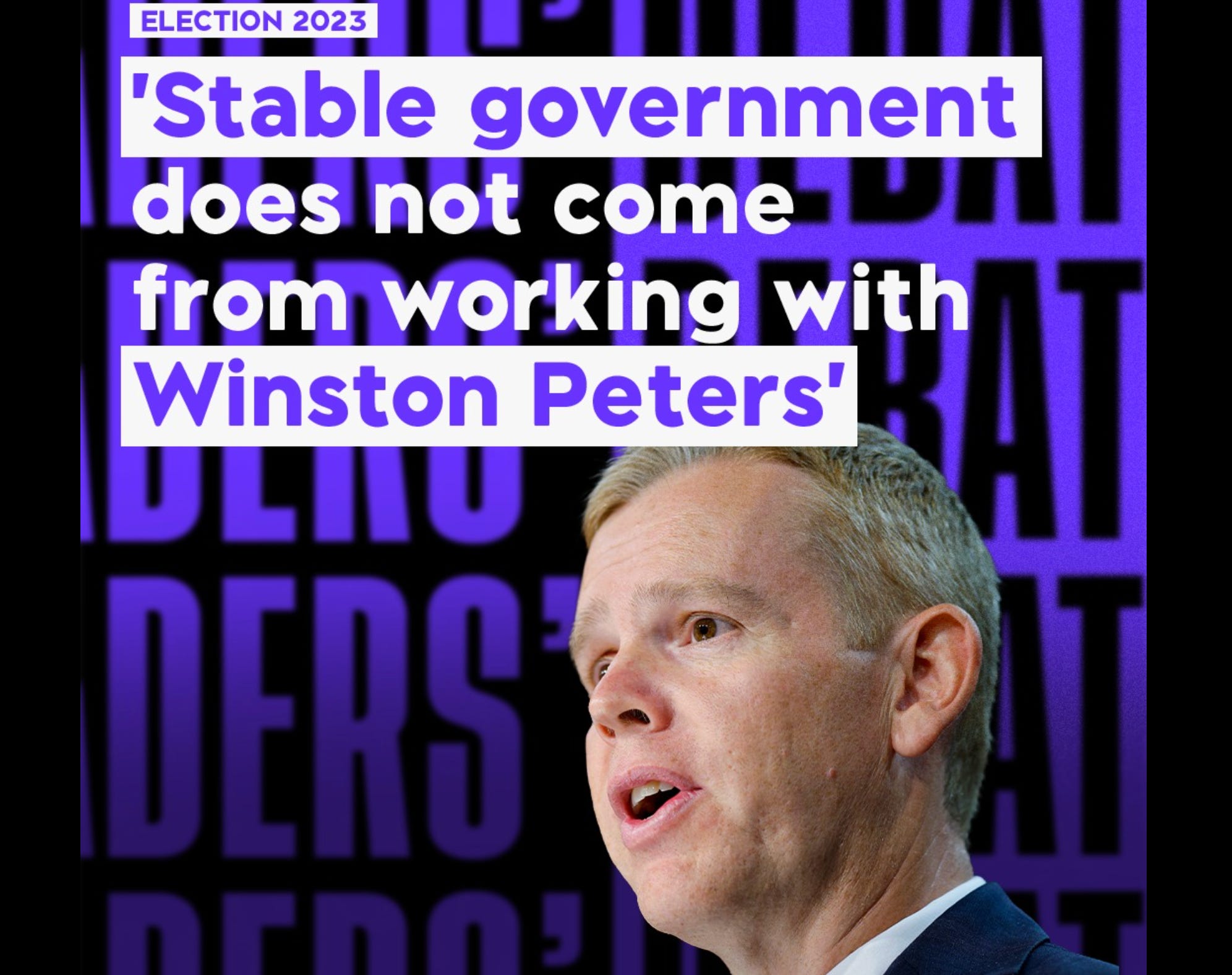
The political left doesn’t want to talk about it. But the most likely outcome of the 2026 general election is a government that includes New Zealand First. And that might even mean a government led by Prime Minister Winston Peters.
This will be highly uncomfortable for many, but it doesn’t mean it won’t happen. So, if you wanted to place a strong bet about what happens after November 7, put your money on NZ First being part of the next government. The polls, the strategic logic, the history — they all point in the same direction. The only real question is whether Peters ends up governing with the right or the left. And here’s where it gets interesting: despite the common assumption that NZ First would only go with National, there is a very real scenario in which Peters forms a coalition with Labour.
The NZ First surge
NZ First scored 11.9% in the January Taxpayers’ Union-Curia poll. As David Farrar has noted, this is almost unprecedented support for NZ First while in power. Historically, governing has been a death sentence for the party. Their support cratered in the 1996-99 National coalition, bled away in the 2005-08 Clark government, and they were turfed out of Parliament entirely after the 2017-20 Ardern government.
This time is different. Peters has broken the curse. As Matthew Hooton put it in his January Herald column, “the NZ First leader has finally worked out not just how to be part of a coalition Government and remain above 5%, but to grow his vote.” The party steadily improved its polling each quarter through 2025, and the latest RNZ-Reid Research poll had them at 9.8% — their highest result in that series since July 2017. Peters has also leapt up the preferred PM rankings.
How? By playing a remarkable double game. As Foreign Minister, he’s cultivated an elder-statesman image abroad. At home, he’s the rabble-rousing populist who lobs grenades at his own government. He’s publicly opposed the India free trade agreement, scolded Luxon over asset sales, vowed to repeal Act’s Regulatory Standards Act, and openly admitted the coalition hasn’t turned the economy around fast enough. As one recent Herald analysis put it, Peters has been good at looking like he’s in the coalition without wearing the coalition’s failures. It’s an audacious balancing act. And it’s working.
Why NZ First will be in the next government
Here’s the arithmetic. The latest polls put Labour on 35%, National on 31.9, NZ First at 9.8, the Greens at 9.6, Act at 7.6, and Te Pāti Māori sliding to just 3%.
In seats, the current right-bloc coalition scrapes back with 61 — the slimmest possible majority. The left bloc adds up to 59. Neither side can comfortably govern without NZ First. The party is on track to be the third-largest in Parliament. That gives Peters the balance of power.
And NZ First strategists, according to Hooton, aren’t just aiming for the kingmaker role. The stretch target? Prime Minister Peters. If NZ First climbs into the high teens while both National and Labour stay in the twenties, Hooton reports that strategists are asking: why not a NZ First-National government with Peters in charge? As Danyl McLauchlan writes in the latest Listener, the prospect “has emerged from the midfield, gaining ground on the outside. Still a long shot, but don’t the lead horses look exhausted?”
The Left’s nightmare scenario
Now here’s the part nobody on the left wants to discuss. If Peters holds the balance of power, he has every incentive to negotiate with both sides. Labour people will protest: “He’d never go with us!” But that’s wishful thinking dressed up as analysis.
Hipkins himself won’t close the door. In a recent interview he listed every party Labour has previously governed with, including NZ First. Asked about an olive branch to Peters, he said: “There’s a lot of water to flow under the bridge before this year’s election.” That’s not a denial. It’s a holding position.
Yes, during the 2023 campaign, Hipkins described NZ First’s statements about immigrants and Māori as “racist” and he talked as if working with Peters again was off the table. But with polls showing NZ First could decide which major party leads the next government, all that is being quietly buried.
Without NZ First, Labour’s path to power runs through the Greens and Te Pāti Māori — and that path is increasingly blocked. Te Pāti Māori is in chaos: infighting, expelled MPs, court disputes, collapsing polls. Chris Trotter made this point bluntly: while Labour’s only available partners are Te Pāti Māori and the Greens, “it simply cannot win.” The ideological baggage those parties carry has placed Labour in what Trotter called “checkmate. In electoral politics, it’s called another three years in opposition.”
Unless there’s another option: New Zealand First.
It seems incredibly unlikely that Labour would turn down the opportunity to form a government with NZ First if it was a choice between this and staying in Opposition. Labour would probably even be willing to let Peters be PM.
Peters won’t rule it out either
Those who insist Peters would never go with Labour need to reckon with several awkward facts. He’s done it before – most recently, from 2017 to 2020, Labour, the Greens and NZ First worked together. Peters was Deputy PM and even acted as PM while Ardern was on maternity leave. The world didn’t end.
Peters is also nothing if not opportunistic. He has governed with both Labour and National, denouncing each before and after. He is not loyal to governments. He is loyal to leverage.
And here’s the crucial strategic point: Peters can’t get his best post-election deal from National unless National believes he might go with Labour, and vice versa. The moment one side thinks they’ve got him locked in, his leverage evaporates. Any previous statements he makes about not wanting to work with Labour should be taken with a very large grain of salt.
Even the NZ First’s newly announced (but recycled) policy of a referendum on the Māori seats won’t prevent a deal being done with Labour. The Post newspaper points this out today in its editorial: “Peters already cried wolf in 2017 when he called for a binding referendum on the future of the Māori seats. That promise disappeared when he negotiated a coalition agreement with Labour. That points to Peters’ unique flexibility. Pinning down what he says and what he means can be a frustrating job. That flexibility has also been key to his survival.”
Meanwhile, NZ First has also been making noises this week about breaking up the electricity gentailers and opposing asset sales. These are policies that sit more comfortably on the left. Peters has started calling NZ First the country’s only true “workers’ party,” championing wage increases and social protections for the elderly in a deliberate echo of his famous 2017 call for “capitalism with a human face.” He talks Labour language on economics while trashing Labour on culture.
This is the Peters paradox. He’s a populist chameleon who can shift between left and right depending on what serves his interests. In the same week that NZ First announced its Māori seats referendum — a policy that Labour and the Greens despise — the party was also talking up breaking the electricity oligopoly, a position that would make many on the left cheer. Peters says NZ First supports capitalism, but, as Hooton explained, “he means the more managed form of capitalism as found in East Asia, combined with a more reliable safety net, especially for the elderly, as in Scandinavia.” That’s not exactly a rightwing manifesto. It’s precisely this ideological flexibility that makes Peters a plausible partner for either side.
The Greens would have to swallow a dead rat
If Labour and NZ First formed a government, the Greens would face the most excruciating choice in their political history. And they’d almost certainly be shut out of Cabinet. They might not even get ministerial positions. NZ First would likely veto meaningful Green participation. But the Greens would still be expected to provide confidence and supply, because the alternative is letting a National-NZ First-Act coalition form instead.
After all, could the Greens really vote down a Labour-NZ First government and hand power to the right? Almost inconceivable. Their base would be horrified. So they’d swallow it, grimly, grudgingly, complaining every step of the way. In fact, Green co-leaders Marama Davidson and Chlöe Swarbrick have already refused to rule out another coalition with NZ First, in a Post interview in December.
What makes the 2026 Labour-Green positioning look so weak is the contrast with the past. In 1999, Labour and the Alliance campaigned overtly together, openly declaring they would form a coalition. Voters knew what they were getting before they voted. Now? A joint press conference at Waitangi with no policy announcement and no formal agreement.
Critically, Hipkins still won’t guarantee Labour would work with the Greens after the election. “My goal is to make sure that we’re doing that in a way that shows we can still work together after the election,” he told the Post. That’s aspiration, not commitment. The likely reason he can’t commit? NZ First may yet demand, as a condition of any deal, that the Greens be excluded.
The Left needs to start talking about this
What strikes me most is the silence. Nobody on the left is publicly discussing the prospect of a Labour-NZ First government. But you can be certain it’s happening in private. Labour’s strategists can read the polls. They know that Labour plus the Greens plus a diminished Te Pāti Māori almost certainly won’t be enough. And there will be many in Labour who view involving Te Pāti Māori in a coalition as deadly.
So, why the public silence? Partly because talking about it would alienate Labour’s base. Partly because acknowledging it would weaken Labour’s negotiating position. And perhaps because, as long as there’s a ghost of a chance Labour could reach 40% and govern with just the Greens, it makes sense to keep that dream alive.
But the dream is fading. The polls tell a consistent story. As RNZ reported, “every poll from every pollster is telling effectively the same story”: a tight race with NZ First sitting in the middle holding everyone over a barrel.
For many on the left, a Labour-NZ First government amounts to a nightmare. Both Labour and the Greens regard NZ First as a reactionary populist outfit. They despise Peters’ social conservatism and his opposition to their middle-class social liberalism. In some ways, people on the left dislike Peters more than they dislike the politicians of the more economically right-wing parties, because at least National is ideologically predictable.
Peters is mercurial, opportunistic, and he delights in antagonising precisely the people Labour and the Greens consider their natural constituency. The Māori seats referendum is just one flashpoint. Labour says it would “never” support such a policy, while the Greens want to entrench the seats into law. They’d be expected to support a government containing NZ First while this policy hung in the air. How do you square that circle? With great difficulty, and a lot of private anguish.
But politicians are pragmatists, not purists. Labour didn’t love governing with NZ First in 2017 either. They did it because the alternative was opposition. And when the moment came, Jacinda Ardern stood alongside Peters and made it work. For a term, at least. There’s no reason Hipkins couldn’t do the same, especially if the reward is the keys to the Beehive.
The political left had better start getting used to the idea. November is coming. And Winston Peters is ready.
Dr Bryce Edwards
Director of the Democracy Project
Bryce, a great summation of our greatest political charlatan, Winston Peters.
I have absolutely no doubt that his recent call for a NON binding referendum on the racist Maori seats will garner NZ First a further lift in the polls.
BUT, the hapless voters easily forget his past treachery on this issue.
During the 1996 campaign Peters PROMISED that he would only go into a coalition if the major party agreed to a BINDING referendum on the Maori seats.
Bolger offered Peters the necessary baubles of office being Deputy Prime Minister and the position of Treasurer which was created especially for Peters.
The referendum was never discussed but Peters got what he wanted - the baubles of office.
The 2017 was worse as far as “ promises “ from Peters was concerned.
Once again, NZ First was in a position to negotiate because Peters stated ad nauseum that a condition of going into coalition was a referendum on the Maori seats.
Both Ardern and Robertson later confirmed that Peters NEVER raised the question of Maori seats as a condition of coalescing with Labour !
Peters could not have cared less.
Once again he had received the baubles of office and his so- called “ promises “ were never discussed nor brought up during the 3 year term.
Not only is Peters our greatest political charlatan but the most economical with the truth in the House today.
Peters “ promises “ and electioneering are not to be believed under any circumstances.
Judge Peters by prior actions , or inactions - NEVER on his “ promises.”
Peters is playing a cunning game. Sound leftish to secure his vote. After the election hangs onto the right’s coat tales once again! People need to be made aware of this. His spots will never change. A duplicitous scorpion with every member of his mafia.