

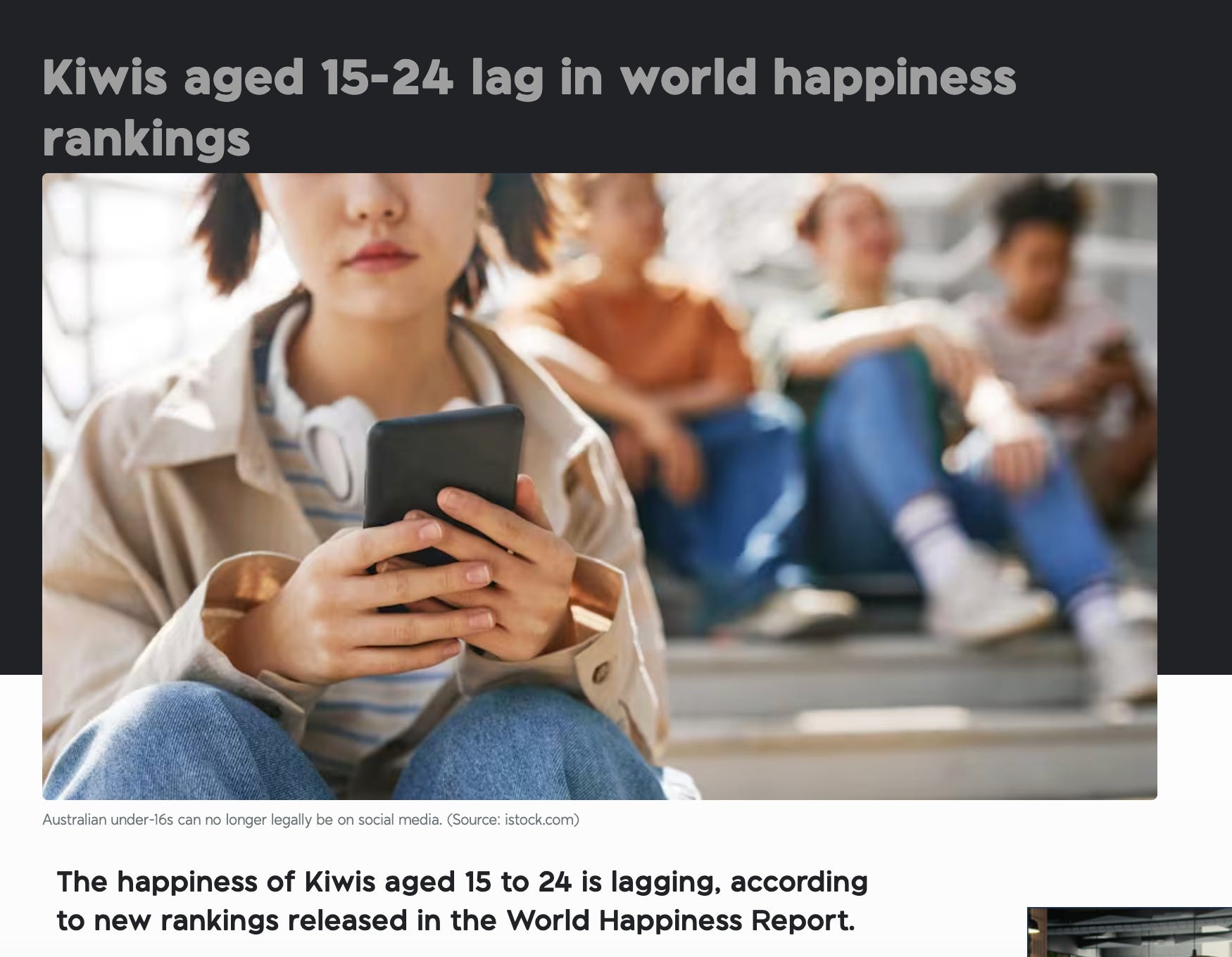
New Zealand has just been ranked one of the happiest countries in the world. This is obviously good news. But there is something badly wrong beneath that glossy headline, especially in terms of loneliness and youth.
The 2026 World Happiness Report, released last month, ranked New Zealand 11th out of 147 countries – up one spot from last year, and the highest-ranked English-speaking nation. On the surface, that sounds pretty good. Better than Australia, better than the United States. Finland, inevitably, came first.
But buried inside the report was the figure that actually matters. For changes in happiness among 15-to-24-year-olds, New Zealand ranked 126th out of 136 countries. Young people’s happiness over the last decade has been plunging. We sit alongside the United States, Australia, and Canada in what researchers have labelled the “NANZ” group: affluent nations where youth happiness is in freefall while older generations report world-leading life satisfaction. In contrast, according to the report, 85 of 136 countries saw youth happiness increase.
AUT wellbeing economist Stephanie Rossouw, a contributor to the report, was blunt about what this means. “This is not a short-term dip,” she told media, “but a sustained decline over more than a decade.” She pointed to social media, especially the algorithmic kind – the doom-scrolling platforms, not the communication tools – but also to something deeper. Nordic countries have social media too. Their young people are not collapsing in the same way.
What the Finns have that we don’t
The difference between Finland and New Zealand, Rossouw argued, is social trust, safety nets, and the strength of social connections. The Finns score far higher than us on all three.
Finns have a deep-seated belief that people will do the right thing, a cultural expectation that reduces the stress of daily life. For example, if you ask a Finn whether they’d get their wallet back if they lost it, they assume yes. And in fact, in Helsinki 11 out of 12 dropped wallets are returned. New Zealanders don’t trust like that anymore.
RNZ ran a piece the same week quoting Finnish philosopher Frank Martela, who offered a useful corrective to the usual happiness discourse. Finland’s secret, he said, is not that Finns are especially joyful. It is that they have fewer people who are deeply unhappy. Universal healthcare, free education, low corruption, and a culture of cooperation create a floor. Nobody falls too far. The result isn’t joy, it’s something more like security.
Rossouw made a similar point in her RNZ Nights interview. Asked why Latin American teenagers report higher life satisfaction than ours despite using social media just as heavily, she pointed to the other variables: worry, sadness, and social connection. New Zealand’s young people carry higher levels of anxiety and lower levels of positive emotion than their Latin American counterparts.
Writing in today’s Post newspaper, Josie Pagani has also dealt with the happiness results. She is right to sneer a bit at the happiness industry. These rankings can be goofy. But the useful part of the report isn’t the ranking itself, it is in the variables that predict the scores: social trust, corruption, safety nets, generosity, the sense that someone would return your lost wallet. New Zealand is slipping on nearly all of them.
Pagani explains also that part of the problem is that experts are no longer very trustworthy for the public. Increasingly, we simply don’t believe what academics, technocrats and officials tell us. This was even part of the pandemic experience, she says: “Experts told us to bump elbows and wash our fruit during Covid. Neither stopped the spread of the airborne virus.”
How cohesion actually works
Danyl McLauchlan’s Listener article this week (“Waning trust, the rise of populism”) is an interview with Sir Peter Gluckman and United Nations development economist Pedro Conceição, and it’s vital for understanding the anxious political state of New Zealand society at the moment.
Conceição’s central finding is stark. Six out of every seven people on the planet now report feeling insecure. People who feel insecure, his data shows, trust others less, drift toward political extremes, and shift their support from competent leaders to dominant ones. A quarter of all countries are now governed by populists – double the previous peak from the 1920s and 1930s – split roughly evenly between left and right.
Gluckman (the former Prime Minister’s Chief Science Advisor) told McLauchlan that social cohesion is probably the most valuable thing New Zealand has: “New Zealand trades on that cohesion. It’s what allows us to get needed skills coming in by way of migration, it’s why people come here for education, why we get foreign direct investment. We are seen as a stable, cohesive, internally compliant-with-law country.”
According to McLauchlan, “Gluckman recalls growing up in a New Zealand where sporting clubs, schools and church groups routinely brought together people of different ethnicities and economic standing.” This has all changed. We are witnessing a hollowing out of the institutions and social bonds that once made this place function. And the sense of cohesion, Gluckman says, is not “self-repairing”. Instead, the forces eroding it are now accelerating.
Gluckman also tells a story about an acquaintance who moved to a small village in Switzerland, wished to buy a house, and so learnt to play the euphonium. The choice of musical instrument might seem bizarre, but the friend explained to Gluckman the logic: “Because by joining the village band, I become part of the community. And the community will now support me to buy a house. Which they have to vote to give permission to do.”
The point is that cohesion is built through shared institutions and repeated contact across social boundaries. Robert Putnam made the argument two decades ago in his book, “Bowling Alone: The Collapse and Revival of American Community”. This is a landmark account of how “third spaces”, where strangers become neighbours, were collapsing across the Western world. Conceição cited Putnam directly in his conversation with McLauchlan.
The digital world has replaced many of these spaces, but what replaced them doesn’t work the same way. It polarises, McLauchlan says. Gluckman put it plainly: “The digital world pulls people apart.”
The Vanishing clubroom
This is not abstract in New Zealand. It is actually quite measurable.
Sport club volunteering has dropped 45% since 2019. Under the new Incorporated Societies Act, thousands of community organisations faced a deadline this month to re-register or be dissolved. As of January, fewer than half had done so. More than 200 have already been wound up. The amateur sport sector has called it a potential “extinction event.”
Church attendance has declined from roughly 20% of the population in the 1960s to about 10% now. By 2033, more New Zealanders will live alone than with another person. In towns like Waiouru, six rugby teams have become none. Golf clubs survive on a dozen members. The volunteering that remains is increasingly casual – a few hours here and there rather than the sustained commitments that once created community.
These are the places where people used to encounter each other. It wasn’t a big deal, yet it also had a big impact.
David Farrar, the National Party pollster, told McLauchlan in his earlier Listener piece on voter tribes that people used to describe themselves as “a National voter” or “a Labour voter” – husbands and wives voted the same way. None of that holds any more. The institutions that once gave voters a shared understanding of politics – newspapers, churches, unions – are weaker than they were, he said. The media market has not just moved elsewhere. It has contracted.
Without these shared spaces, the only common ground left is online. And online, as Gluckman says, people fragment. McLauchlan adds that: echo chambers work like civic associations turned inside out: they give you a tribe, but only by giving you an enemy.
The paywall now starts at halfway through all Democracy Project newsletters. Please take out a paid sub if you want to support this service and access the full content, including the following sections: “Mental health and loneliness”; “Voters who have stopped showing up”; “The Political question”; “Bowling alone in NZ”