

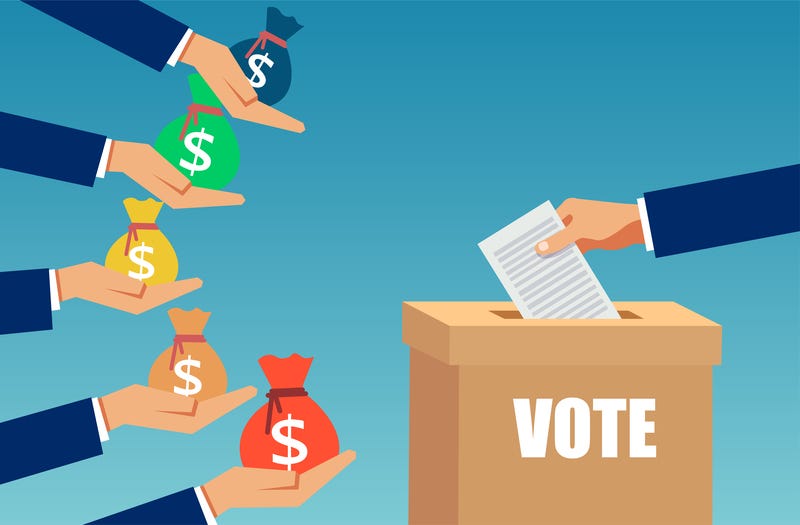
Election year is ten weeks old and already the donations register at the Electoral Commission tells a familiar but uncomfortable story. Nearly a million dollars in large donations has been declared so far in 2026. The coalition parties have opened the year with a commanding fundraising lead. The opposition parties are barely visible. And the people making the biggest donations are the same sorts of donors who usually dominate this terrain: wealthy businessmen, corporate entities with regulatory interests, and a handful of individuals who spread political money across parties the way investors spread risk.
What follows is a guide to where the money is coming from, who these donors are, and why some of these donations should trouble anyone who cares about the health of New Zealand democracy.
The Numbers
The Electoral Commission’s register of donations exceeding $20,000 is one of the few windows we have into who bankrolls our politicians. In election years, these large donations must be declared within 20 working days. As of early March, the three coalition parties have collectively received $750,000 in disclosed large donations. Act leads the pack with $350,000. National has pulled in $250,000. NZ First has received $150,000.
On the other side? Labour has received $22,333. The Greens have received $43,015. That is a ratio of roughly ten to one in favour of the political right.
Some of this gap is normal. Parties of government always attract more donor attention than parties in opposition. But the sheer scale of it, this early in the cycle, is extraordinary. As Anna Whyte reported for Interest.co.nz, the money started flowing earlier than in 2023, when the first large declarations did not appear until late February.
And remember: this is only the tip of the iceberg. The $20,000 threshold captures the biggest donations, but plenty of five-figure sums sit beneath it, invisible until the annual returns land in April or May next year. And donations made during 2025 are still hidden from public view. They will not appear until the annual returns are published in the next couple of months. So, what we can see on the register right now is a fraction of what is actually sloshing around the system.
A Gas company says thank you
The single most striking entry on the 2026 register is GMP Environmental Limited, which gave $100,000 to each of the three coalition parties in mid-February. That is $300,000 in total, spread identically across National, Act, and NZ First. Same amounts, near-identical dates.
The name GMP Environmental does not tell you much. It sounds vaguely green. But a quick trip to the Companies Register reveals the truth: GMP Environmental is a subsidiary of Greymouth Petroleum, one of New Zealand’s largest oil and gas operators. The use of a subsidiary with “Environmental” in its name rather than the parent company name is worth noting. Nothing illegal about it. But it has the convenient effect of making the donation look rather different at first glance.
And the timing makes this impossible to ignore.
In 2021, the previous Labour government passed the Crown Minerals (Decommissioning and Other Matters) Amendment Act, a direct response to the Tamarind disaster which left taxpayers facing a bill of about $400 million to clean-up an abandoned offshore oil field. The law imposed automatic liability on oil and gas companies for their own decommissioning costs. The industry despised it.
When the National-led Coalition took power in late 2023, the lobbying began. The result was the Crown Minerals Amendment Act 2025, enacted in August last year, which rolled back key parts of that protection. The new law weakened decommissioning liability, introduced ministerial discretion over who pays for cleanup, and changed the very purpose of the Crown Minerals Act from “manage” to “promote” petroleum exploration. Greymouth Petroleum was among the most vocal lobbyists for these changes.
Just months later, one of Greymouth’s subsidiaries transfers $100,000 to each of the three parties that delivered exactly the legislative outcome the gas industry wanted.
The blogger No Right Turn put it with characteristic bluntness, calling the donations “payment for services rendered” and describing what he sees as “naked corruption. Bribery. Law for sale.” He noted that it takes little effort to follow ownership up the corporate chain to see who is really paying, or to consider the legislative history to see what they are paying for.
That is strong language, and not everyone will agree with it. But the sequence is hard to ignore. A company lobbies hard for legislative relief. The government delivers it. The company then funds the government parties in equal measure through a subsidiary that obscures the connection. You do not need to prove a formal quid pro quo for this to corrode public trust. The appearance alone is enough. The No Right Turn blog argued that we need to “ban large donations, get money out of politics forever, and break the power of the rich over our political parties.”
Brian Cartmell: half a million and counting
As RNZ’s Farah Hancock reports, the largest individual donor to emerge so far is Brian Cartmell, a Queenstown-based technology entrepreneur who, by his own account, has distributed at least half a million dollars across the political parties.
Cartmell’s $100,000 donation to the Opportunity Party was declared in early March. Act confirmed receiving $200,000 from him in 2025. Cartmell himself said he donated equally to the three coalition parties, though neither National nor NZ First would confirm amounts.
RNZ’s Farah Hancock has shed useful light on his background. She reports: “Cartmell moved to New Zealand in 2010 and gave up his US citizenship in 2015. His former professional background includes working for the Internet Entertainment Group, an online pornography company. It was a pioneer in live webcam shows and subscription services.” According to Hancock, Cartmell also founded a domain registry firm that managed the .cc country code for the Cocos Islands. He was also an early investor in Bitcoin.
Today the Companies Register shows Cartmell as a director and shareholder in a range of New Zealand companies, from the crowdsourcing platform PledgeMe to the craft beer brand Yeastie Boys. According to Hancock, he also holds a small stake in Invisible Urban Charging, an electric vehicle company co-founded by former National Party candidate Jake Bezzant.
In a statement on his website, Cartmell said the coalition parties represent “the best available chance of navigating” a period of significant change, and that “healthy democracies need parties willing to put forward ideas major parties won’t.” Cartmell’s statement that “voters, not donors, decide the direction of New Zealand” is at best a convenient fiction.
He says he supports transparent political donations. Fair enough. That is more than many big donors manage. But when one individual is distributing more than half a million dollars across the political system, ordinary voters are entitled to ask what kind of access that money buys.
The Hedger
Another donor deserving attention is Michael Grant Sullivan, an Auckland building and civil engineering businessman who donated $200,000 across all three coalition parties on the same day in January. National received $100,000. Act and NZ First got $50,000 each.
Sullivan founded Clearwater Construction in 1984 and has built a reputation in large-scale residential, commercial, and industrial projects across Auckland and Christchurch, including luxury apartment developments. He is now the director of Countrywide Properties, the firm behind some of the most expensive luxury apartment projects in the country. His latest project, 22 Karori in Orakei, features a penthouse that recently sold for around $17m, a record-breaking price for the New Zealand apartment market.
He had previously given $50,000 each to Act and National before the 2023 election. When contacted by Interest.co.nz, Sullivan preferred not to comment.
His approach is the textbook hedge. He is not backing one party. He is backing the entire coalition. The message is fairly clear: whoever holds the relevant ministerial warrants after the election, Sullivan wants all three parties to know he supported them.
This matters. Because governments don’t just set general policy, they shape the planning system, consenting pathways, infrastructure decisions, procurement settings, and tax preferences that can massively affect property and construction profits. When a single wealthy donor in that sector funds every party in government on the same day, it is hard not to read that $200,000 donation as an investment in a relationship with power. In fact, for property developers whose business depends on the speed and profitability of high-end developments, a $200k investment in the three parties holding the levers of housing and Fast-Track reforms is simply good business.
Act: the party that’s cleaning up
If any single party is doing conspicuously well in this early money rush, it is Act. The party has declared $350,000 in large donations so far this year, more than National and NZ First combined.
Alongside GMP Environmental’s $100,000 and Sullivan’s $50,000, Act has received $100,000 from Nicholas Mowbray and another $100,000 from Van Den Brink Karaka Limited.
Mowbray is the co-founder of Zuru, the global toy and consumer goods empire that has made the Mowbray family one of the wealthiest in New Zealand. His political giving is prodigious and almost entirely directed rightward. Public donation records show $100,000 to Act in late 2024, $150,000 to Act in 2023, and $250,000 to National in 2022. Add the $100,000 to Act in February this year and his cumulative political donations since 2022 exceed $600,000, the vast majority flowing to Act.
Van Den Brink Karaka Limited sits within the Van Den Brink family’s poultry empire. The family business, founded in 1954, is one of New Zealand’s three largest poultry processors, has a turnover reported at around $200 million, and employs between 400 and 600 staff. Brinks Chicken is the brand most consumers will recognise. This is a significant corporate donation from a major player in New Zealand food production.
The pattern is hard to miss. Act, the party most committed to deregulation, lower taxes, and smaller government, is attracting the lion’s share of big corporate and wealthy individual money. Whether those donors are buying specific policy outcomes or simply supporting a party whose ideology they share is the eternal question of political finance. But the alignment between Act’s agenda and the commercial interests of its major donors is not accidental. Less regulation, lower compliance costs, a friendlier environment for business. The donors know what they are doing. They know what they are funding.
The Left’s thin war chest
Look at the other side and the contrast is painful.
Labour’s sole declared donation is $22,333 from Mary Theresa O’Brien, a Beach Haven, Auckland resident. O’Brien passed away on 1 March 2026, aged 92. Her obituary described her as a brilliant violinist and devoted teacher. It is a poignant donation. It looks nothing like the corporate and business money flowing to the right.
The Green Party’s only declared donation of $43,014.56 came from Francisco Hernandez, one of their own list MPs. This is an internal party tithe — Green MPs routinely donate a share of their parliamentary salary back to the party — not the same as corporate money buying access.
Phillip Mills, the Les Mills gym franchise boss and founder of the environmental advocacy group Pure Advantage, is the one significant donor operating on the centre-left. He gave $50,000 to the Opportunity Party in January, the first big donation of election year to cross the disclosure threshold. He told the Herald’s Adam Pearse he was confident the Opportunity Party could break into Parliament, drawing a comparison with the “teal” independents who shook up Australian politics. “What we’ve seen from the current coalition Government is some really environmentally destructive stuff,” Mills said. “There are just a lot of people that are really pissed off about it.”
Mills also confirmed donating $100,000 to Labour and $50,000 to the Greens late last year, amounts that will appear in the annual returns due in April. His vision is a Labour-Greens-Opportunity coalition. Whether that is realistic or not, his willingness to spread money to a new party reflects genuine frustration with the existing options.
The Opportunity Party wildcard
One intriguing subplot is the emergence of the Opportunity Party as a serious fundraising operation. Between Cartmell’s $100,000 and Mills’s $50,000, the small party has declared $150,000 in large donations. For a party that received around $300,000 in total donations across all of 2023, and has never won a seat in Parliament, that is a dramatic start.
The party’s general manager is Iain Lees-Galloway, a former Labour minister, and its new leader is Auckland businesswoman Qiulae Wong. Lees-Galloway told RNZ the donations were “incredibly helpful” for a party without parliamentary resources. “A donation like this makes a huge difference to us to be able to get our message out.”
What is interesting is that the Opportunity Party is attracting money from opposite ends. Cartmell backs the coalition. Mills backs Labour and the Greens. Both have chosen to also put money behind this small outfit. That could signal genuine crossover appeal. Or it could simply reflect the eclectic tastes of people rich enough to spread their political giving around without worrying about the bill.
What this adds up to politically
If you zoom out from the individual donors, a bigger pattern appears.
The coalition’s ten-to-one fundraising advantage over the main opposition parties is not just a curiosity. It is a problem for democracy. Not because wealthy people should be barred from political participation, but because this level of financial imbalance inevitably distorts who gets heard.
Many of these 2026 examples of donations illustrate what is wrong. The GMP Environmental donations come straight after they have successfully lobbied for a major legislative change. Whether or not there was an explicit deal, the appearance of purchased influence is toxic. And the hedging by Sullivan and Cartmell reinforces the point. These are not donations driven by ideological passion for one party’s philosophy. They are strategic investments to keep doors open in whatever minister’s office matters after the election.
And what we can see is only a fraction of the total. Cartmell’s 2025 donations to the coalition parties are not yet on the public record. We know about them only because a journalist (RNZ’s Farah Hancock) asked and Cartmell chose to confirm some of them. Without that journalism, voters heading into the general election later this year would have no idea. The disclosure system catches the big fish eventually, but the lag between when donations are made and when the public can see them remains enormous.
Every election cycle we have this same conversation. The money flows in, questions get raised, politicians insist donations do not buy influence, and nothing changes. Until New Zealand gets serious about limiting the power of money in politics, we will keep watching the same pattern play out: a handful of wealthy donors and corporate interests bankrolling the parties most sympathetic to their worldview, while everyone else is left to hope their single vote still counts for something.
Dr Bryce Edwards
Director of the Democracy Project
Further Reading:
