

Lobbying reform is the issue every party seems to endorse in principle and none delivers. Suddenly it is being demanded from all directions at once: New Zealand’s official transparency watchdog has rediscovered its voice, an anti-monopoly campaigner is firing letters at the Auditor-General, working lobbyists are calling for rules over their own trade, and a minor party has put a register in its election pitch.
The cause is no mystery. Last month New Zealanders learned that in mid-2024 executives from Fonterra and Z Energy supplied the Prime Minister’s office with briefing notes proposing a change to climate law, including draft statutory wording. The material was hand-delivered to Christopher Luxon’s then chief policy adviser, Matt Burgess, and a copy was sent to his personal email account. None of it was disclosed in response to Official Information Act requests. It surfaced only through court-ordered discovery in the Smith v Fonterra climate case. The Government has since moved to change the law along the lines the companies proposed, a retrospective amendment that will extinguish the case before it can be heard.
I said in a recent interview that this scandal might prove a “landmark” in how New Zealanders think about their democracy. The evidence is now accumulating weekly. A lobbying reform debate that has spluttered along for more than a decade has caught fire, and in election year the politicians will find it much harder to smother.
From wonk issue to election issue
What’s different this time is the sheer number of voices. Transparency International New Zealand has issued its most assertive statements in years. Tex Edwards’ Monopoly Watch is running a full-blown campaign for a Lobbying Transparency Act. The Opportunity Party wants a compulsory register and ministerial stand-down periods. Health advocates, who have spent years documenting the influence of the alcohol, tobacco and food industries, are pressing the same case. Even working lobbyists are joining in: Holly Bennett used a Spinoff column to condemn colleagues who hand over “untraceable” hard-copy briefings.
New Zealand has been here before, and each time the moment has passed. Holly Walker’s 2012 Lobbying Disclosure Bill passed its first reading only to die at select committee. Chris Hipkins promised action after the Kris Faafoi affair in 2024, and what eventuated was a voluntary code of conduct consulted into such weakness that Transparency International itself called the final draft “meaningless”. Each attempt was, in effect, lobbied out of existence by the very interests it would have constrained.
The result is that New Zealand remains an international outlier. As Danyl McLauchlan notes in the Listener this week, the OECD in 2024 ranked this country fourth-worst of its 38 members for regulating lobbying. There is no register of lobbyists, no requirement to disclose clients or funding, no cooling-off period for ministers moving into the industry, and no enforceable ethical standards. As McLauchlan notes, the conventional Wellington view is that the country is too small for such guardrails (a premise he rejects).
The commentariat finds its voice
McLauchlan’s Listener column this week (A study in corporate coalition collusion; paywalled) is the most penetrating piece of commentary the scandal has produced. He describes the affair as a “mundane conspiracy”, behaviour that is “simultaneously shocking yet exactly how everyone already assumed climate and environmental legislation is drafted under the coalition government”. He puts the danger plainly: “we are drifting towards a two-tier system in which the corporate sector can operate outside legal constraints, while everyone else has to follow the rules like a sucker.”
He detects “a sense that the country is being run on behalf of insiders and donors, that the law itself is up for negotiation for those who have access”, and he closes with a line that should worry every defender of the status quo: “the ever-growing numbers of online conspiracy theorists are directionally correct: there really are hidden cabals manipulating our politics from behind the scenes.”
Even the sceptics concede the basics. Pattrick Smellie of BusinessDesk, a one-time political press secretary with little appetite for regulatory enthusiasm, writes that the affair “stinks, and it makes everyone trying to do above-board lobbying look terrible”.
Transparency International joins the fight
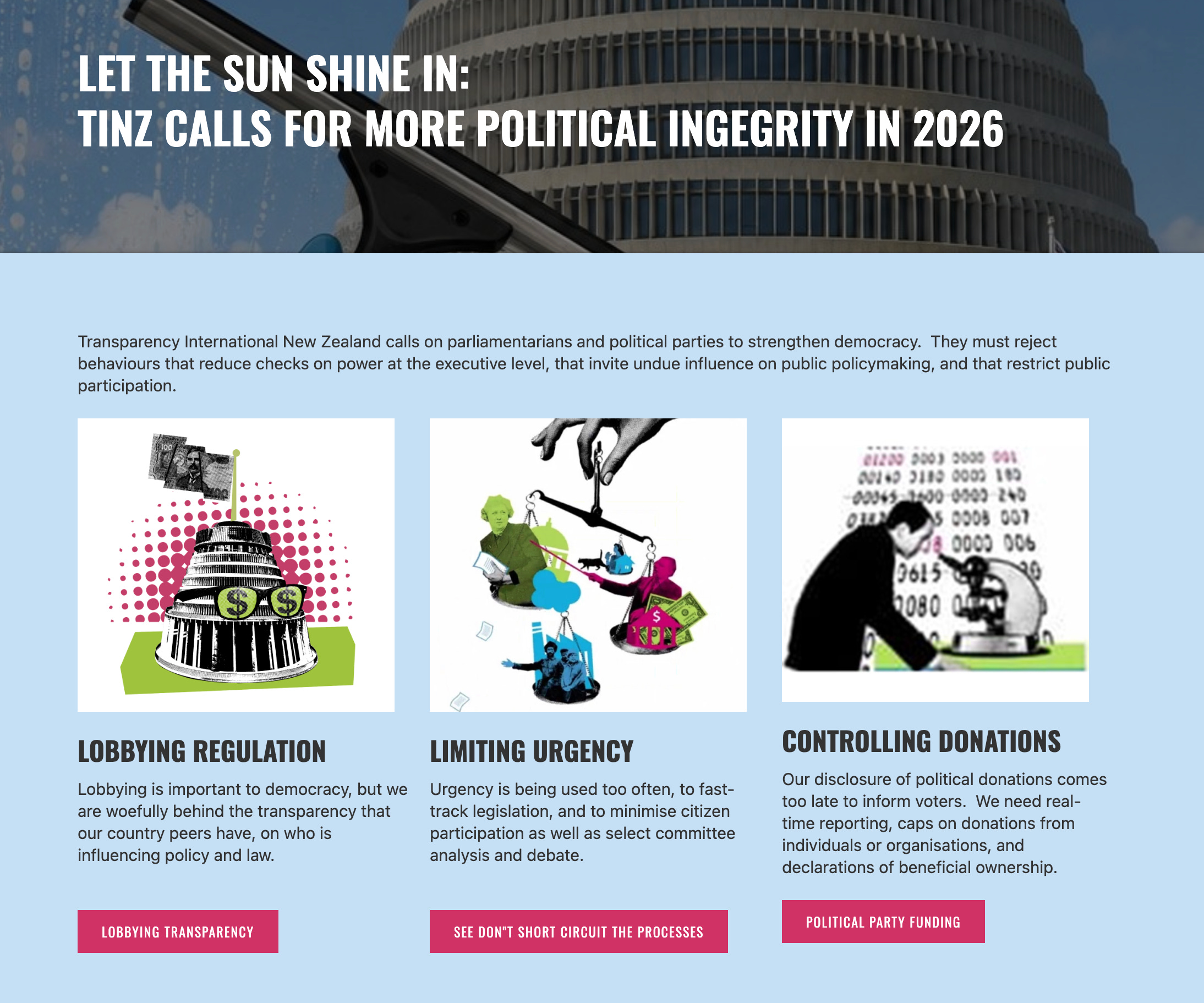
The most significant institutional development is the awakening of Transparency International New Zealand (TINZ). Last week TINZ has named lobbying regulation, political donations and the abuse of parliamentary urgency as its three election-year priorities.
Chair Anne Tolley, a former National Cabinet minister, says New Zealand is well behind its peers: “We have seen the results over several parliamentary terms: where industries and other interest groups with deep pockets, friends in high places and easy access to power are unevenly influencing government policy. All without public visibility.”
Executive director Julie Haggie went further on the specifics of the scandal: “It appears that a corporate interest, using non-scrutinised means, is able to then get legislation passed [under urgency] which is also not being scrutinised by the public.” TINZ wants a public register of lobbyists with regular disclosure, stand-down periods for those moving between Parliament and industry, real-time reporting of political donations, caps on donations, beneficial ownership disclosure for corporate donors, and a “positive test” before urgency can be invoked. Its research shows the current Government has passed 57% of its legislation under urgency, against 29% for the last Labour government.
None of this is the work of protesters or radicals. TINZ sits squarely inside the Wellington integrity establishment, which is exactly why its intervention lands: when a body this mainstream demands a crackdown, the centre of gravity has moved.
The paywall now starts at halfway through all Democracy Project newsletters. Please take out a paid sub if you want to support this service and access the full content, including the following sections: “A late conversion”, “Tex Edwards turns up the heat”, “What reform would actually look like”, and “Meanwhile, the door keeps revolving”.
