

Business leaders are more open to rules on lobbying than many would expect, according to the Herald’s latest “Mood of the Boardroom” survey. Big companies are among the heaviest users of the country’s unregulated lobbying industry, so this undercuts the assumption that business will always resist reform. It also leaves the next government with fewer excuses for avoiding a reform that most of the developed world made years ago.
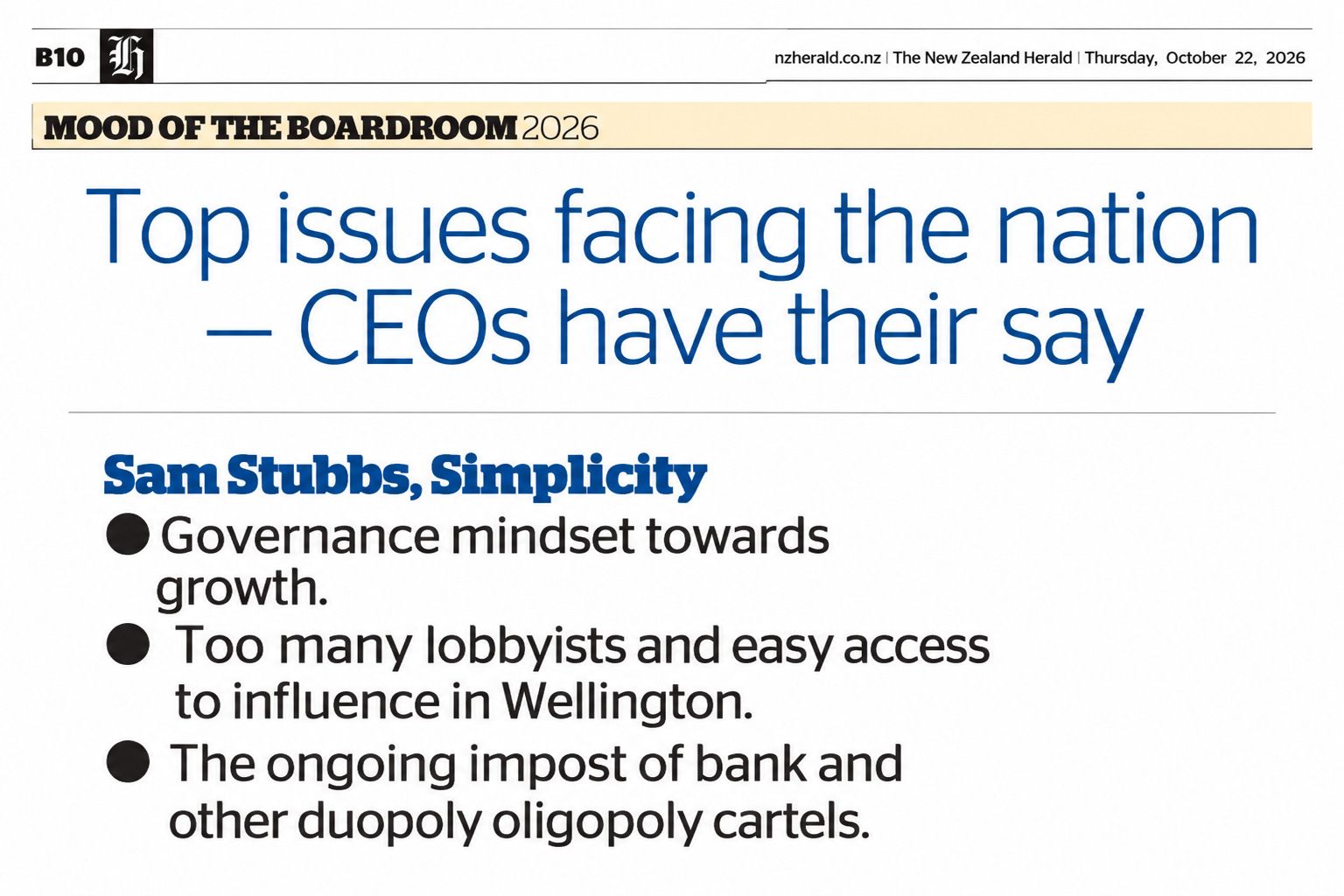
The boldest statement on lobbying and business influence came in the report from Sam Stubbs, founder of the non-profit KiwiSaver provider Simplicity. Asked to name the top issues facing the country, he listed “too many lobbyists and easy access to influence in Wellington”, along with “the ongoing impost of bank and other duopoly oligopoly cartels”.
A pass mark for lobbying reform
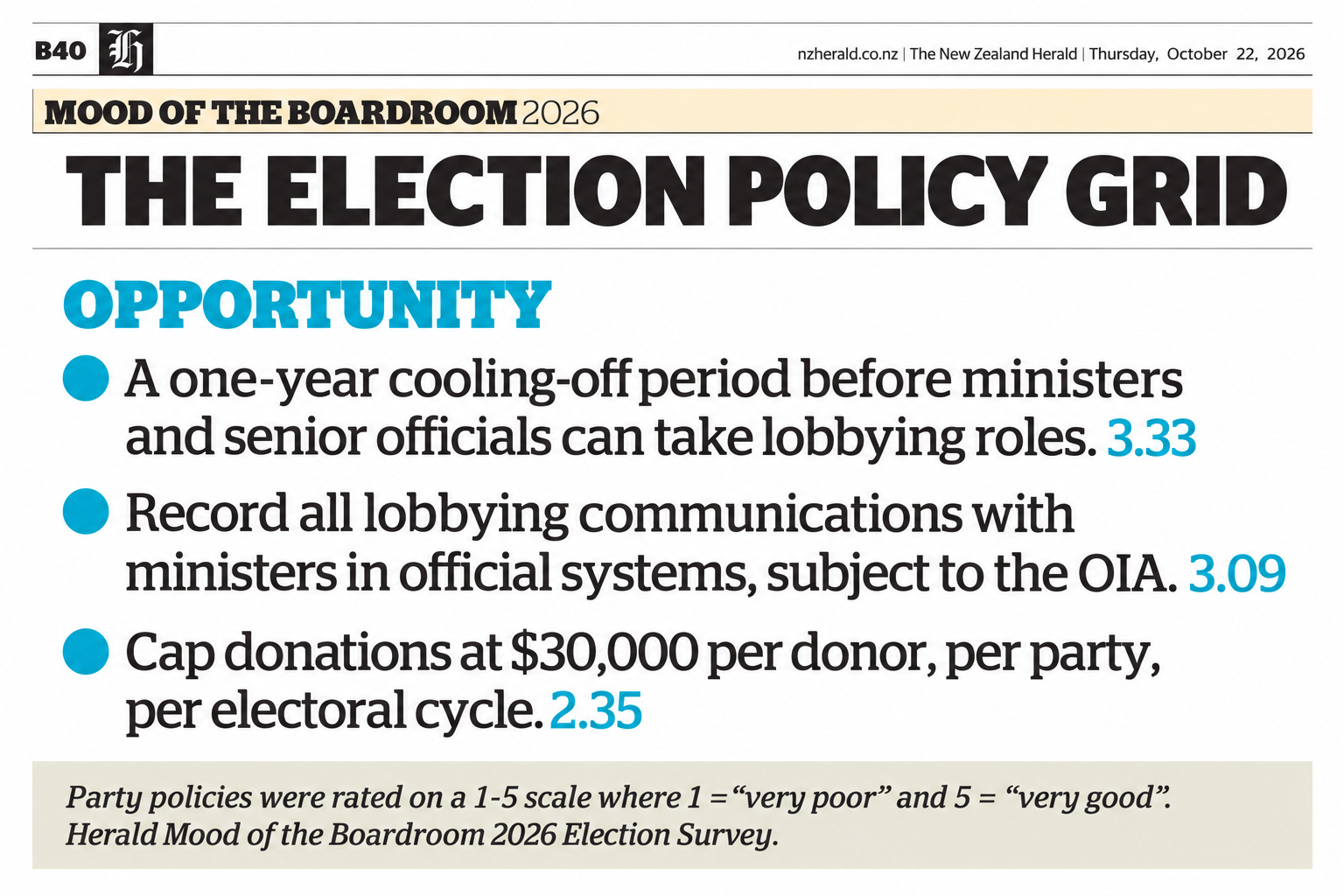
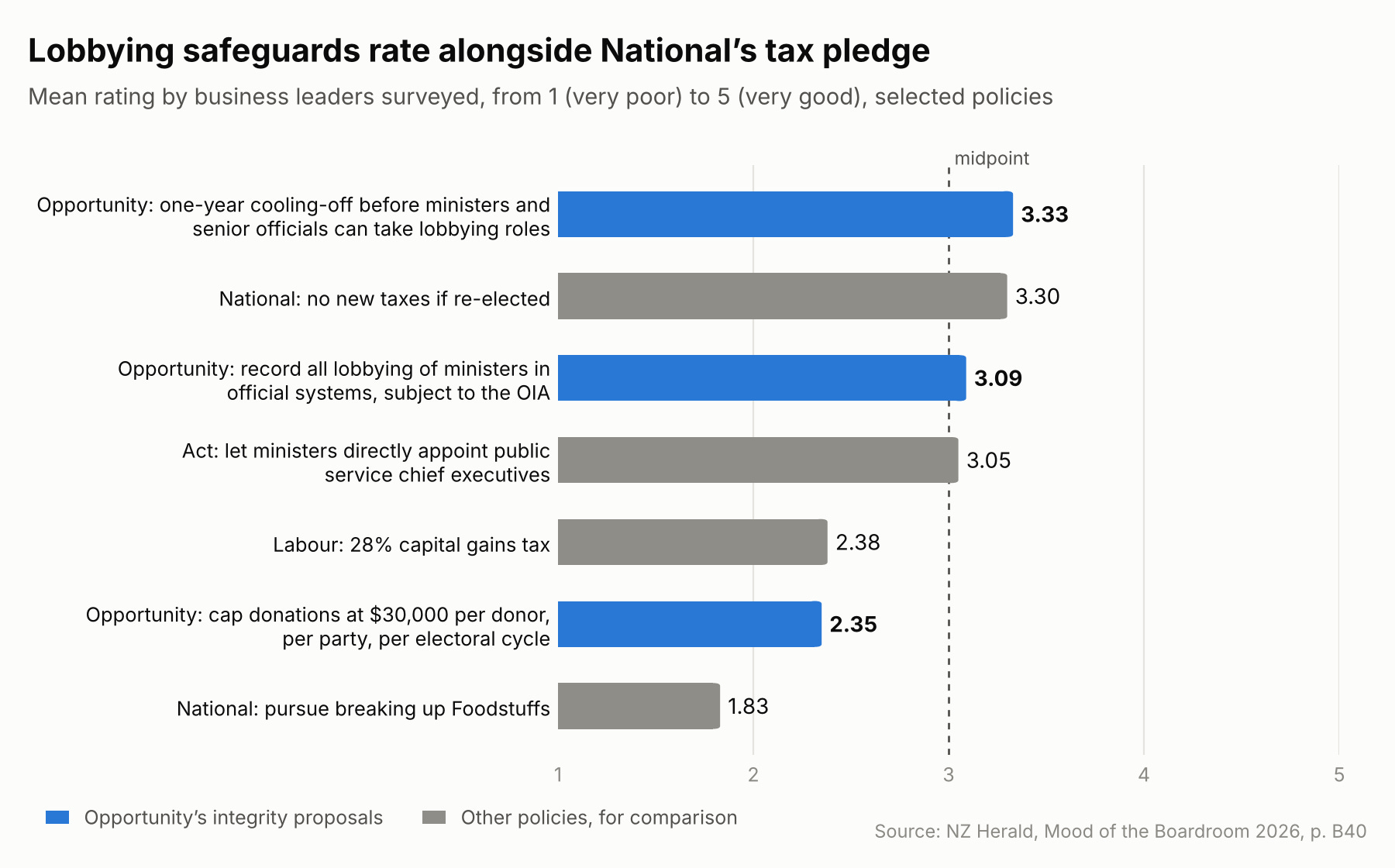
The survey asked business leaders to rate election policies from 1, “very poor”, to 5, “very good”. Opportunity’s proposal for a one-year cooling-off period before ministers and senior officials can take lobbying roles scored 3.33/5. Recording all lobbying communications with ministers in official systems, subject to the Official Information Act, scored 3.09/5.
Both exceeded 3, halfway between the scale’s two extremes. Only 34 of the 99 policies rated reached that point. Interestingly, the cooling-off period scored about the same as National’s pledge of no new taxes, on 3.30/5.
Of course, these are averages, and they could conceal sharply different views. And because the survey hasn’t asked about lobbying before, it can’t tell us how far business opinion has moved. Even so, the fact that it asked about a cooling-off period for lobbyists at all shows the issue has become part of mainstream election debate.
Why business is open to reform
Business leaders have good reasons to take reform seriously, and one is public opinion. In a national survey by Emma Shields and colleagues, published in the New Zealand Medical Journal in August, 88.6% of respondents expressed some level of support for mandatory rules for lobbyists, and 74.4% backed a one-year cooling-off period before politicians and their staff can become lobbyists. Support for mandatory rules was above 80% among the voters of every party. Most of the parties are on board too. Opportunity and the Greens have detailed plans, and Labour, which proposed only a voluntary code when it was last in government, now promises a mandatory register of lobbyists and a code of conduct.
National has gone the other way. In government its Justice Minister, Paul Goldsmith, halted officials’ work on lobbying reform, even though Nicola Willis supported a register and a cooling-off period for ex-ministers when National was in opposition, as Newsroom has reported. Willis has since complained that she “felt the full force” of supermarket lobbying, calling the supermarkets “one of the most well-resourced entities in New Zealand when it comes to lobbying”.
I suspect many business leaders also understand that their own political influence depends on public trust. When access to ministers looks like something only the best-connected can get, the reputation of business suffers along with that of politicians, and its social licence is put at risk. And plenty of firms simply don’t gain from the current unregulated lobbying system at all. Most businesses don’t employ lobbyists, and business challengers in concentrated markets, like Stubbs’ Simplicity competing with the bank-owned KiwiSaver providers, often find the incumbents already have the ear of ministers, so backing reform is the smart move for them too.
A long time coming
I’ve been arguing for rules on lobbying and the revolving door for more than a decade, while governments of both colours found reasons not to act and former ministers moved into lobbying within months of leaving office. Researchers such as Max Rashbrooke and Lisa Marriott, Health Coalition Aotearoa, Transparency International and Tex Edwards’ Monopoly Watch have also started adding to the pressure, and I’d like to think my own columns, including LobbyistWatch, have helped too. So it’s satisfying to see business leaders now recognising the case for reform.
Not everyone is convinced
Business is far from united, though. Opportunity’s proposed cap on donations of $30,000 per donor, per party, per electoral cycle scored just 2.35/5, about the same as Labour’s capital gains tax (2.38/5).
Some in the industry are sceptical as well. Lobbyist Mark Unsworth told NBR’s Brent Edwards in September that “Everybody lobbies”, and said of the lobbyists he sees at the Beehive, “I have no problem with that. It is democracy.” He has a point. Ordinary contact with an MP shouldn’t become a compliance exercise. But professional and corporate lobbying can be made transparent without preventing anyone from making their case.
New Zealand still has no mandatory lobbying register or cooling-off period for former ministers. The OECD’s 2026 assessment confirms that we lack a framework for regulating lobbying. Three-quarters of OECD member countries have cooling-off rules for public officials; New Zealand is outside that group. We’ve tolerated this wild west for far too long.
What the next government should do
Whoever forms the next government should be pressed to act early in the term, with legislation, a timetable and independent enforcement. Opportunity has made regulating lobbying and capping donations one of its five bottom lines for supporting a government, so if it holds the balance of power, it should insist that a lobbying register and a cooling-off period are written into the coalition agreement.
Business leaders who favour reform should also say so before coalition talks begin. BusinessNZ’s own manifesto says “Government decision-making must be open”, and praises the Ministry for Regulation’s “open-door policy” with business. The next step is to be open about who walks through that door. It would help if BusinessNZ, the EMA and the chambers of commerce said publicly that they back a mandatory register and cooling-off periods, knowing the rules would cover their own lobbying too. After more than a decade of delay, the tide may finally be turning on lobbying reform.
Dr Bryce Edwards
Director of the Democracy Project
In today’s “Further Analysis” after the paywall below, I look at how business groups are campaigning in this election, and at the big money behind some of the campaigns. Most of this activity never has to be declared. I also compare business with the unions, and with past elections.
Paid subscriptions fund this research.
———————————————--
