

Local government needs reform. No serious person can look at 78 councils, collapsing infrastructure, rates blowouts and anaemic voter turnout and say the system is working well. It isn’t. But that is precisely why the Government’s new plan should worry us.
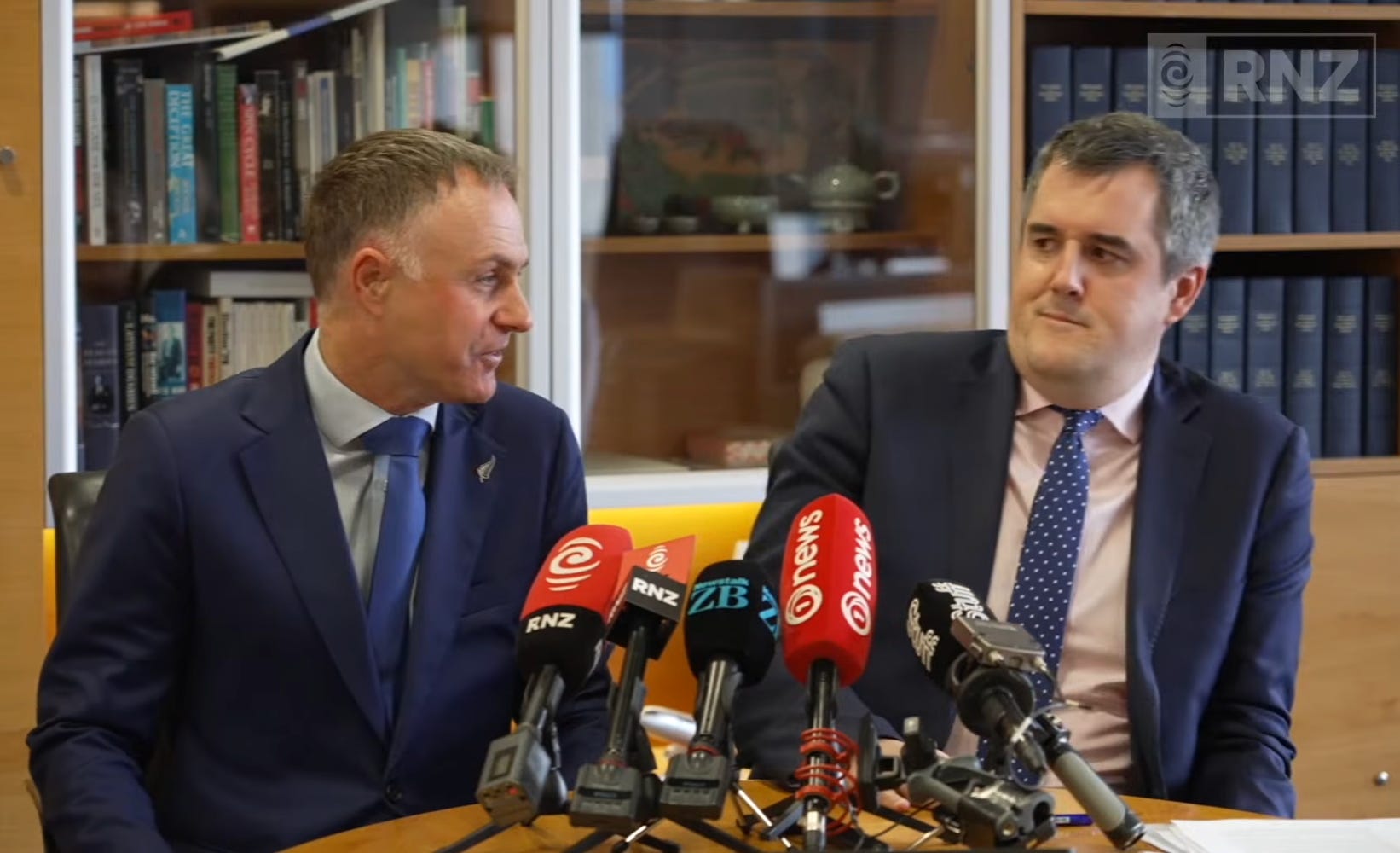
Yesterday, RMA Reform Minister Chris Bishop and Local Government Minister Simon Watts announced what they’re calling the “Head Start Pathway”: councils have until August 9 (just 90 days) to submit proposals to amalgamate into larger unitary authorities, or the Government will design a structure for them. The ultimatum was blunt: “Lead your own reform, or we will do it for you.” Bishop said it at the press conference. He said it again on Hosking. He hasn’t really stopped saying it. And it’s an astonishing ultimatum that will be galling to many local authorities who are genuinely engaging in the reform process.
The brass neck of it
Henry Cooke, writing for The Post, put the problem with characteristic precision: “There is a strong case for local government simplification. It’s being undermined by the way the Government is going about it.”
That’s the crux of this column. Not whether amalgamation is a good idea. It might be, in many cases. The question is whether this is a sensible way to do something this consequential.
Consider what Bishop had to say when pressed on the Government’s mandate. He admitted that National had not campaigned on local government reform but insisted that didn’t matter, because the Government could do it anyway.
Cooke also notes today, that this was hard to reconcile with the comments of the Government’s Local Government spokesman in 2021 (“one Christopher Luxon”) who said of Labour’s council review: “This review cannot become a byword for centralisation or an opportunity for power to be taken away from ratepayers. It’s crucial that outcomes are led by communities, not by central government.”
Luxon campaigned explicitly in favour of “localism” and against “centralisation”. National attacked Labour’s centralising impulse in health, tertiary education, water services, and promised to put local communities back in the driving seat. Now they are doing the same thing, only faster and with less process.
Cooke gives the Government one fair defence. Opposition is easy. Government is harder. Once ministers discover how many councils, boards, iwi, officials, planners, lawyers and local egos are involved, “localism” can start to look less like a principle and more like a blockage.
Fair enough. Governments do discover constraints. But the NZ Initiative, the business think tank that has championed localism for years, must be watching this with something approaching horror. The localism agenda is not merely being set aside; it is being actively reversed. And there has been no serious attempt to reconcile this with what the Government actually promised.
Reform by ultimatum
The blogger No Right Turn puts the democratic objection more bluntly: “National’s attempt to dictate the merger of councils, abolish regional government, and reduce local representation is the very opposite of localism. There is an established process for this. Councils can use it if they want to, after consulting their electorates. The fact that so many have chosen not to speaks for itself about what they want.”
The existing Local Government Commission process is slow. Sometimes painfully slow. But that is partly the point. Amalgamation is not a new bus route or a procurement tweak. It changes who governs whom.
Auckland’s super city did not arrive after a 90-day homework exercise. It followed years of argument and a Royal Commission. Even then, plenty of Aucklanders still think it produced a larger, more remote machine.
Bishop, when asked whether the country had enough consultants to ready every council’s proposal in three months, told reporters councils had the resources themselves and would have no trouble consulting their communities quickly. Furthermore, he stated: ‘‘Honestly, local government spends its life consulting people.’’ That’s rather glib.
Economist Michael Reddell put it bluntly on social media: “3mths is absurdly short.” He’s not wrong. Reddell also pointed to the Government’s own recent track record of large-scale public sector reorganisations. He said that it “would be more reassuring if the govt could show us the last large scale public sector reorganisation that really worked for the public. Health NZ, the mega-polytech?” Both of those are still unravelling.
Reddell makes another good point: if the Government genuinely thinks amalgamation is desirable, let it make the case, and “let voters in [individual] council areas decide.” He argues there should be mandatory referendums on amalgamations. It’s a reasonable position. If the Government believes the public agrees with it, why not find out?
The Gore District mayor’s reaction, in today’s Otago Daily Times, was telling: “These are once in a generation conversations that we’ve got to pack into three months — so yeah, they will be complicated.” Upper Hutt mayor Peri Zee described the timeframe to The Post as “extremely tight” and said she was “highly sceptical” that the benefits of amalgamation outweighed the costs. Buller mayor Chris Russell: “This is not something to be rushed if we want to get it right.” These are not anti-reform voices. They are people being asked to redesign their democratic structures before their annual plans are even finished.
Bishop has one practical reason for moving fast. His RMA reforms need councils that can actually operate the new planning system. He does not want to rebuild planning law only to leave it in the hands of the same fragmented local structure.
Fair point. But it is still an assumption, not evidence. Bigger councils do not automatically mean better planning. Sometimes they just mean bigger planning departments.
The paywall now starts at halfway through all Democracy Project newsletters. Please take out a paid sub if you want to support this service and access the full content, including the following sections: “The magic savings machine”, “Does NZ even have too many councils?”, “What about the bigger questions?”, “The political calculation”, “Confusion at the centre” and “What reform should look like”.