

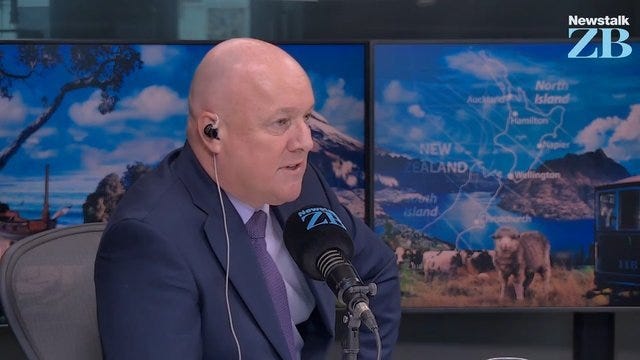
A Newstalk ZB listener sent in a text message on this morning asking the Prime Minister to “stop this farce of 5% parties controlling the outcome of Government”. Kerre Woodham read it out. Christopher Luxon started where he usually starts, pointing to European countries with far more tangled coalitions than ours. Then he went somewhere else entirely. Asked whether he would hold a referendum on MMP if he was still Prime Minister next year, he said: “Yeah, I think I would.”
That was all it took. There was no press release, no policy document and no sign that the referendum commitment itself had been settled or communicated across National’s caucus. On a mid-morning talkback show, the Prime Minister appeared to commit himself, and by implication a future National government, to reopening New Zealand’s constitutional settlement.
No one should object to a country revisiting how it elects its Parliament. The objection is to doing it like this.
What he actually said
Luxon’s reasoning on holding a referendum, such as it was, ran like this: “I think I would because I actually think, you know, that it is quite right to check in constitutionally and say, ‘Is this the system, New Zealand, you still want?’ You know, ‘You voted for this in the 90s, we’ve had a check-in in the [20]10s, 20 years down the road or whatever it has been, is it still where you want to be?’“
He then explained why he wanted more National ministers around the Cabinet table. “When you have to form coalition governments, you don’t have the same values, you don’t have the same policies, you’re not talking to the same people,” he said. And then the line that has defined the week: “The question is, I keep saying, I don’t need some yahoo or numpty from some other party around that table.”
Asked directly whether he meant his current coalition partners, Luxon said no. But when Woodham asked whether he would rather have Mark Mitchell at the Cabinet table than New Zealand First candidate Michael Laws, the Prime Minister replied: “You said it.”
Luxon offered no argument that MMP produces unrepresentative parliaments, or bad legislation, or unaccountable MPs. He did not say what system he would prefer instead. His complaint was that proportional representation obliges him to share power with people he does not rate. He was not complaining about the electoral system. He was complaining about having to negotiate.
There are legitimate complaints about MMP. The 5% threshold discards votes, the electorate-seat rule has treated similarly supported parties differently, the party list system give party organisations considerable power, and pivotal parties can secure influence beyond their numerical strength. Those are arguments for defined reforms and a properly designed review. Luxon identified none of them.
Adam Pearse of the Herald read it as a symptom rather than a policy. Tying major constitutional reform to the prospect of “yahoos and numpties” around the Cabinet table, he wrote, “suggests a leader under pressure to answer for the dysfunction and lack of delivery that has hobbled his coalition.”
Was it National Party policy?
The Herald, RNZ and Stuff all asked National’s MPs the same question this afternoon. Their answers never settled whether Luxon had announced official party policy.
Nicola Willis, when asked whether an MMP referendum was National Party policy, said: “The Prime Minister is the leader of the National Party.” She added that she had been aware “these were views that he held and that we’ve discussed in our caucus”.
Simeon Brown is National’s campaign chair, so he might be expected to know the party’s policies. Asked about it, he said: “He was on radio giving a view, and that’s great.” Asked repeatedly and directly whether it was National Party policy, Jamie Ensor reports, he didn’t answer. Asked whether it had been through caucus, he walked off.
Mark Mitchell said flatly that National was “not campaigning on that”, while also saying it was something to revisit next term if the party was returned. He then admitted: “I haven’t seen the Prime Minister’s comments.”
Willis’ defence is worth pausing on, because it inverts the concept of transparency: “I think it’s good to have a prime minister who gives you open honest answers,” she said. But candour about a passing thought is not transparency. Transparency would mean publishing the policy, its reasoning and the alternative on offer. What Willis is defending is the absence of any visible policy process, dressed up as authenticity.
It didn’t come out of nowhere
The convenient explanation doing the rounds is that Luxon simply blurted this out. Henry Cooke set out the process failure in The Post. Luxon’s announcements, he wrote, are “election-shaping pronouncements made without a press release or any collateral prepared alongside them”, and there is “little if any merit in making these election-changing pronouncements in such a haphazard and seemingly unplanned way.”
But one piece of evidence complicates the gaffe theory. In May last year, at National’s regional conference in Orewa, Justice Minister Paul Goldsmith told a crowd of party faithful that he “would love to get rid of” MMP. Jonathan Killick reported for The Post that Goldsmith said it wasn’t on the agenda “right now”, but that he believed the electoral system should be revisited every fifteen years. He added that he wouldn’t want to go back to First Past the Post.
That is the minister who would have to legislate a referendum telling party members that he would “love to get rid of” MMP, while rejecting a return to First Past the Post and leaving the preferred replacement unspecified. The remarks have received little attention in today’s coverage.
Put that alongside the four-year-term proposal and a possible move to a less proportional electoral system, and the concern becomes obvious: longer between elections, fewer parties constraining the executive, and no guaranteed strengthening of accountability in return. Each proposal is arguable on its own. Taken together, they point towards a freer hand for the government of the day.
Politicians initiating and framing changes to the rules that determine their own power face the oldest conflict of interest in democratic life. The same problem appears in ministerial declarations, lobbying access and political donations. Here it arises on the largest possible scale.
The timing matters. Recent polls have put National around 30%, sometimes below it. Minor parties are rising and Opportunity is knocking on Parliament’s door. Under a less proportional system, that arithmetic could look very different for National. It was under First Past the Post, after all, that National twice took office on fewer votes than Labour, in 1978 and 1981.
The response that will do Luxon most damage came from his own coalition partner. Winston Peters said “MMP broke the stranglehold of two parties running roughshod over our economy without social licence”, and then delivered the line Luxon will not shake: “Now that the two old parties are losing their grip on power, they want to change the electoral system to favour their falling fortunes.”
Shutting down and taking away true democratic representation, Peters wrote, “should be seen for what it is – a power grab and an ignorance for what it means to be a democracy.” He also said, of the fact that Luxon appeared not to have told his caucus: “It means there could be interesting repercussions if you know what I mean ... you can do the interpretation.”
Peters is self-interested, obviously. But he has a longer record on this question than most of Luxon’s critics: he was arguing for proportional representation in 1990, when he was still a National MP.
David Farrar, the longtime National pollster, was politer but no more supportive. “It is unclear if this is merely a desire by the Prime Minister, or official National Party policy. Either way, I think it is premature,” he wrote, arguing that thirty years is a more sensible interval than fifteen.
The paywall now starts partway through all Democracy Project newsletters. Please take out a paid sub if you want to support this service and access the full content, including the following sections: “How constitutional reform should happen”, “A constitutional problem, or a Luxon problem?”, “Who would run the campaign?”, and “A referendum with no majority”.