

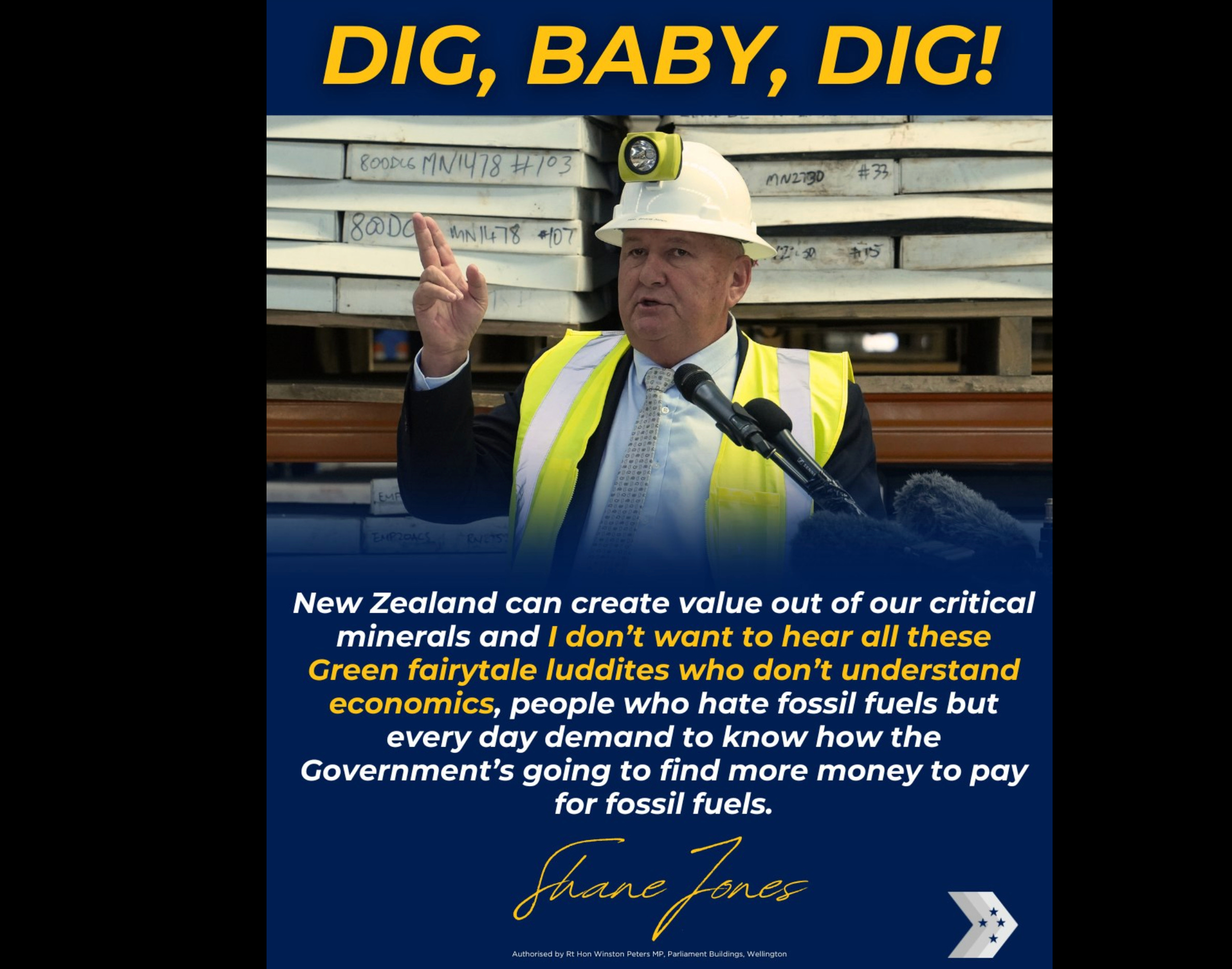
Yesterday, Shane Jones hosted a meeting at the Beehive. The guest list tells you quite a bit about whose interests his government is serving.
The Resources Minister gathered mining company bosses, a senior US State Department official, and diplomats from Australia, Japan and South Korea in Wellington for what was billed as a “critical minerals roundtable.” The American delegation — led by Michael DeSombre, assistant secretary of state for East Asian and Pacific affairs — heard pitches from New Zealand mining companies hoping to tap into US-backed finance for their projects. Jones canvassed the idea of the government setting minimum prices for certain minerals, a kind of public price floor for private extractors.
According to Thomas Coughlan’s account in the Herald, Jones told the room he wanted to create a “narrative” that critical minerals were “a legitimate part of the New Zealand economy.”
What is already legitimate is the money the extraction sector has been putting into coalition party accounts. The Electoral Commission released the 2025 annual donation returns last week, and this column — the third in my current series on who is funding New Zealand politics — goes looking at what the mining, oil, and gas sector has been contributing.
The answer, in outline: roughly $295,000 in declared donations in 2025, spread mainly across NZ First and National. That is a smaller figure than the property and construction sector’s $497,000, which I covered in the previous column. The dollar figure understates the relationship. What the sector received from the coalition in 2025, and what it paid back in early 2026, is the cleanest legislation-to-donation sequence in the current cycle.
The wishlist that was delivered
The 2025 calendar year was a spectacular policy year for the extraction sector.
The Fast-Track Approvals Act 2024 listed eleven mining projects eligible for the government’s streamlined consenting pathway, bypassing the ordinary Environment Court and council process. Among those listed are OceanaGold’s Waihi North and Macraes Phase 4, Santana Minerals’ Bendigo-Ophir gold mine in Central Otago, and Bathurst Resources’ Buller Plateaux Continuation project to extend the Stockton and Escarpment coal mines. The government committed $80 million of its Regional Infrastructure Fund specifically to critical-minerals projects. It allocated $200 million in Budget 2025 to co-invest in new gas field developments. It set a target of doubling New Zealand’s mineral exports to $3 billion by 2035.
Energy Resources Aotearoa chief executive John Carnegie was appointed by Energy Minister Simeon Brown to the EECA board in March 2025 against official advice, as Eloise Gibson reported for RNZ.
And, most consequentially, the Government passed the Crown Minerals Amendment Act 2025.
That legislation changed the very purpose of the Crown Minerals Act, from “manage” New Zealand’s petroleum and mineral resources to “promote” their development. Not a minor revision. The Act also weakened decommissioning liability for petroleum operators, replacing automatic trailing liability with ministerial discretion over who pays for clean-ups. It repealed the 2018 ban on new offshore oil and gas exploration permits. It broadened the operational latitude for new exploration activity.
Labour MP Deborah Russell, during the bill’s third reading debate, named the bill’s hidden constituency. Those consulted on the late-stage Supplementary Order Paper, she said, were “shadowy participants in the oil and gas industry… who we don’t know who they are”, who “much prefer to be able to lobby a minister” than work to a statutory rule.
A name that does some work
There is a postscript to the 2025 donations. On 19 and 20 February 2026, GMP Environmental Limited made three donations: $100,000 to the National Party, $100,000 to Act, and $100,000 to NZ First. Three parties, three identical deposits, the same week — $300,000 in all.
GMP Environmental Limited is a subsidiary of Greymouth Petroleum, one of New Zealand’s largest oil and gas operators. The company is controlled by Mark Dunphy, an NBR Rich Lister with an estimated net worth of over $200 million, who had a documented adversarial public history with the previous Labour government’s Crown Minerals policy — he sued Energy Minister Megan Woods in 2018 over the offshore exploration ban. Greymouth was, by multiple accounts, among the most vocal lobbyists for the decommissioning liability changes the Crown Minerals Amendment Act 2025 delivered.
Donating through a subsidiary is legal and common. But the choice of “GMP Environmental” as the donor of record is worth considering. The name, on a quick scan of the Electoral Commission register without further research, suggests environmental consultancy or environmental services. The corporate website for GMP Environmental describes it as supplying trucks, trailers, mudtanks, generators and portaloos, mostly to oilfield clients. It is, functionally, a logistics subsidiary of a gas exploration company. The “Environmental” branding is doing real work in obscuring that connection.
The blogger No Right Turn, writing in March 2026, called the donations “payment for services rendered” and described the arrangement as “naked corruption. Bribery. Law for sale.” While that’s a fairly sharp way of putting it, the pattern makes it hard to read any other way. After all, when an industry helps lobby for a legislative change that shifts hundreds of millions of dollars of potential liability off its balance sheets and onto taxpayers, and then, seven months after that legislation passes, routes $300,000 to the three governing parties through a subsidiary whose name partly obscures the connection, the appearance of a quid pro quo is so overwhelming that the technical legality of the transaction stops looking like a defence and starts looking like part of the problem.
RNZ’s Kirsty Johnston established, through Official Information Act requests, that officials gave industry bodies — including Energy Resources Aotearoa, OMV, Todd and Methanex — confidential pre-consultation on the Crown Minerals Amendment Bill, sharing draft amendment text for feedback on “workability” and adjusting wording in response.
One company’s feedback led officials to clarify drafting in a direction that “confirm[ed] the guarantee was limited to ‘unmet costs’ or ‘a proportion of those unmet costs’, reducing the scope of potential liability” the company would face. Officials noted internally that the company “intend to convey their thanks” before the legislation was even public. The legislation was, in other words, not just lobbied for through normal submission channels: it was substantially co-authored by the regulated sector. GMP Environmental’s three-party donation arrived into that context.
The backdrop: $293 million of public money
In 2019, Tamarind Taranaki, a Malaysian-owned petroleum company, became insolvent and walked away from its obligations to decommission the Tui oil field off the Taranaki coast. New Zealand taxpayers ended up paying approximately $293 million — drawn from an initial appropriation of $443 million — to clean up a field a private company had profited from but refused to close. The Labour government passed the Crown Minerals (Decommissioning and Other Matters) Amendment Act 2021 specifically to prevent a repeat of that scenario, creating trailing liability provisions that made petroleum operators responsible for decommissioning costs even after selling or offloading assets.
The oil and gas industry opposed those provisions from the moment of their passage. Greymouth Petroleum was among the most persistent advocates for their repeal.
The Crown Minerals Amendment Act 2025 effectively reopened the liability gap the 2021 law had closed. It replaced automatic trailing liability with ministerial discretion, meaning that whether the next Tamarind leaves taxpayers with a $300 million bill now depends on a minister’s judgement call rather than a statutory rule. The minister who controls that discretion is the same minister whose party is the primary recipient of extractive-sector donations.
The paywall now starts at halfway through all Democracy Project newsletters. Please take out a paid sub if you want to support this service and access the full content, including the following sections: “The 2025 donor footprint”, “The minister at the centre of all of it”, “Critical minerals, critical questions”, and “The integrity problem isn’t the donations”.