

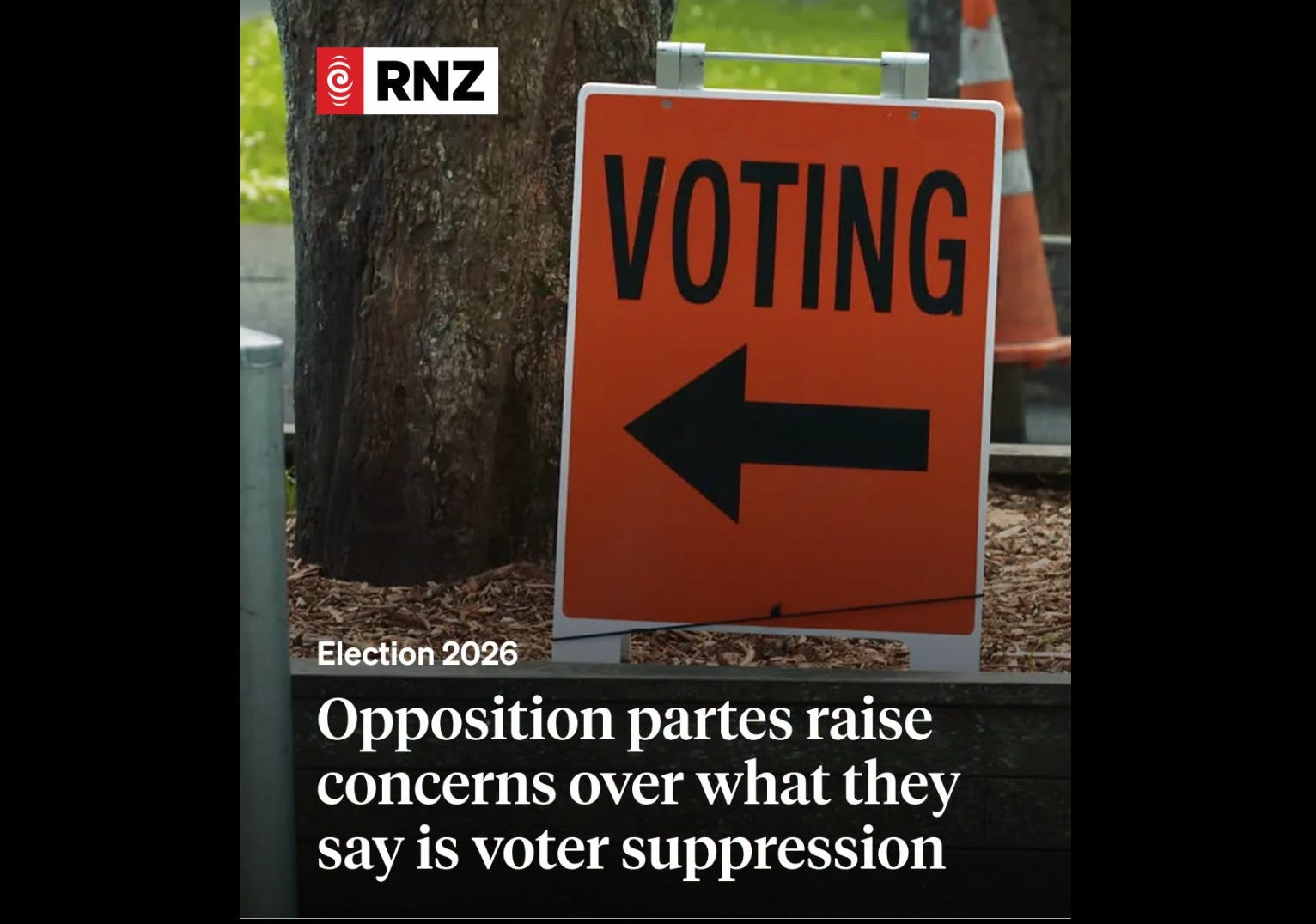
Labour and the Greens are accusing the coalition government of voter suppression. Trevor Mallard says the 13-day enrolment cut-off that occurred on Sunday looks like “the voter suppression you expect from Trump or Hungary”, and Chlöe Swarbrick is “incredibly concerned about this government’s moves to actively suppress voting”. Ministers say they have merely fixed a vote count that was slow and error-prone in 2023.
Neither side’s account holds up. As I argued in opinion piece in the Herald today, the cut-off is a serious mistake that will cost tens of thousands of eligible people their vote, many of them young. The Hungary comparison is overblown, though, and Labour’s hands aren’t clean. It changed the enrolment rules in 2020 without National’s agreement and handed the coalition the precedent it has now used. Whoever holds a bare majority can rewrite the rules for the next election, and both main parties have become far too comfortable doing it.
So, I agree with Labour and the Greens that enrolment should remain open much later. Where I part company with them is over their apparent belief that this is entirely a problem of National’s making. Labour helped establish the precedent the coalition has now exploited.
Self-dealing at the ballot box
We take conflicts of interest seriously when they involve government contracts, ministerial appointments or politicians’ financial interests. Yet we seem remarkably relaxed about something potentially more consequential: governments changing the rules under which they themselves seek re-election.
It’s a form of constitutional “self-dealing”. The politicians competing for power also get to decide some of the conditions under which everyone else participates.
Otago University law professor Andrew Geddis identified the problem in his submission on the coalition’s legislation. It represented “a current governing majority changing electoral law in a way that will benefit their chances of being re-elected”. And Liam Hehir, who has written one of the more substantial defences of the new law, acknowledges that “it would be surprising to me if the Government had given no thought to the political consequences of its decision”.
Justice Minister Paul Goldsmith isn’t inventing the counting problem. The Auditor-General found serious failures in the handling of the 2023 election, with enrolment processing taking eleven days instead of the five allocated. Important checking procedures were rushed, and errors went undetected. There was a genuine administrative problem to solve.
But why should the answer be to restrict enrolment rather than invest in making election administration more reliable? The Government hasn’t convincingly established that this was the best solution, especially when it was changing the rules for an election it would itself be contesting.
Labour handed over the loaded gun
Labour can’t claim clean hands either. Its Government introduced election-day enrolment in 2020 with NZ First and Green support, passing the legislation by 63 votes to 57 against National’s opposition.
A revealing 2019 Ministry of Justice impact assessment records that officials were directed by the Minister of Justice to examine only the election-day enrolment option, rather than the wider range of ways to improve participation. That’s a remarkably narrow approach to such an important change.
The same document shows that the Electoral Commission supported election-day enrolment in principle but suggested postponing it until 2023. It was worried about the operational pressures, particularly with referendums also being held in 2020. The Commission said implementation that year was possible with safeguards, and the Ministry recommended going ahead. Labour accepted that advice rather than the Commission’s preference for waiting.
Labour effectively handed the incoming Government a loaded gun. National could now argue that if Labour was entitled to change enrolment rules without its agreement, National could do the same. Goldsmith made precisely that argument when defending the coalition’s legislation last December, rejecting suggestions that Labour’s changes were acceptable while National’s were supposedly “terrible”. The bill passed by 68 votes to 54.
The irony is particularly rich given what NZ First’s Darroch Ball said during the original debate. He accused National of not wanting more people to have access to voting. Peters then ended up blaming counting delays on a law his own party had supported throughout its passage through Parliament.
Changing the political culture
Arguably, governments must retain the ability to reform electoral law even when the Opposition refuses to agree. Otherwise, a party could veto the repeal of an unfair rule simply because it suited its interests.
But a parliamentary majority shouldn’t be the beginning and end of the matter. Electoral reforms ought to involve serious attempts at cross-party agreement, independent advice and extensive public consultation. If a government decides to proceed without broad agreement, it should explain why. Major changes should also normally take effect at a later election, rather than immediately altering the conditions of the next contest.
Officials have made a similar argument. A Ministry of Justice aide-mémoire, obtained by Newstalk ZB last year, said changes affecting democratic rights “should be enduring and only occur following careful consideration and a consultative approach”. They should also restrict those rights no more than necessary.
The coalition’s bill did go through formal consultation, with the Justice Committee receiving 2,738 written submissions. The second reading and committee stage then went through under urgency in December, when, as Duncan Garner puts it, “nobody was paying much attention to election rules over the festive season.”
I was concerned about this back in May 2024, when the coalition was considering the change. I wrote that National, Act and NZ First “would be wise to consult widely with society before getting rid of election-day enrolment”. Others, including Geddis, electoral lawyer Graeme Edgeler and the Law Society, subsequently raised serious concerns. Yet the wider political controversy barely registered until the legislation had passed and the election was approaching.
Journalists, academics and civil-society organisations need to take electoral changes much more seriously while the rules are being written. And there’s no golden age of electoral reform to return to. Joshua Ferrer’s research suggests the supposed convention of bipartisan agreement in New Zealand was never nearly as strong as politicians like to pretend. Perhaps it’s something we need to build, rather than rediscover.
Labour is now promising to restore later enrolment if it wins the election. I hope it does. But Chris Hipkins himself said in July that significant electoral changes should have “broad public support through a referendum, or a good degree of bipartisan support”.
Hipkins could start by telling voters, before the election, exactly how Labour would go about restoring later enrolment. Would he consult National and the other parties? Would he seek agreement about how electoral changes should be made in future, even if National opposes this particular reform?
And would National accept those same expectations the next time it takes office?
Until the parties answer those questions, their arguments about electoral principles will continue to look suspiciously dependent on whether they’re in government or opposition.
Dr Bryce Edwards
Director of the Democracy Project
The enrolment controversy has produced some extraordinary claims, from 400,000 supposedly lost votes and Trump-style suppression to suggestions that people who miss the deadline don’t deserve to vote anyway. In the “Further Analysis” section below on “The good, bad and outrageous arguments about voter enrolment”, I examine the more revealing arguments from politicians and commentators, including Richard Prebble, Mike Hosking, Gordon Campbell and Martyn Bradbury. Some stand up to scrutiny. Others deserve rather more scepticism.
Paid subscriptions make this work possible.
--------------------
