

New Zealand is at a crossroads. The election of a new Parliament every three years always provides a time for reflection on how the country might do things differently. And this time, the moment seems unusually open. The election campaign showed a high level of discontent with “business as usual”, with an awareness that change is needed in New Zealand – even if there is a lot of disagreement about what that change might be.
That makes it a good time to start something new here too. Since last year I have written a long run of columns about what I call “Broken New Zealand”: markets that don’t work, public services in decline, and a political system that too often serves those with the best access. Much of the country seems to share the diagnosis. An Ipsos survey last year found three in five New Zealanders thought the country was broken, and this month voters turned away from both major parties.
The hard questions are about how to solve problems that everyone can see, and that have gone unfixed for decades. This is the first column in a series, “Fixing Broken New Zealand”, that will take those questions one problem at a time.
Danyl McLauchlan has given the best account of why the problems persist. Writing in the Listener just before the election, he described 30 years of “Drift”, in which “mistakes were rarely reversed” and each policy disaster was “defended by whoever benefited from it”. He warned that whoever forms the next government “will face intense pressure from those who’ve benefited from the decades of Drift to stay the course”. Matthew Hooton takes up the same idea in today’s Sunday Star-Times, and the Helen Clark Foundation’s recent book, Facing Up to Our Future, makes a version of the argument across 20 chapters.
Each column in this new series will set out the most serious proposals for dealing with one long-running problem, along with the strongest objections. I will also be asking “who pays” and “who benefits”, because New Zealand is not one household with a single set of interests, and most “fixes” move money and power from some people to others. The fixes also have to be democratic. Auckland’s mayor mused this month that “democracy’s had its day”, before saying he had not meant that New Zealand should adopt China’s model. It shows where impatience with drift can lead.
#1: The retirement and savings problem
At the core of my “Broken New Zealand” thesis is the notion that in recent decades the country has stagnated and gone into decline. Much of the decline is political and economic. Most of the old policy settings and institutions are no longer fit for purpose, and no real leadership is addressing that.
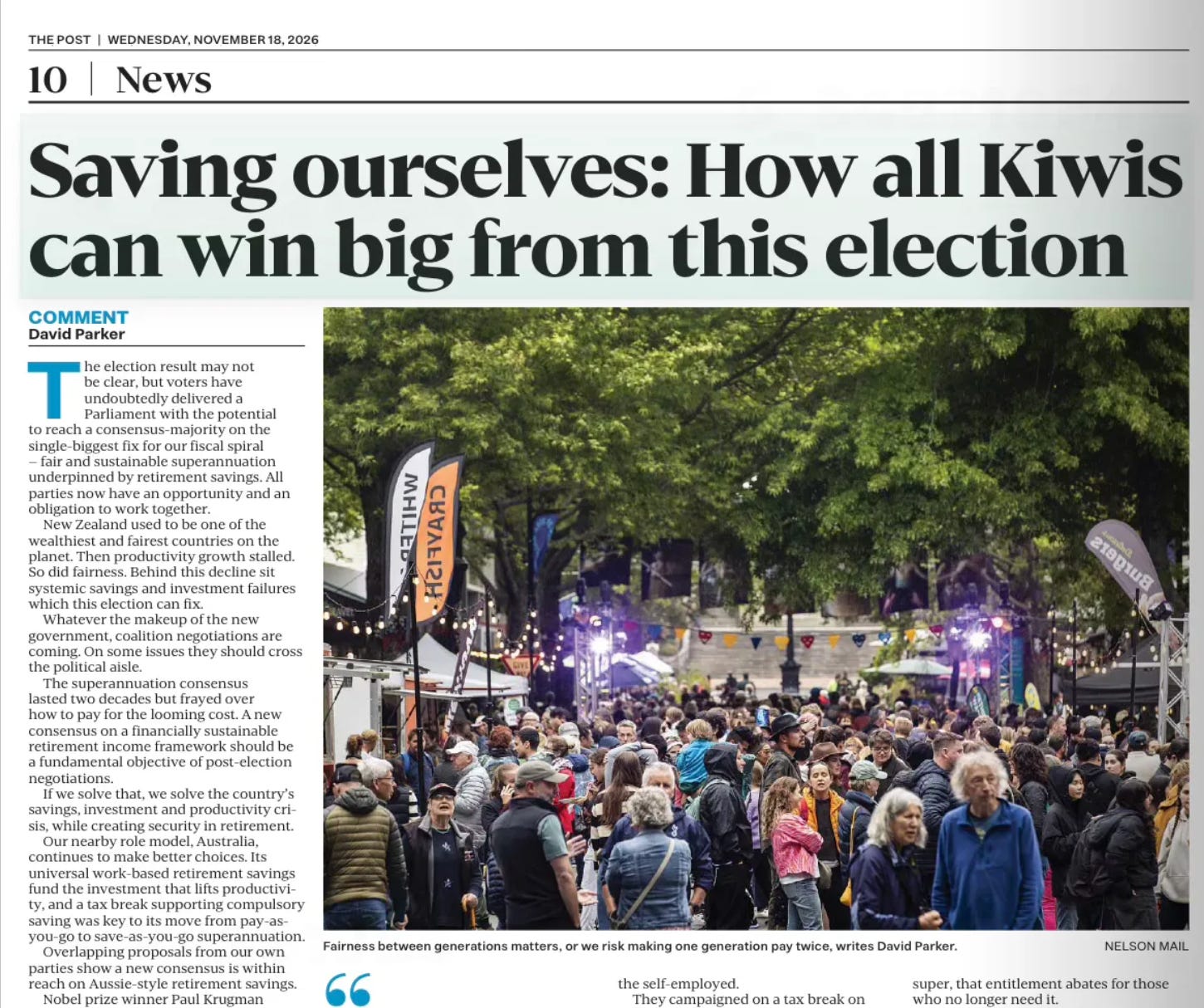
In starting this new Democracy Project series, I was inspired by an opinion piece written by former Labour minister David Parker. Published last Wednesday in The Post, Parker’s column was titled Saving ourselves: How all New Zealanders can win big from this election (paywalled), and it made a pitch for a new attempt to resolve one of the biggest and most interconnected problems in the New Zealand economy: superannuation, savings and low productivity.
This is one of the oldest problems in New Zealand politics: how retirement is paid for, and what a low-saving economy does to wages. New Zealand pays a universal pension out of current taxes. As Parker notes, Treasury’s pre-election figures put NZ Super at $26.5b this year, against $22.2b for all education from preschool to university. By 2030/31 the gap widens to $32.9b against $22.0b.
The other half of the problem is what never got built. Australia has had compulsory retirement saving since 1992, and that pool of capital is invested in businesses and infrastructure. On figures that David Parker used last week, Australians retire with more than five times the savings of New Zealanders, capital per worker has grown by 2.4% a year there against 1.6% here, and Australian wages are now 30 to 40% higher. Treasury Secretary Iain Rennie said in a speech in February that 20 to 40% of New Zealand graduates leave, “often in their peak earning years”.
None of this is new. A compulsory scheme was legislated in 1974 and scrapped after the 1975 election. Another was put to a referendum in 1997 and rejected by more than 90% of voters. Since then, New Zealand has gained the New Zealand Superannuation Fund and KiwiSaver, but successive governments keep tinkering with the details of both, and there is still no long-term consensus on either.
Parker’s pitch
Parker’s thoughtful and serious column is an attempt to break the pattern of paralysis in retirement policy and low national savings. He argues that the new Parliament has a chance to settle superannuation and savings together, across party lines, whoever ends up governing.
His proposal is a trade. Retirement savings would get the favourable tax treatment they have in most of the OECD, including Australia, where contributions and earnings are taxed at 15%. Parker is blunt that this is “fiscally unaffordable” by itself. It would have to be paid for by reducing NZ Super for people with large private incomes, by raising the age of eligibility, or both.
The conditions he attaches are that change should be gradual and leave no one worse off, and that no generation should pay twice, once for their parents’ pensions and again for their own. He also offers a new idea: that Budgets be required by law to show the fall in the country’s unfunded pension liability alongside the cost of any savings tax break. At present only the cost is reported.
There is a lot to respect in how Parker has gone about this. During the campaign National, NZ First and Opportunity all promised compulsory KiwiSaver, and Labour promised compulsory employer contributions. Neither major party offered workers tax relief in return, and neither tied compulsion to the future of NZ Super. Ruth Richardson argued that compulsion alone charges workers twice, and NBR’s Tim Hunter that it “makes no sense without change to NZ Super”. Parker has named the missing half of the bargain and put a price on it, which neither major party did before the vote, and which sits well outside what his own party campaigned on.
Parker is optimistic that the country is at the point where change might occur: “With broad understanding in society and Parliament of the productivity case and the Australian comparison, the time is ripe for political leadership to chart the way forward.”
His opinion piece prompted an immediate response. The day after it appeared, National and Labour both restated to The Post’s Anneke Smith their willingness to work across Parliament on superannuation. National said it was too early to say what a deal would look like, and Labour wants aged care on the table as well – see her report, National, Labour recommit to cross-party work on superannuation (paywalled).
Coincidentally, on the same day that Parker’s call for change appeared, Keith Woodford, a former Lincoln University professor, published his own think piece: How do we solve the superannuation problem? In this, Woodford notes “a widespread belief that superannuation in coming decades is going to be a major problem for New Zealand” but believes that “the current debate is not well informed”, and he can’t see any reform being successful without “a strong level of consensus across the political spectrum”. Like Parker, Woodford looks to the Australian reforms and their tax arrangements, though more cautiously. He stresses what the tax concessions cost and that New Zealand’s conditions differ.
The catch
Taking Parker seriously is not the same as accepting his prescription, and the polling shows why any deal will be hard. An RNZ–Reid Research poll in July found 70% support for compulsory KiwiSaver. When it was bundled with a higher pension age, support fell to 38%.
There is also the question of who is meant by “ourselves” in a column headlined “Saving ourselves”. Natalia Albert notes that around 40% of people over 65 have “virtually no income other than Super”. The Financial Markets Authority’s latest report records 1.42 million KiwiSaver members who put nothing in over the year to March. A worker on $1,000 a week would see $60 leave their pay at a 6% contribution rate, while their taxes went on paying for today’s pensions. For that worker, the terms of the trade matter more than the principle.
Those terms are the subject of today’s second column below, for paid subscribers. It looks at the economists, such as Leonard Hong and Robert MacCulloch, who argue that retirement policy is really investment policy, at whether more saving would mean more investment in New Zealand, and at three questions any deal has to answer: who saves, who pays, and who profits.
Dr Bryce Edwards
Director of the Democracy Project