

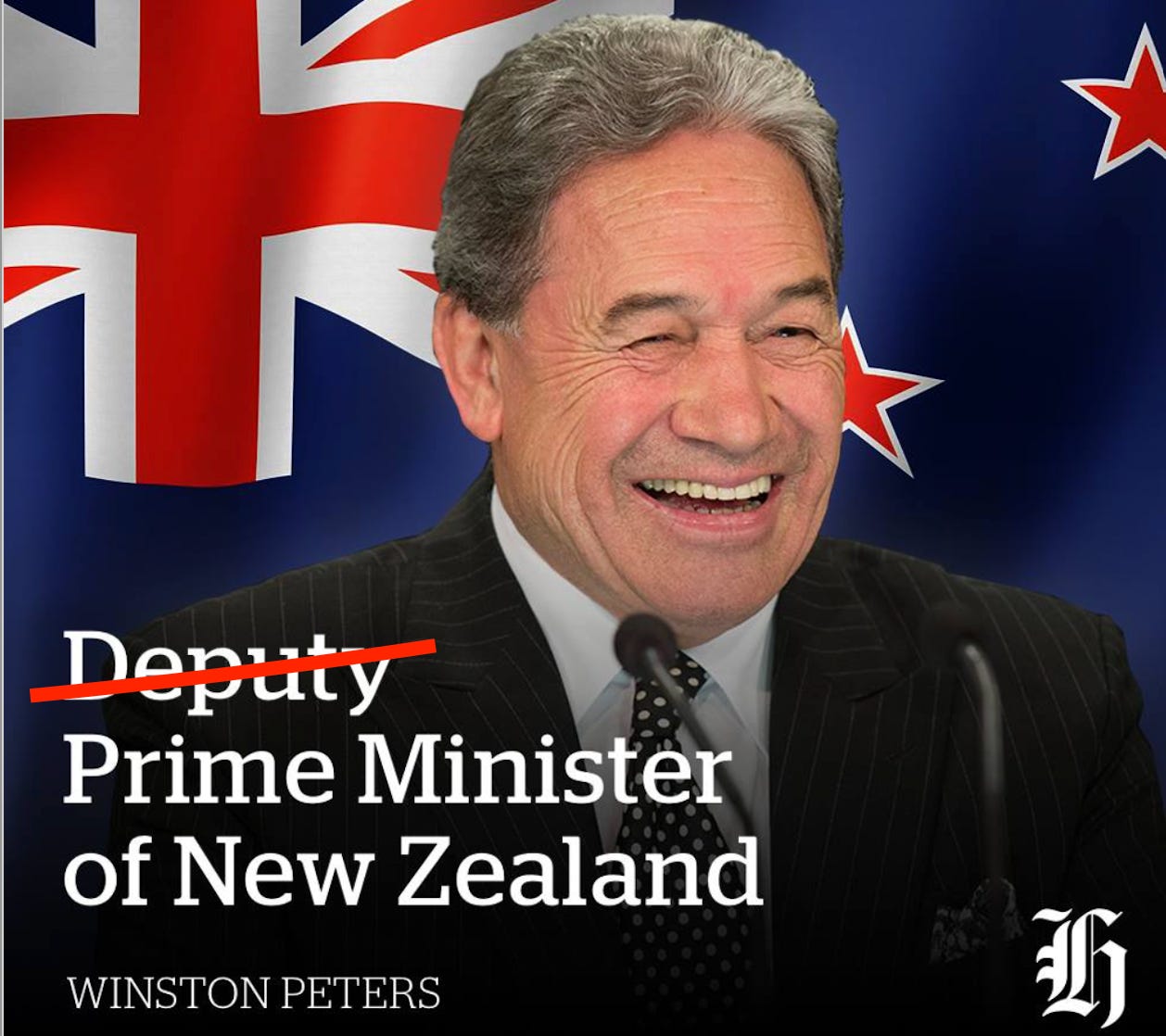
New Zealand First is in the ascendancy, and there are signs that 2026 could turn out to be the party’s best in its three decades of existence. Could it even lead to Winston Peters winning his ultimate prize role: Prime Minister?
Political commentator Matthew Hooton is very well connected to insiders in the New Zealand First party, and as a result, produced an insightful column on Friday for the Herald about the party’s internal thinking and strategy. He signals that NZ First is pivoting towards Labour voters (to steal them), building the party’s support into “medium-sized party status”, all with the intention of leveraging this to demand the post-election prize of leading the next Government, with Peters in charge.
It’s audacious, yet plausible. And it certainly fits in with other observations that 2026 is likely to be “The Year of Winston Peters”.
Two Successful years in government
Peters appears to have broken the “curse of minor coalition partner” – in which smaller coalition partners tend to be overshadowed and damaged in MMP governments. As Hooton points out in this column, “the NZ First leader has finally worked out not just how to be part of a coalition Government and remain above 5%, but to grow his vote.”
NZ First is certainly polling strongly while in government, ending 2025 around 9% support after entering Parliament in 2023 with 6%. This is almost unprecedented for a party that historically bleeds support on the government benches. What’s more, Peters has even become a firm third-place contender for preferred Prime Minister in the polls, Hooton notes, “not too far behind the hapless Christopher Luxon and invisible Chris Hipkins.”
The Two Winstons: Statesman abroad, firebrand at home
Peters’ resurgence relies on a strategy of maintaining two distinct personas. As Foreign Minister, he has cultivated the image of a polished elder statesman on the world stage – the Winston Peters who dons a pinstripe suit and toasts alliances at international forums. But diplomats reportedly joke there are “two Winston Peters”: Dr Jekyll abroad and Mr Hyde at home.
The first Winston has spent over 200 days overseas this term, visiting dozens of countries and skilfully handling big-power diplomacy from Washington to Beijing. This statesman Winston projects stability and gravitas, bolstering Peters’ case that he brings experience and credibility rival leaders lack.
Then there’s the Winston Peters that New Zealanders see back home: the rabble-rousing populist who returns from those diplomatic trips only to lob grenades at his own Government. This is Peters in full Mr Hyde mode, attacking “woke leftists” and outflanking his coalition partners whenever it suits. He has made a point of prising open daylight between himself and the National-led government he’s technically part of. Time and again, when Prime Minister Luxon’s administration stumbles or pushes an unpopular policy, Peters finds a way to differentiate NZ First from its partners.
He has played a risky double game throughout 2025: simultaneously a core member of the Government and its loudest internal critic. For instance, after National floated the idea of future asset sales, Peters publicly scolded Luxon’s team (“we have a coalition agreement which says there will be no asset sales!”), casting himself as the defender of Kiwi assets against his own allies. He’s also vowed to repeal Act leader David Seymour’s flagship Regulatory Standards Act, openly repudiating the policies of his coalition partner.
This strategy is calculated. By acting as both insider and outsider at once, Peters maintains his anti-establishment brand and inoculates NZ First against the usual fate of minor parties that get tainted by governing. It’s an audacious balancing act. And so far, it’s working.
Riding the populist zeitgeist
Peters’ blend of left-leaning economics and right-leaning cultural politics has always been his core political brand. In 2026, it’s proving more potent than ever, largely because the political zeitgeist has caught up with him.
As Hooton points out in his Friday column, globally, nationalist-populist movements have gone mainstream – from Trump’s America to Meloni’s Italy and beyond – mixing economic nationalism with culture-war grievance. Peters, who founded NZ First back in 1993 on an anti-globalisation, anti-elite platform, suddenly finds the currents flowing his way. What once seemed like cranky anti-establishmentism now looks prescient. Hooton says: “NZ First is New Zealand’s only anti-globalist, nationalist party: unashamedly patriotic, socially conservative, anti-woke and driven by self-declared ‘commonsense’.”
This international tailwind makes it easier for Peters to sell NZ First’s message at home. Voters frustrated with the status quo see kindred movements overseas and are more receptive to Peters’ rhetoric. In effect, the world has moved toward Winston’s long-held positions. That shift has allowed NZ First to rebrand not just as a centrist kingmaker between National and Labour, but as a movement in its own right, tapping into a global backlash against elites. Peters’ nationalism, scepticism of free-market globalisation, and law-and-order tub-thumping all feel “of the moment” in a way they didn’t a decade ago.
Targeting Labour’s working class base
Central to NZ First’s 2026 strategy is a concerted raid on Labour’s voter base. According to Hooton’s column, Peters and his lieutenants aren’t too worried about siphoning support from National or Act this time, as the big prize is disaffected Labour supporters, particularly working-class and socially conservative voters who feel abandoned by the Labour Party’s liberal turn.
Hooton argues that Peters is casting NZ First as the country’s true “workers’ party” and deriding Labour as the “wokesters’ party.” Peters proclaims: “We are the only party relating to ordinary working-class New Zealanders”. His goal, according to Hooton, is to “gut Labour” over so-called woke politics. Peters wants to convince blue-collar Labour voters that NZ First represents their values and economic interests better than the Labour Party does.
There’s evidence that this approach can work. Roughly half of NZ First’s voters in 2023 were people who had voted Labour in 2020, according to academic analysis of voter surveys. Hooton says: “Since the mid-2010s, Labour’s and NZ First’s polling has tended to move inversely, suggesting they compete for the same voters.”
Peters is angling to flip that dynamic decisively in 2026 by reeling in Labour’s disgruntled base. He has even resurrected language straight from Labour’s traditional playbook: talking about putting a “responsible face of capitalism” and championing wage increases and social protections. (It’s a deliberate echo of his famous call for “capitalism with a human face” when he anointed Jacinda Ardern as Prime Minister in 2017.) By sounding almost Labour-like on economic issues, while trashing Labour’s focus on cultural liberalism, Peters hopes to peel off centre-left voters who feel Labour has lost the plot.
Act’s David Seymour has alleged that Peters’ pro-worker, interventionist rhetoric is a sign NZ First is preparing to do a deal with Labour. But most observers (and Peters himself) insist the opposite, and Hooton reports: “NZ First strategists say Peters is talking Labour language not to praise but to bury it”. NZ First’s strategy is to take Labour’s lunch, not share it.
Even Winston’s long-time ally Shane Jones has cheekily hinted that working with Labour might hold appeal – not out of any love for Labour, but as a way to punish the Greens and usurp Labour’s role as voice of the working class (especially working-class Māori). It’s likely bluster, yet it underscores the point: NZ First wants to replace Labour as the political home for a chunk of old-school, blue-collar voters. Peters is effectively auditioning to be the champion of “the little guy” that Labour once was, minus what he derides as Labour’s obsession with pronouns, protest and political correctness.
Culture wars and political theatre
To capture those socially conservative Labour-leaning voters, and to energise his base generally, Peters has fully embraced a culture-war campaign. There is a segment of Labour’s 2023 support that holds traditional or nationalist views, and NZ First is going after them hard. Post reporter Henry Cooke recently noted that a sizeable minority of Labour voters harbour “anti-woke” sentiments (for example, many worry about crime and social disorder, or feel that being born in New Zealand is important to being a “true New Zealander”). Peters is tapping straight into those sentiments.
At NZ First’s annual convention in September, the party made its hard-right turn crystal clear. Delegates passed remits calling for New Zealand to withdraw from the Paris climate accord, to declare English an official language, and to impose a strict “Kiwi values” test on immigrants with the warning: if you don’t sign up to our values, don’t come. The message is unabashed nationalist populism: New Zealand First is trumpeting that it will make New Zealand great again, in its own Kiwi way.
On the parliamentary front, NZ First MPs have been churning out a flurry of private members’ bills engineered to grab headlines on hot-button cultural issues. They’ve introduced (and often later withdrawn) bills to legally define “man” and “woman” by biological sex, to ban any flag other than the New Zealand flag from government buildings, to force referendums on Māori co-governance, to repeal climate commitments, and even to mandate referendums on water fluoridation. None of these proposals has any chance of becoming law. In fact, many of the members’ bills are quickly abandoned. But generating legislative victories was never the point. It’s performative politics.
As the Spinoff’s Joel MacManus observed with some amusement, NZ First has created a series of provocative-but-temporary bills designed purely to stoke controversy and keep the party in the news. The tactic is obvious but effective: dominate the conversation with wedge issues and remind culturally conservative voters that Winston is on their side in the so-called culture wars. Peters insists this flurry of bills is put forward in good faith to highlight “the real issues” worrying everyday Kiwis. But even he half-admits it’s a way of rehearsing campaign talking points on gender, race, and nationalism well in advance of the election.
There is a darker dimension to NZ First’s culture-war resurgence, however. The party’s fire-and-brimstone rhetoric has attracted a new cohort of anti-establishment and conspiracy-driven supporters, many of whom were radicalised by the anti-vaccine and anti-government protests of recent years. Longtime political journalist Richard Harman reported from NZ First’s convention that the movement is experiencing an “existential crisis” of identity.
The 280 delegates who showed up in November were a record crowd, but a significant chunk of them were newcomers from the fringes – people who distrust science and mainstream politics. When a medical professional at the conference dared to defend vaccines and modern medicine, he was jeered. A discussion about climate change was met with laughter and derision. For a party that once prided itself on pragmatism, infrastructure, and regional development, this influx of conspiratorial paranoia poses a challenge: how to reconcile the anti-science, anti-elite crusaders with old-school NZ First supporters who simply want roads, jobs and regional investment? So far, Peters’ answer has been to double down on cultural grievance as the glue holding the factional tent together.
Shane Jones, ready to take over the leadership next term
One man enthusiastically stoking these flames is Peters’ deputy and presumed successor, Shane Jones. Officially elevated to deputy leader, Jones has been touring the country like a populist revival preacher, and he’s drawing notable crowds. Five hundred people showed up to hear him in Tauranga; 250 packed a hall in Lower Hutt; there were overflow audiences in Nelson and New Plymouth. Jones says: “People are thirsting and hungering… hankering for both change and boldness.” Never one for subtlety, Jones has explicitly compared his approach to Donald Trump’s.
At the convention, he bemoaned his own Government’s timid “managerialism” and called for “profound leadership” to shake up the system. He even warned that if his signature initiative (a fast-track infrastructure consent process) doesn’t start delivering results soon, “the campaign I will run will not only be Trumpian – you’ll hear about it in Australia.”
In other words, Jones is ready to take a blowtorch to the political establishment if given the chance. His brash, unapologetic style is a feature, not a bug, in NZ First’s campaign: it’s aimed at the many voters fed up with bland technocrats and craving a bit of entertainment and outrage with their politics. Peters has effectively deputised Jones to be NZ First’s Trump-like rabble-rouser on the trail, firing up the crowds with populist red meat. Between Peters’ own well-honed dog whistles and Jones’ barnstorming, the party is positioning itself as the voice for anyone sick of “woke elites” and eager to send a rocket through the system.
Populism, hypocrisy and integrity
Winston Peters relishes railing against the political establishment, but how well does NZ First live up to its anti-elitist, anti-corruption image? This term has seen the party’s support grow, yet questions linger about Peters’ consistency and integrity. For all his talk of governing “for the little people” and holding others accountable, Peters’ record is hardly spotless. In recent years, NZ First has shown a willingness to quietly embrace some of the very forces Peters used to crusade against. The party that once made a big show of fighting cronyism is now notably cosy with certain wealthy donors and lobbyists.
Peters has also executed some remarkable policy U-turns with little explanation. He is an adept political shape-shifter, and critics argue that his populism often masks a cynical opportunism.
Even NZ First’s parliamentary tactics raise eyebrows about sincerity. The flurry of members’ bills on culture-war topics – most of them quickly withdrawn or quietly dropped – underscores a pattern of prioritising headlines over substantive lawmaking. As noted, the party submitted 14 private bills this term and gave up on 10 of them soon after – a hit-and-run approach to legislating that treats Parliament as a stage for stunts. When a party uses up its limited bill slots on proposals it has no intention of seeing through, one has to question how serious it is about solving real problems versus simply trolling for publicity.
2026 Scenarios: Crown or Kingmaker?
All of this sets the stage for the biggest question: Will 2026 be the crowning moment of Winston Peters’ career, or just another reprise of his kingmaker act? Peters himself is setting the bar high. Having survived this term without the usual collapse, he’s openly aiming to “break new ground” in the next election.
As Hooton reports, NZ First’s strategists talk of making the leap to a medium-sized party, fundamentally breaking the National-vs-Labour duopoly and creating a three-bloc system. With both major parties currently polling historically low (around the low 30s each), Peters sees an opportunity to upset the old order. The party’s worst-case scenario for 2026, insiders say, is merely holding the balance of power again and Peters returning as Deputy PM – a role he’s already held three times. The best-case scenario, Hooton writes, could be something far more transformative.
NZ First strategists have mused: what if NZ First and National together won a majority, with Peters as Prime Minister? It sounds far-fetched – and indeed it is, under most conditions. Peters’ party would likely need to surge well into the teens for a Prime Minister Winston Peters to be a remotely plausible outcome. But in this volatile climate, one can’t rule anything out.
If Labour and National were both stuck around 25% and NZ First somehow climbed to, say, 15%, there would be enormous pressure on the majors to accommodate Peters’ demands. He could even just insist on a rotational prime ministership or a short stint in the top job as the price of his support.
Would that be democratic? Many would bristle at a scenario where a 10–15% party seizes the premiership. But the scenario speaks to the scale of Peters’ ambition heading into this campaign. For the first time, he’s openly dreaming beyond the kingmaker role.
Of course, other outcomes are also on the table. Left-right coalition mathematics aside, Peters could choose a path of maximal independence. Seasoned left-wing commentator Chris Trotter has speculated that NZ First might position itself on the cross-benches after 2026 – propping up a government on confidence and supply but not formally joining a coalition, thereby avoiding the compromises that come with ministerial posts. Trotter quips that “with woke clowns to the left of him and free-market jokers to the right, Winston’s offer to sit in the middle grows more appealing.”
It’s an intriguing idea: Peters could essentially tell both major parties, “you need me to govern, but I won’t formally join either of you – I’ll support whichever of you agrees to my priorities, case by case.” Such a stance would be unprecedented in New Zealand, but Peters loves to keep people guessing. It would certainly underscore NZ First’s independent brand.
On the other hand, it might also limit his ability to secure the big prizes that he’s enjoyed in past deals. Whether Peters would truly prefer the cross-benches to the Cabinet table is up for debate. History suggests he rather likes being in government, on his terms.
One thing is certain: Winston Peters is running a shrewd campaign in waiting. Long-time observers note that he’s “running the smartest race” of any politician right now (to quote commentator Vernon Small). He’s capitalising on the poor polling of his larger partners – as Newsroom’s Laura Walters warns, “watch out for Winston, the man set to gain from his partners’ pain.” Every stumble by National or Act, every misstep by Labour, is an opportunity for Peters to pounce and present NZ First as the competent, commonsense alternative.
He’s also diligently practising his greatest hits, as the Spinoff’s Catherine McGregor puts it, resurrecting the familiar themes and grievances that have worked for him before, from immigration fears to law-and-order outrage, so that by the time election season is in full swing, his message will be sharply honed and instantly recognisable.
Hooton also points to the new NZ-India free trade agreement as a perfect opportunity for the party: “NZ First strategists can’t believe their luck in National handing it the open immigration provisions of the proposed free-trade agreement with India without having locked in Labour’s support, meaning that issue will dominate the early part of the year. Ultimately, it’s assumed Labour will support the deal for fear of losing its Kiwi-Indian vote”.
Hooton says that the deal comes with conditions that play into NZ First’s talking points: it largely excludes dairy (prompting questions about New Zealand farmers being sold out), it dangles a promise that Kiwi businesses will invest a staggering $34 billion in India over 15 years (while New Zealand’s own infrastructure is starved of funding), and it offers more immigration access to Indian workers at a time when Peters is warning about pressures on housing and jobs. In short, the India FTA is a tailor-made issue for Winston to rail against – globalist policy elites undermining Kiwi interests, etc.
Shane Jones will be there to help. As The Post’s Ben Thomas points out this week, the deputy has already been campaigning against Indian immigration recently: “Shane Jones didn’t so much dip his toe in the topic of increasing Indian immigration as cannonball off a railbridge into it, with a diatribe about the prominence of the surname ‘Singh’.”
As he gears up for what will surely be his final campaign, the 81-year-old Peters truly has nothing to lose and everything to gain. It’s looking like he plans to bow out after this, handing the reins to Shane Jones. Therefore, Peters is throwing everything he’s got into 2026. He’s broken the mould that doomed him in previous coalitions, he’s surfing a wave of populist discontent, and he’s eyeing a legacy-defining role in reshaping New Zealand’s political landscape. Will 2026 be the big year that Winston Peters finally crowns his long career with real power, perhaps even the top job? Or will it simply be another chapter in the never-ending Peters saga: influential, yes, but ultimately more of the same kingmaker drama we’ve seen before?
Peters has positioned himself brilliantly for one last tilt at glory. Now it’s up to New Zealanders to decide how this final act plays out: a triumphant finale, or just an encore performance of populist theatre.
Dr Bryce Edwards
Director of the Democracy Project
Further Reading:
