

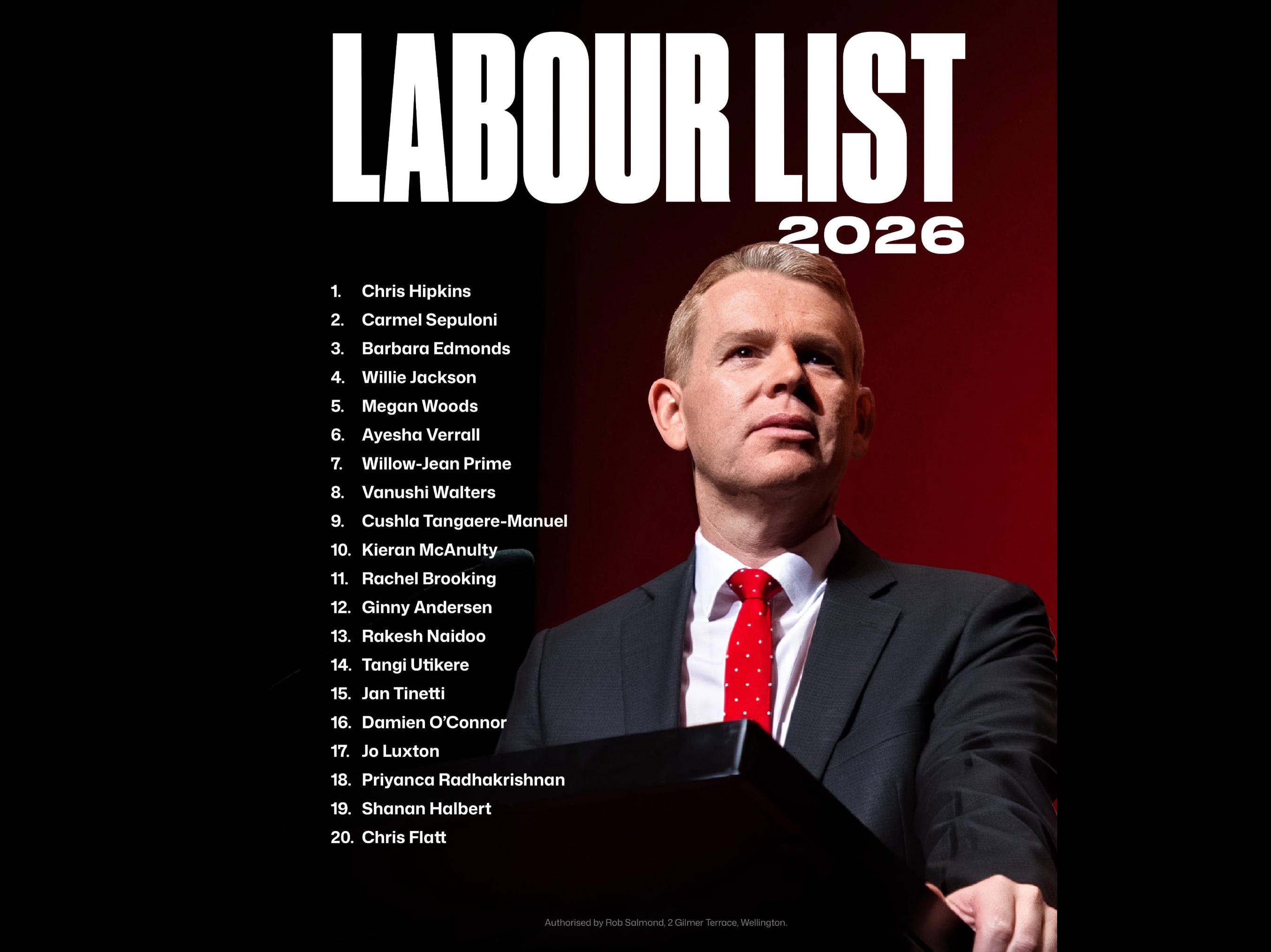
Greg O’Connor found out, one way or another, that there was no longer a place for him in Labour’s future. The outgoing MP for Ōhāriu had wanted to stay in Parliament. More than that, he had made no secret of his ambition to become Speaker if Labour returned to power. But his electorate was abolished in the boundary review, through no fault of his own. He then lost the contest for the replacement Wellington North seat to Ayesha Verrall. That left the party list as his only option. And then, over the weekend before Labour’s announced the details of their 2026 election list, he found he was not on it, or at least not high enough on it to continue.
A papal conclave with casualties
In departing politics, O’Connor has responded with a good line: “The Labour Party list process makes the choosing of a Pope look transparent”, explaining, “there’s so many moving parts to it.” He declined to say whether his decision not to stand followed a poor list placing: “What goes on between myself and the party — I’m not going to be commenting on that.”
It was a classic political exit: loyal enough not to start a war, honest enough to make the point.
O’Connor’s departure is a useful way into thinking about Labour’s 2026 list. Not because the whole story is about him, of course. But because his absence tells us what a party list really is. A party list isn’t a tidy administrative document — it’s a map of power, favour and identity inside Labour. It tells us who a party thinks it needs, who it is prepared to lose, and what sort of government it imagines it might become.
For Labour, the list matters more than it does for National. National tends to win more electorate seats when it is doing well. Labour, especially under MMP, often relies much more heavily on the list to construct its caucus.
Even when Labour does win a decent number of electorates, the list still decides not only who enters Parliament but who has status, who is being protected, and who is being quietly told to win an electorate or leave. Henry Cooke put it well in The Post: the list “will do much to shape the party’s next three years and more, whether or not it wins the election.”
Renewal without rupture
The governing logic of this 2026 list can be put quite simply: Labour wants to look new, but above all it wants to look safe.
That’s not a bad strategy. Any opposition party trying to return after a heavy defeat faces the same problem. Bring back too much of the old team and voters conclude you have learned nothing. Sweep too many people away and you look like a risky start-up rather than a government-in-waiting.
Newsroom’s Sam Sachdeva captured this neatly, saying Labour had “had a bob each way”, with several first-time candidates pushed high up a list that was otherwise “somewhat lacking in sparkle”.
That verdict is fair. This is a restoration list, not a revolution list. It says: we have refreshed ourselves, but we have not gone mad. We have new people, but not a new leftwing insurgency. We are different enough to ask for another look, but familiar enough to be trusted with the keys again.
The most important symbol of that managed overhaul is Barbara Edmonds. The first two list places are automatically reserved for Chris Hipkins and Carmel Sepuloni, so number three is the first genuinely political ranking. Edmonds has gone from 18th in 2023 to third in 2026.
This is the most persuasive part of Labour’s reset. Edmonds brings tax expertise, a personal story that reaches beyond Wellington, and a tone that suggests seriousness rather than slogans. She is not Grant Robertson 2.0, which is part of the point. Labour is trying to show that it has moved on from the Ardern-Robertson era without repudiating it.
Has Labour solved its talent problem?
Back in February, Listener columnist Danyl McLauchlan wrote a sharp piece about Labour’s “elite human capital” problem — the observation that the party’s biggest liability in the the last Labour government was its own caucus. “In six years they lost seven ministers, most of them under ridiculous circumstances,” McLauchlan wrote. “Much of the drift that characterised Jacinda Ardern’s government can be attributed to this lack of talent... This does not feel like a problem solved.”
The new list answers that criticism, but only partly. Labour does now have a wider pool of people who look as though they could do serious work. There are lawyers, unionists, public servants, community figures, business people, activists and technocrats. Ayesha Verrall remains strong in health. Edmonds is a real asset in finance. Vanushi Walters has been lifted dramatically, from being out of Parliament after the 2023 election to number eight. Cushla Tangaere-Manuel is now in the top ten. Reuben Davidson has climbed sharply.
Fresh faces, familiar networks
The new candidates are a good example. Labour has placed six first-timers in winnable positions: police superintendent Rakesh Naidoo at 13; dairy union leader Chris Flatt at 20; Waitangi Tribunal member Kingi Kiriona at 22; School Strike 4 Climate founder Sophie Handford at 26; activist lawyer and author Max Harris at 29; and KPMG Asia-Pacific chief executive Warrick Cleine at 30.
On paper, that is an interesting mix. Naidoo gives Labour policing and community-network credibility. Flatt brings old-school union experience with a rural and agricultural flavour. Kiriona brings Māori institutional experience. Handford gives the list youth and climate appeal. Harris brings intellectual energy from the activist left. Cleine gives Labour something it does not usually have much of: visible high-level business experience. Interestingly, he’s also a donor: he gave $8,000 in 2025 and a similar amount in 2024, on top of roughly $36,000 across 2020 and 2023, plus further funding to support Damien O’Connor’s West Coast campaign.
But the “fresh voices” framing should not be swallowed whole. Some of these candidates are fresh only in the parliamentary sense. Flatt was Labour’s general secretary from 2009 to 2012. Harris is a celebrated figure in the Labour-Green intellectual world. Kiriona comes from institutions that have long dealt closely with Labour governments. These are impressive people, and several may become strong MPs. But this is not an outsider revolt. It is Labour expanding its inner circle.
The placement of Craig Renney tells another story. The Council of Trade Unions’ chief economist is at 51, with a realistic route to Parliament only through a difficult electorate contest (winning Wellington Bays off the Greens’ Julie Anne Genter). If Labour wanted to advertise a bold economic-left turn, it had an obvious vehicle here but chose not to use him that way. Similarly, Handford and Harris are fresh leftwing activists, but not given very high list positions.
The paywall now starts at halfway through all Democracy Project newsletters. Please take out a paid sub if you want to support this service and access the full content, including the following sections: “The power map”, “The Naidoo problem”, “Representation is not a programme”, and “A better team, but for what?”.
