

The Green Party should be flying high right now. They’re not. As the 2026 election year begins in earnest, the Greens find themselves in a deeply anomalous position: polling has slumped, internal organisation has been shaken by staff departures and scandals, and the co-leaders seem strangely detached from the scale of their problems.
The political conditions could hardly be more favourable for an opposition party like the Greens. The National-led coalition government is struggling with economic headwinds and bickering coalition partners. Labour under Chris Hipkins has retreated into a kind of strategic hibernation, keeping its policy cards frustratingly close to its chest. This should be the Greens’ moment to shine, to rally disaffected voters and position themselves as the bold progressive alternative. Instead, they’re flailing.
What’s going on?
The Polling plunge
The numbers tell a sobering story. The Greens reached as high as 15 percent in some polls earlier in the parliamentary term. The 1News-Verian poll in December 2025 put them at just 7 percent. That’s a significant drop from their 2023 election result of 11.6 percent, and it places them at roughly a fifth of Labour’s support. For a party whose co-leader declared barely a year ago that she expected “far larger” support heading into 2026, the reality check is brutal.
The Post’s end-of-year political scorecard gave Chlöe Swarbrick a 6.5 out of 10, noting she had “held it together through another very tough year” and remained “incredibly capable, incredibly angry, and the party’s best performer in the House.” But the assessment was tempered: “She has definitely had stronger years.” Harriet Laughton, also writing in The Post, captured the mood succinctly: “It’s been an eventful term so far, including this past year, with controversies, resignations and slipping public support.”
Co-leader Marama Davidson, reflecting on the year with journalists Julia Gabel and Thomas Coughlan, sounded weary. “It does feel harder, the political environment. I thought it was tough already,” she said. “The nature of it, maybe even the media sensationalism doesn’t really humanise us.” There’s something poignant about that admission. But blaming the media for not humanising politicians is a curious complaint from a party that has struggled to humanise itself through a parade of self-inflicted disasters.
The shift in Swarbrick’s public demeanour is notable. Once the “cool” outsider who told a heckler “OK Boomer” and became a millennial icon, she now often comes across as weary and defensive. The youthful energy has been replaced by drier, more technocratic messaging. The vibes are off.
A Squandered opportunity
Here’s the puzzle. The political stars should be aligning for the Greens. The Coalition Government has pushed controversial legislation, from the Treaty Principles Bill to fast-track infrastructure projects that override environmental protections. Public submissions overwhelmingly opposed many of these measures. The Government has handed the Greens an abundance of targets.
Meanwhile, Labour has been oddly quiet. Hipkins appears to be running a “small target” strategy, hoping the government defeats itself through overreach. This vacuum on the left should be exactly where an energetic, policy-driven minor party steps in to capture the disenchanted. The Greens released detailed policy documents throughout 2025, including an industrial strategy, a comprehensive Green Budget, and a fiscal strategy that challenged core assumptions of the Public Finance Act. They did the homework.
Yet none of it translated into increased support. The Greens made plenty of noise over environmental rollbacks but failed to convert that into votes. Why?
Own goals
Part of the answer lies in the relentless parade of own goals. The scandals and departures this term have been extraordinary. Elizabeth Kerekere. Darleen Tana and the migrant exploitation affair. Golriz Ghahraman’s shoplifting scandal. Benjamin Doyle’s bizarre social media controversy and subsequent resignation. Each incident consumed media cycles and sapped morale.
Then came the embarrassing moment in October when Davidson failed to show up on time for the second reading of her own Right to Repair bill, causing it to be discharged from the House. She apologised for being “20 seconds too late.” It’s hard to claim you’re ready to lead the country when you can’t make it to the chamber for your own legislation.
The Staff exodus
Behind the scenes, 2025 was even messier. The party’s senior staff ranks were decimated. Chief of Staff Eliza Prestidge-Oldfield resigned in September, citing health and wellbeing concerns. Director of communications Louis Day followed weeks later. Senior press secretary Johnny Blades also departed, along with other media team members. Such an exodus of top aides in the lead-up to an election year is alarming. It signals internal turmoil and burnout that no amount of positive spin can paper over.
The late-2025 hiring of respected former MP Kevin Hague as the new Chief of Staff was presumably intended to steady the ship. But the damage to perceptions had already been done. How can a party claim to be ready to “lead the next government” when its entire senior communications team walked out the door within weeks of each other?
The Hubris problems
This brings us to the hubris problem. Barely a year ago, Swarbrick told the party’s AGM: “We can and we will lead the government in the not-too-distant future. I mean it to the core of my being.” She urged members to build “the biggest Green movement the world had ever seen.”
Journalist Graham Adams observed that “a year and a half later, those ambitions look increasingly detached from reality.” At the August AGM, Swarbrick described the Greens as “a vehicle for political change, the big ideas factory.” Adams was unsparing: “A ‘big ideas factory’, staffed by what she called ‘a bunch of earnest nerds’, is a far cry from supplanting Labour. In short, Swarbrick’s fever dream has broken.”
The mismatch between rhetoric and reality has become part of the problem. The more the Greens talk about “leading the left” while sitting on single-digit polling, the more they look like they’re drinking their own Kool-Aid.
Denial and blame-shifting
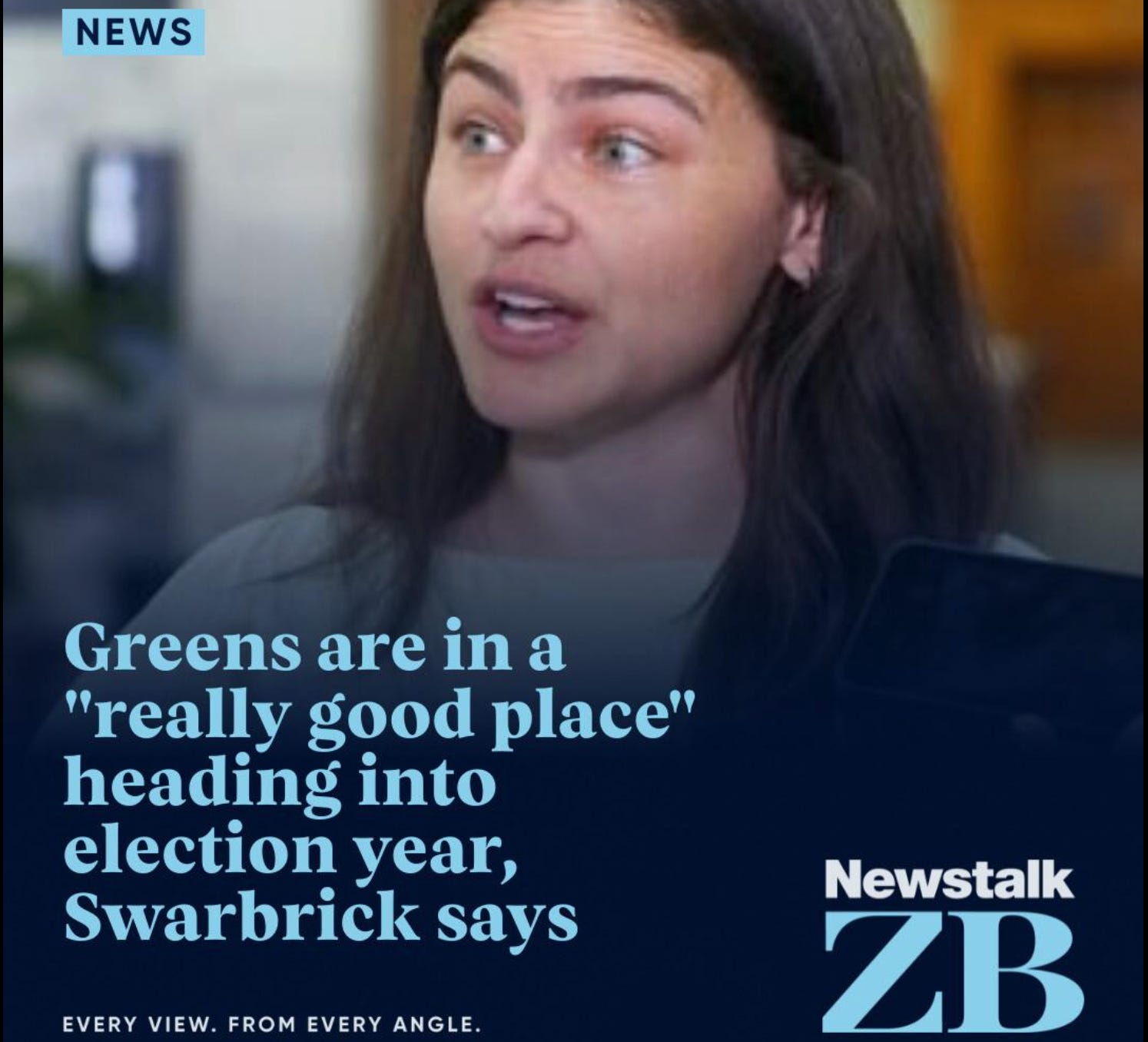
Perhaps the most troubling sign is the apparent denial. Despite everything, Swarbrick recently told Newstalk ZB she thinks the party is “in a really good place” heading into election year. When pressed on falling support, the explanations offered by the co-leaders have been curious.
Swarbrick argued that the polling drop was caused by the Government passing unpopular bills: “The Government is trying to disengage people from politics,” she said.
This is extraordinarily weak. And it’s analytically backwards. Unpopular government legislation usually galvanises opposition support. If voters were outraged by the Government’s agenda, they should be flocking to the opposition, not tuning out. The fact that anger at National hasn’t translated into Green support suggests a failure of Green strategy, not some Government conspiracy to suppress civic engagement.
If voters were truly outraged and saw the Greens as the alternative, Greens support should be rising as people seek a vehicle for their anger. By claiming the Government has successfully disengaged voters, the co-leaders are admitting they’ve failed to mobilise discontent. It’s a victimhood narrative that absolves the party of responsibility for inspiring and organizing.
Then there’s the social media excuse. Swarbrick told Newsroom’s Fox Meyer that her Instagram stories, which once reached 20,000 views, now barely hit 1,500. She suspects algorithmic shadow-banning over her stance on Palestine. Davidson echoes the sentiment, reminiscing about videos that once drew a million views versus today’s handful. The blame falls on “tech billionaires” and the “outrage-generating machine” that social media has become.
There’s something to this. Algorithms have shifted. But the narrative of conspiracy conveniently sidesteps harder truths. Social media platforms changed for everyone, not just the Greens. Perhaps their content simply isn’t resonating the way it once did. Perhaps a party that now encompasses everything from climate economics to gender theory to Treaty justice gets lost in a crowded information space. Perhaps voters distracted by a genuine cost-of-living crisis don’t have bandwidth for the Greens’ post-materialist focus that speaks mainly to affluent inner-city voters.
Rather than confronting these possibilities, Swarbrick’s solution was to suggest everyone in the party “touch grass” and have face-to-face conversations instead. It’s presented as a return to authentic politics. But it also sounds like a retreat from the digital sphere that once fuelled the party’s rise. For a politician whose breakthrough came through social media savvy, the pivot to dismissing online activism as an “outrage-generating machine” reads as an admission of defeat.
Andrea Vance delivered one of the sharpest verdicts, describing the Greens as “a caucus of anarkiddies posting out a social-justice clickbait.” Chris Trotter questioned whether anyone beyond the party’s “welded on supporters” would buy a promised return to environmental fundamentals “from Chloe ‘keffiyeh’ Swarbrick and Marama ‘It’s all the fault of cis white males!’ Davidson.” Harsh, perhaps, but these critiques point to a real perception problem the Greens have done little to address.
The party appears to be in a state of structural denial. Instead of hard introspection, the leadership has retreated into conspiracy theories about algorithmic suppression and deflection about government disengagement. Arrogance and hubris are holding them back.
What next?
As 2026 unfolds, the question is whether the Greens can course-correct before it’s too late. They enter election year with their poll numbers trending down, their internal organisation in flux, and their strategic positioning unclear. My next column in this series will examine what’s driving this predicament, from the party’s entanglement in culture wars to the declining salience of climate change and the failure of their social media strategy.
For now, friendly observers could be forgiven for asking: have the Greens lost their way?
Dr Bryce Edwards
Director of the Democracy Project
Further Reading:
