

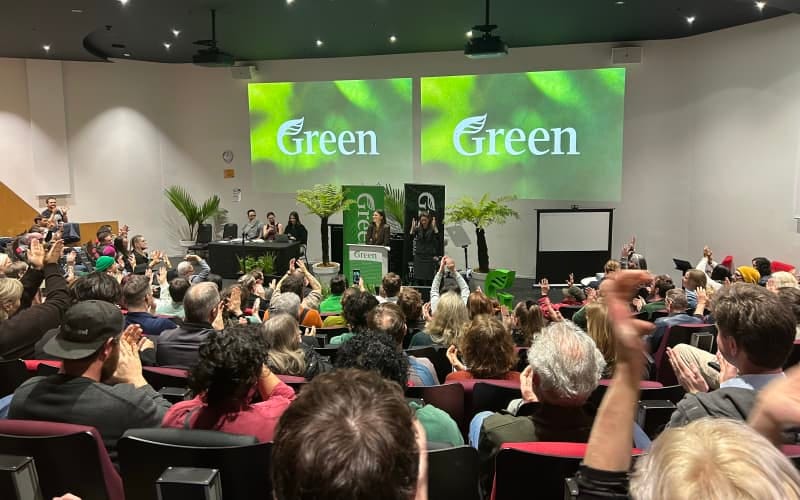
Chlöe Swarbrick had an unusual message for Green Party members at the weekend: stop talking only to people who already agree with you.
Launching the party’s election manifesto in South Auckland, Swarbrick said the Greens needed to speak to people they did not know and even those they did not like. No one would accept new information, she warned, if they felt under attack or believed they were losing.
This sounded like a rebuke to her own party. The Greens can appear culturally narrow, self-righteous and more comfortable condemning people than persuading them. Yet little of the wider anger about living costs, corporate power and failing public services appears to be flowing to the Greens. A recent Talbot Mills poll put the party on 9%, below the 11.6% it won in 2023.
The weekend’s answer was its new campaign slogan: “For All of Us”. The party revived its old “Buy Kiwi Made” politics, talked repeatedly about people’s “material needs”, and promised to put electricity prices, tax and water at the centre of its election campaign.
Most of the policies were familiar. What changed was the way the Greens presented themselves. They want to look less like a political subculture and more like a broad movement capable of speaking to people who are unhappy with the country but do not yet see themselves as Green voters.
At the very least, the AGM showed that the Greens recognise their political problem. Whether the party itself has changed is harder to know.
A Green Party for people it does not like
Swarbrick told RNZ that the party was fighting for the basic rights to food, healthcare, shelter, education and job opportunities not only for “the people that we know and like”, but also “for the people we don’t know and even those we don’t like”.
In her speech to members, she made the lesson more explicit. The Spinoff’s Hayden Donnell reported her saying: “No one is ever going to be able to empathise with your worldview if they feel that they are under attack. No one is ever going to be able to accept new information if they feel they are losing. If we want to win, we’ve got to win together.”
Donnell described this as “a plea for a broad-based Green Party that welcomes in new voters rather than browbeating them”. He’s right. The speech was partly a message to Green activists about how they conduct politics.
Stuff’s Isaac Davison also highlighted Swarbrick’s call to move away from “bloodsport politics”. Rebuilding the country and expanding the Green movement would require “building connection, and building trust”, she said: “We have to talk not just to each other, but to those we’ve never talked to before.”
In political terms, the slogan “For All of Us” is an attempt to move the Greens towards a more universalist politics, and away from identity politics. Progressive parties have increasingly organised themselves around the recognition and protection of particular groups. Although that can be valuable, it can also produce a politics that looks like a collection of separate and divisive claims rather than a common programme for society.
The universalist promise is simpler: everyone should be able to rely on decent housing, healthcare, education, energy and income security. That is potentially more powerful than asking voters to identify with the internal culture and language of the Green Party.
Making that turn is harder than announcing it. The Greens would have to listen seriously to people who disagree with them, including socially conservative voters and those whose livelihoods might be disrupted by Green policies. Persuasion would have to take priority over declaring which side of history everyone is on.
The new message also sits awkwardly alongside some of the party’s other rhetoric. A week before the AGM, Marama Davidson called the coalition Government “a pack of bastards”.
When The Hui presenter Julian Wilcox suggested that was harsh, Davidson replied: “It’s not harsh enough, Julian. The real-life damage that they have been doing to people, women, disabled people, Māori, the trampling over Te Tiriti, the absolute desecration of our tāiao, our living systems. There’s far stronger words. I’m being mild.”
Davidson also attacked Opportunity because it had not ruled out supporting National. She said the party remained open to keeping “Luxon and that bastard government in power”.
Davidson had valid grounds for anger. She pointed to the cancellation of pay equity claims, falling real incomes, high rents and environmental damage. But when she describes opponents in those terms it’s then hard to call for an end to bloodsport politics. It makes it easier for critics to conclude that “For All of Us” means everyone except those who vote for the wrong parties.
The “real New Zealand First”
Another revealing part of Swarbrick’s speech was her attempt to reclaim the language of nationalism from Winston Peters. She reached back to the Greens’ 2005 Buy Kiwi Made initiative and argued that New Zealand needed to support local jobs, production and infrastructure. “We’ve got to buy Kiwi-made. We have to build Kiwi-made,” she said. “That might just be what I mean when I say we are the real ‘New Zealand first’ party.”
Behind the joke was a serious strategy: a form of economic patriotism, or progressive economic nationalism. Rather than defining the national interest mainly through immigration, borders and cultural grievance, Swarbrick is defining it through ownership, production and economic security.
The manifesto promises to revive Buy Kiwi Made, direct more government procurement towards New Zealand firms, strengthen regional industry and use public ownership to reshape the electricity sector. NBR’s Brent Edwards reported Swarbrick saying that Kiwipower was intended not only to lower household bills, but to protect the country’s ability “to make and grow what New Zealanders needed”.
This places her in the same international milieu as British Green leader Zack Polanski. Swarbrick has pointed to Polanski and New York mayor Zohran Mamdani as politicians who succeeded by concentrating on “cost of living, affordability and improving lives for regular people through people power”.
Polanski calls his approach “eco-populism”: connecting environmental policy to bills, rent, wages and public ownership, while directing anger towards concentrated corporate power. Unlike the versions offered by New Zealand First or Donald Trump, this populism defines the divide as being between households and communities on one side, and banks, monopolies, and large asset owners on the other.
Stuff columnist Verity Johnson recently drew out what the left- and right-wing versions have in common. She argued that Swarbrick and Peters were “the same person in different pants”: both understood “ordinary, 70k a year anger” at housing costs, grocery prices and governments’ failure to confront entrenched corporate power.
Johnson’s comparison only goes so far. But Peters has been effective at identifying discontent, even when his solutions are unconvincing. The Greens’ opportunity is to acknowledge the same anger while directing it towards economic ownership and concentrated power.
The paywall now starts partway through all Democracy Project newsletters. Please take out a paid sub if you want to support this service and access the full content, including the following sections: “The return of material politics”, “Who gets New Zealand’s power?”, “Opportunity and the problem of the Green record”, “The test of credibility”, and “Has the party turned a corner?”.
