

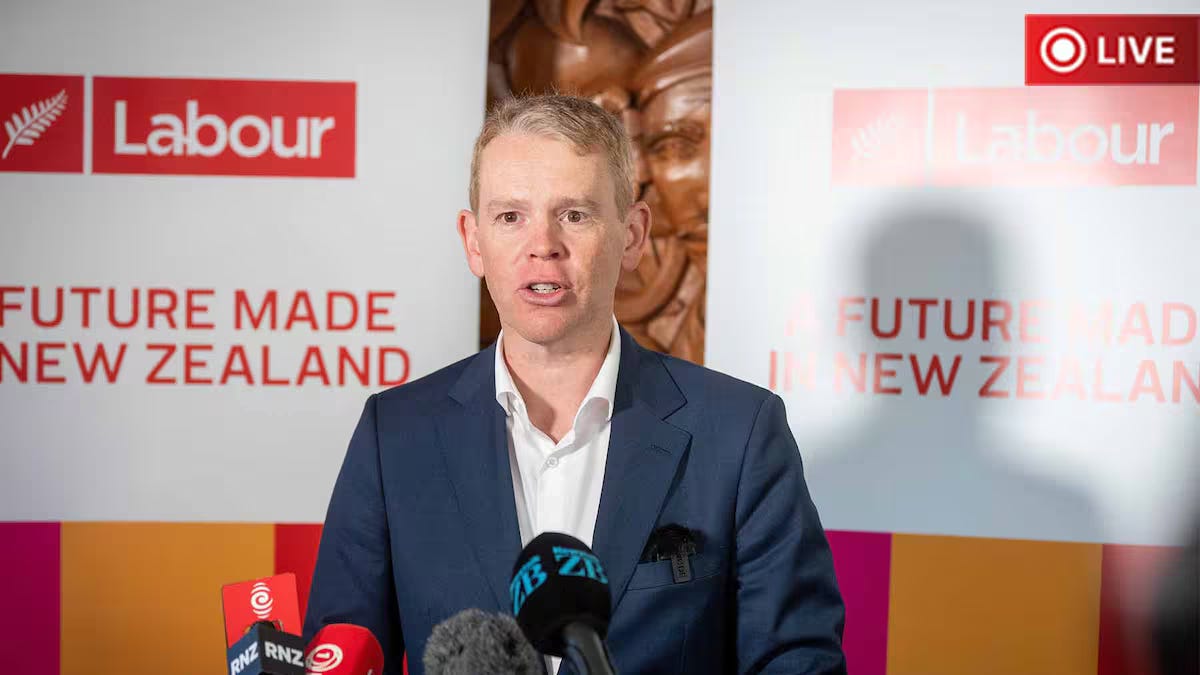
Chris Hipkins delivered his State of the Nation speech this afternoon in Auckland, and the verdict is clear enough: there wasn’t much in it. No new policy. No surprises. No real detail on how Labour would govern differently. It was, by design, a low-key affair. The question now is whether voters see this as strategic discipline or something less flattering.
The speech, delivered to the Auckland Business Chamber and hosted by former National leader Simon Bridges, was a restatement of themes Hipkins has been road-testing for months. Cost of living. Jobs. Health. Homes. Affordability. If you’ve been paying any attention to Labour’s messaging since early this year, nothing in the speech would have caught you off guard.
And that’s precisely the problem.
A Speech full of slogans but short on substance
Hipkins unveiled a new campaign slogan: “A future made in New Zealand.” He also repeated the familiar refrain of “Jobs. Health. Homes” (though he insisted this was “not a slogan, a to-do list”). Whether voters find that convincing remains to be seen. Slogans dressed up as action plans are still slogans.
The speech’s centrepiece was the word “affordability”, which is a term Labour has borrowed, quite deliberately, from the political vocabulary of New York City’s new mayor Zohran Mamdani. As Henry Cooke and Luke Malpass of The Post observed after Labour’s conference last year, the branding may look like Mamdani’s, but the policies don’t. Mamdani ran on free childcare, city-run grocery stores, rent freezes. Labour is offering three free GP visits and a targeted capital gains tax. The style borrows from Mamdani; the policies emphatically don’t.
Hipkins hammered the Government relentlessly on the economy: “People are working harder than ever and falling further behind. Groceries cost more. Power costs more. Insurance costs more”. And: “New Zealanders were promised the cost of living would be fixed. Two years later, it’s worse.” He was blunt about the Coalition’s direction: “There is no plan. New Zealand is stagnating.”
Fair enough. But a political leader who criticises the Government for lacking a plan needs to have one of his own. And today, we didn’t get one.
Waiting for the Budget, or just waiting?
The most telling aspect of the speech was what was missing. As The Post’s Amelia Wade reported, Hipkins signalled that major policy announcements would have to wait until after the Government’s Budget in May, which she said is “a move aimed at projecting fiscal restraint.” Wade also reported that Labour would avoid “large, complex reform programmes.”
This is being framed as discipline. Labour got burned last time by its failure to deliver key programmes such as KiwiBuild, light rail, Three Waters. Hipkins is acutely aware of that legacy: “Let me be clear: I want to know that I can deliver on any promises that I make. Frankly, Kiwis have had enough of promises that aren’t kept.”
That line drew the clearest link between today’s speech and the trauma of Labour’s 2023 landslide loss. Hipkins is still doing penance for the sins of the last government. He explicitly acknowledged Labour had “tried to do too much, too fast, and we lost our focus.” He’s pledged not to try to do everything in the first term.
It is a reasonable position. But it’s also a convenient one. We are now nine months from the election. Labour has been in opposition for over two years. And yet, beyond the capital gains tax and three free GP visits, the policy cupboard looks fairly bare. Finance Minister Nicola Willis wasted no time making that point in response, declaring Labour “two years into Opposition and devoid of any new ideas.” Last week on Morning Report, Willis skewered Labour deputy Carmel Sepuloni for being unable to articulate a single policy that would boost productivity. “You never do because you don’t have any,” Willis said.
Hipkins will argue that patience is a virtue, and that he’s being careful and costing things properly before making promises. And there’s something to that. But voters in the middle are entitled to wonder: if Labour won’t tell us what it stands for, why should we vote for it?
The Newstalk ZB and Herald reports noted that Hipkins said a future Labour government would need multiple terms to achieve its promises. That’s a stark departure from the party that promised to have most of Auckland’s light rail built in a single term and to be building 12,000 KiwiBuild homes a year. Neither happened. So the downgrading of expectations is understandable. But a party that now promises to do less also needs to be much more specific about what it will do.
Climate change: suddenly on the agenda
One of the more interesting aspects of the speech was how much space Hipkins devoted to climate change. This is notable because, at Labour’s December party conference Hipkins didn’t mention climate change at all. Not once. Yet here it was today, front and centre.
What changed? Almost certainly the summer’s extreme weather. The deadly Mount Maunganui landslide in January, which killed six people after a hillside collapsed onto a campground, shocked the country. You don’t need to be a political strategist to see how events like that create political urgency around climate.
Hipkins was critical of the Government for cutting “$3.2 billion from the very fund designed to prepare us for what’s coming.” He argued that “the cost of inaction on climate change now far exceeds the cost of action” and said Labour would invest in renewable energy, positioning New Zealand as a “renewable energy superpower.” He also confirmed Labour would scrap the Government’s proposed LNG import terminal if it wins office before a deal is signed.
Strong words. But once again, the detail was missing. What industries would Labour invest in? What does “renewable energy superpower” actually mean in practice? What’s the climate adaptation plan? Hipkins offered rhetoric when what’s needed are specifics. Labour has been playing catch-up on climate for years now, and a few paragraphs in a State of the Nation speech doesn’t change that.
A “Different” Labour? We’ll see
Hipkins is still labouring to convince voters that this is a fundamentally different party from the one that lost in such spectacular fashion in 2023. He’s been saying it for two years now. Today he said it again: “I know Labour didn’t get everything right last time — and some of you don’t hold back in telling me!”
The self-deprecation is part of the strategy. Be humble. Be honest. Be relatable. Don’t over-promise. It’s the anti-Ardern playbook: less transformation, more transaction.
The speech was also notably more personal and emotional than Hipkins’s usual fare. He spoke about his kids keeping him up at night, about young New Zealanders being forced to choose between staying in the country they love and leaving for better opportunities. “It breaks my heart,” he said. “Because it means we are failing them.” The emotion felt genuine. Hipkins is not a natural showman, and the fact that he ventured into that territory suggests his advisers believe voters need to see more of the person behind the politician.
What wasn’t in the speech
What’s most revealing about a State of the Nation speech is often what’s left out. The politics of omission defined Hipkins’s 2023 strategy, and it appears to be defining 2026 as well.
As Te Ao Māori News’s Māni Dunlop reported, the speech “focused squarely on affordability, energy and economic reform, with no direct reference to Te Tiriti o Waitangi or Māori-specific policy.” There was no mention of Māori, the Treaty, or anything resembling the culture wars that have dominated New Zealand politics for the past three years. Hipkins uses the term “New Zealand” and not “Aotearoa”, which is a shift in stark contrast to the last Labour government. “I love New Zealand,” he said today. Not Aotearoa. Not Aotearoa New Zealand. Just New Zealand.
This is deliberate positioning. Hipkins wants to signal that under his leadership, Labour won’t be drawn into the identity politics battles that his opponents want to fight. In the discussion after his speech, when pressed on New Zealand First, he was critical of their “distraction tactics,” singling out “culture wars” in particular. But he’s also happy to play the omission game himself. But if Māori-specific policy is off the table for a State of the Nation speech in election year, what does that say about Labour’s priorities?
There was also no mention of coalition partners in the speech itself. Afterwards, Hipkins told reporters: “I’m leaving all options on the table at the moment — and that includes minority government.” As Stuff noted, “minority governments tend to rely on confidence-and-supply agreements with small parties, but do not necessarily form a majority coalition”. It’s a deliberate hedge. Hipkins won’t say who he’d govern with, just as he won’t say much about what he’d do in government. The ambiguity is the strategy.
The Bigger picture
Labour is leading in most polls, but the right-wing coalition still has the numbers to return to government. It’s a knife-edge race. And in that context, you can understand why Hipkins is running a cautious campaign. Don’t scare anyone. Don’t promise what you can’t deliver. Keep the focus on cost of living and let the Government’s record do the damage.
But elections are also about vision. They’re about telling voters where you want to take the country. And right now, Labour’s pitch amounts to: “We’ll be more careful this time.” That might be enough if people are sufficiently fed up with the Government. It might not be enough if voters are looking for something genuinely inspiring.
David Seymour delivered perhaps the most cutting assessment of Hipkins’s political persona recently, comparing him to an “anesthetist” whose voice lulls you to sleep and makes you forget about the pain. It’s cruel, but it points to a real vulnerability. If the election becomes a contest between two cautious managers (Luxon and Hipkins) who both promise competence without ambition, a lot of voters might simply tune out.
Hipkins ended his speech with a flourish: “A future made in New Zealand. Not made for us. Made by us. Let’s build that future together.” As rhetoric goes, it’s fine. But rhetoric without policy is just words. And after two years in opposition and nine months out from an election, voters deserve more than words.
The next few months will tell us whether today’s caution was clever positioning or a missed opportunity. Labour needs to start filling in the blanks soon. Because right now, the to-do list reads more like a blank page.
Dr Bryce Edwards
Director of the Democracy Project
Further Reading: