

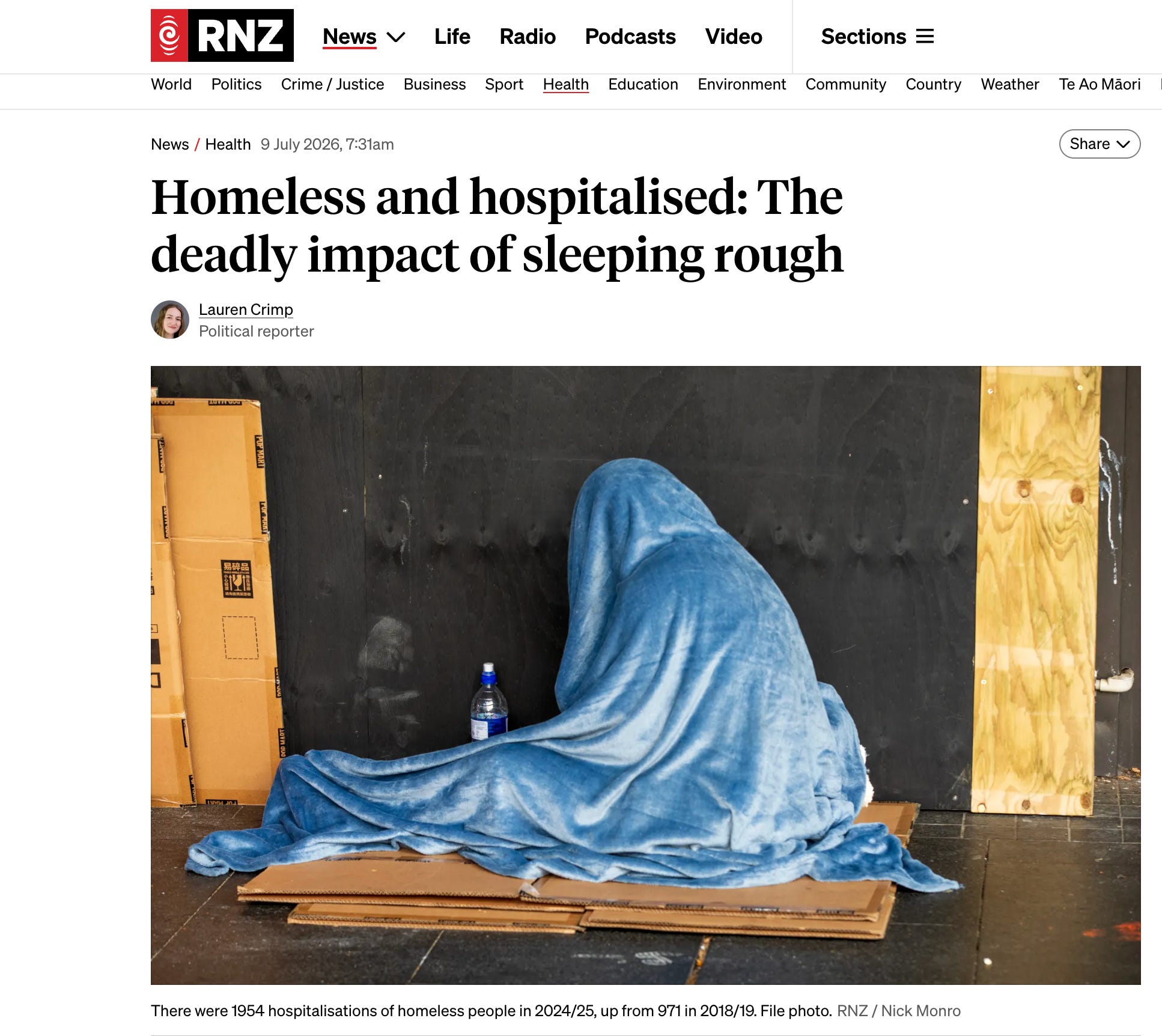
Yesterday, RNZ published the most important piece of journalism written about homelessness in New Zealand in a long time: Lauren Crimp’s “Homeless and hospitalised: The deadly impact of sleeping rough”. She tells the story of Dr Bruce Arroll, a GP at the Auckland City Mission’s Calder Centre. He describes the population he serves as “the sickest I’ve ever worked with.”
His former suburban clinic in Manurewa, with 5,000 patients on the books, recorded a death every three or four months. The Calder Centre has 2,300 patients — most of them homeless or formerly rough-sleeping — and records a death every fortnight. The average age of those who die is 55 for men, 54 for women.
People in dire need are dying homeless in their mid-fifties, in a country that builds twin skyscraper towers for the CBD and fast-tracks approval for luxury apartments. What does that say about the choices our politicians are making, and refusing to make?
Crimp’s RNZ article also explains that hospitalisations of homeless people have doubled in six years, from 971 in 2018-19 to 1,954 in 2024-25. Seven of those hospitalised in the most recent year were babies under four. Twenty-five were discharged from maternity wards.
And yet the Government’s primary response to this crisis — its signature policy — has been to give police the power to tell homeless people to move on.
A choice: just not the homeless person’s
One sentence has cut through more sharply than anything else this year — from Aaron Hendry, who runs the youth homelessness service Kick Back: “Homelessness is a political choice. We can — and must — begin making different ones.”
Homelessness in New Zealand is not a natural disaster, an unfortunate accident, or a mystery. It is the predictable product of decisions made by successive governments — decisions about who gets housed, who gets subsidised, and who gets moved along. And in 2026, the political class has converged on a tacit consensus: the problem is to be managed, hidden, counted down and spun — not fixed.
The right’s answer is policing. The left’s answer is condemnation of the policing, unaccompanied by any plan remotely matching the scale of the need. The homeless person has become a problem to be managed for the comfort of everyone except the homeless person.
The 75% solution
The visible explosion of rough sleeping followed directly from the Government’s own policy decisions. In August 2024 the coalition tightened emergency housing eligibility, giving MSD staff the power to decline applicants deemed to have “contributed to their own housing instability”. It set a target to cut emergency housing numbers by 75%. Officials warned at the time that the emergency housing changes risked increased rough sleeping. The Government proceeded anyway.
The results arrived on schedule. A Salvation Army and Community Housing Aotearoa survey showed rough sleeping in Auckland more than doubling in the year to September 2025 — from 426 to 940. Auckland City Missioner Helen Robinson, thirteen years at the Mission, says: “I have never seen this scale of homelessness in my 13 years... there are literally hundreds of people who are rough sleeping here in Auckland... there’s totally unmet need.”
But in January this year, the Government announced it had achieved its target of reducing emergency housing numbers by the 75% target — five years early. Associate Housing Minister Tama Potaka issued a press release trumpeting the achievement. Prime Minister Christopher Luxon crowed about getting “2,400 kids out of squalid, crime-ridden motels.”
This was presented as a triumph. But as Shamubeel Eaqub has pointed out, “I don’t think the public is stupid.” Certainly, the public was right to be sceptical. The 75% reduction was achieved not by housing people, but by making it harder to get in.
MSD’s performance targets for staff
Last month a TVNZ Q+A investigation exposed the way in which MSD managers were directed to keep emergency housing numbers down. Managers were told that they could face “consequences” if they didn’t meet those targets.
Auckland City Missioner Helen Robinson was asked what she thought of those incentives. “Staff are perversely incentivised to say no,” she said. She has worked at the mission for 13 years. “I have never seen the scale of rough sleeping like I have seen now.”
It’s an old trick: pick a number you want down, choke off access to whatever produces it, and declare victory.
Each month for the past 16 months, there were 1,000 more inquiries to MSD about emergency housing than there were formal applications submitted. That gap of 1,000 applications a month represents real people — people who made contact with the system and were screened out before a formal application was ever lodged.
And of those who did make it to a formal application and were declined, a third were offered nothing at all. After MSD’s client service general manager told RNZ that “we don’t leave people with nowhere to go,” RNZ asked what happened to the 30% declined who weren’t offered any alternative support. The answer, eventually, was that “people are under no obligation to tell us where they are living.”
MSD subsequently qualified the original claim. The Government’s entire narrative — that people in genuine need are being helped — collapsed under a single piece of journalism.
Criminalising the consequence
Into this context, the Government has introduced its move-on orders bill. The legislation, now at select committee, would give police the power to issue orders to anyone aged 14 or older found found behaving in ways the bill classes as disorderly, intimidating, threatening or disruptive — or breaching the peace, obstructing businesses, begging or rough sleeping. Breach the order and face a maximum $2,000 fine or three months’ imprisonment.
The Prime Minister has repeatedly insisted the bill doesn’t criminalise homelessness.
But this is Victorian vagrancy law revived: poverty itself redefined as a public nuisance. And look at who opposed it. Officials warned it would make homelessness worse. Oranga Tamariki and the Ministry of Justice didn’t support it. The Attorney-General found the bill appears inconsistent with the Bill of Rights Act. Even the police were reluctant to lead a response to homelessness. Justice Minister Paul Goldsmith batted all of this away.
Stuff’s Emma Ricketts has today filled in the missing piece: rough sleeping and begging did not accidentally drift into the bill. They appear to have been left there by ministerial choice, against official advice. Police warned that they did “not support criminalising rough sleeping and non-aggressive begging”, describing such behaviour as a nuisance for retailers but still at “the low end of the spectrum” of anti-social behaviour. Police wanted the focus narrowed to genuinely risky conduct — aggressive begging, intoxicated aggression and fighting — and warned that move-on powers should not criminalise behaviour arising from mental health and social need.
Rickett’s reports that a December aide-mémoire to Justice Minister Paul Goldsmith reportedly warned that Treasury, Crown Law, Corrections, Police, MSD, the housing ministry and Oranga Tamariki all had concerns, especially about orders capturing people experiencing homelessness. So when ministers say the bill does not criminalise homelessness, the honest response is: their own officials appear to have told them that it would.
So when ministers say the bill does not criminalise homelessness, the honest response is: their own officials appear to have told them that it would.
The honest justification slipped out anyway. The Prime Minister framed the issue on Newstalk ZB as one of “tourist safety”. Auckland Mayor Wayne Brown was blunter still, telling the Herald that “scruffy-looking” homeless people were causing “economic damage” and should be moved “out into the countryside”. A policy written for tourists, billed to the homeless.
What makes the criticism impossible to dismiss as bleeding-heart reflex is that it comes from the right as well. Liam Hehir — a conservative commentator, writing on his Substack — accepts that intimidating behaviour in public spaces is a real problem deserving a real response. But he draws the line precisely where this bill erases it: “It amounts to a power to move people on for being homeless. Not for threatening anyone. Not for blocking anyone’s path. For the fact of having no home.”
Hehir calls the discretionary scheme “a blueprint for inconsistent and capricious enforcement” and insists that “people must not be criminalised for being poor.” When officials, the Attorney-General and conservative commentators all reach the same conclusion, it’s no longer a partisan objection.
The bill also fails on its own terms. As human rights lawyer Sophie Bradwell-Pollak pointed out in the Listener, the policy “promotes a false and harmful narrative: that people experiencing homelessness are responsible for rising crime and disorder” — even though serious assaults in the Auckland CBD continued to fall while rough sleeping more than doubled. She calls the bill “a wolf in sheep’s clothing”. Policing doesn’t build houses.
Justice Minister Paul Goldsmith explained the purpose of the orders clearly when he said they were about “reclaiming our streets and our city centres for the enjoyment of everybody who visits, works and lives there.” Not for the enjoyment of those who are forced to live in those streets. For the people walking past them.
Strip away the framing and it’s a beautification exercise, not a housing measure. It is designed to improve the aesthetic of places like the Auckland CBD for the City Rail Link and Convention Centre openings — both Luxon and Goldsmith have, at different moments, been remarkably candid about this.
The paywall now starts partway through all Democracy Project newsletters. Please take out a paid sub if you want to support this service and access the full content, including the following sections: “The Prime Minister didn’t know”, “Labour’s hands aren’t clean”, “The landed gentry and their Parliament”, “What would actually work”, and “Moving on”.
