

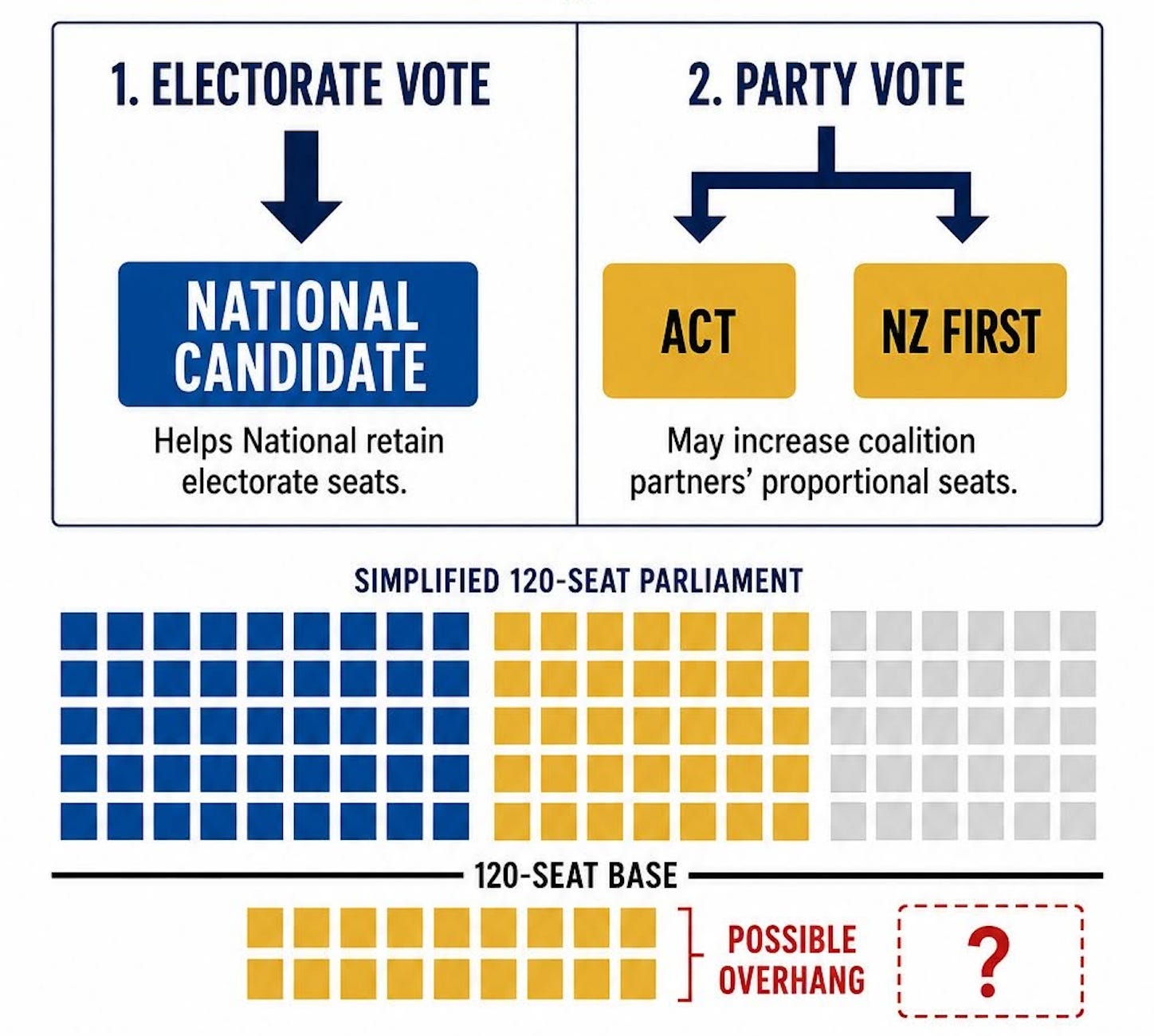
A strange argument is developing on the political right about how National could help the coalition get re-elected: National supporters should stop giving the party their party votes.
Don Brash has been pushing the idea. So have several rightwing commentators. The suggestion is that centre-right voters continue voting for National’s electorate candidates, but give their party votes to Act or NZ First instead. Done on a sufficiently large scale, this could produce an overhang and increase the total number of MPs available to the right, which would significantly improve the Government’s chances of re-election.
It sounds bizarre, but there is some logic to it. National is struggling in polling for the party vote while remaining much stronger at electorate level. That creates the possibility that it could win more local seats than its party vote would normally entitle it to.
And Te Pāti Māori has just made a version of the same idea central to its own election campaign. It is officially asking supporters for the candidate vote only and directing their party votes to Labour and the Greens. The effect would be an overhang.
None of this is illegal. Nor is tactical voting new under MMP. But if voters on either side are organised specifically to create overhang seats, we are moving into different territory. The question is no longer just how cleverly parties can use MMP. It is whether the proportionality at the heart of the system can itself become something parties deliberately try to defeat.
The right discovers the overhang
National is currently polling around 30%, well down on the 38% it received in 2023. Yet weak national polling does not automatically mean losing the same proportion of electorate contests. National currently holds 44 electorate seats and has a powerful local organisation in many of them. Its pollster David Farrar has told The Post that an accidental National overhang is “plausible but not probable”. If National’s party vote falls far enough while many of its electorate MPs survive, it could simply stumble into one.
Rightwing political commentator Ashley Church puts the arithmetic plainly: “Let’s say National’s party vote entitles it to 36 MPs but it wins 40 electorate seats. National doesn’t lose four of those electorate MPs. All 40 of them go to Parliament, which means Parliament itself grows by four seats.”
This is how an overhang works. Normally the party vote determines how many MPs a party gets in total. If it is entitled to ten seats and wins six electorates, the remaining four come from the list. But if it wins twelve electorates despite being entitled to only ten seats, all twelve electorate winners remain and Parliament expands by two. Other parties do not have seats taken off them to compensate.
That arrangement makes sense when it happens naturally. After all, it would be extraordinary to tell an electorate that the candidate it just elected cannot become an MP because the nationwide party-vote arithmetic does not allow it. We have had overhangs before. The present Parliament has 123 MPs, with two of those additional seats resulting from Te Pāti Māori winning more electorates in 2023 than its party vote entitlement, and another MP subsequently added through National’s Port Waikato by-election victory.
Nobody, until now, has set out to produce that result on purpose.
Brash has suggested on The Platform that voters wanting the current coalition returned could give their electorate vote to National everywhere except Epsom and Tāmaki, while giving their party vote to Act or New Zealand First. Ani O’Brien has labelled this “the Brash Strategy” and has spelled out how far the logic goes.
Her simplest scenario has National winning 43 electorates but receiving a party vote that would normally entitle it to only 25 MPs. National would still get all 43 electorate MPs. That is an 18-seat overhang. The party votes transferred to Act and New Zealand First, meanwhile, would give those parties more list MPs.
O’Brien also discusses a much more extreme piece of modelling in which National falls to 19.8% of the party vote but retains 43 electorates, while Act rises to 12.8% and New Zealand First to 15.6%. That produces a Parliament of 141 MPs and gives the right 78 seats, with 71 needed for a majority. She stresses that this is an illustration rather than a prediction, but it demonstrates the potential scale of the loophole. In her words, Te Pāti Māori can create only a handful of overhang seats, while the rightwing version “is far more explosive”.
O’Brien isn’t necessarily advocating the strategy, but others are. Church explicitly recommends electorate vote National and party vote Act or New Zealand First. Peter Williams reaches much the same conclusion while conceding it is “not absolutely ethical or in the spirit of the electoral system but needs must”. Danyl Mclauchlan has also reported in this week’s Listener that NZ First activists online are encouraging a National-electorate/NZ First-party-vote approach.
Oliver Hartwich of the New Zealand Initiative has run the numbers. On current polling, he argues, National will win more electorates than its party vote covers, which “would leave close to 900,000 National party votes with no effect whatsoever on the result”. His modelling suggests that if one National party voter in nine moved their party vote to a coalition partner, the current Government could obtain a parliamentary majority even if the opposition parties won more votes collectively. At one in four, the coalition could end up with 69 seats in a 132-seat Parliament.
This may never happen, for several reasons. Most importantly, none of it is National Party policy. National’s leadership has rejected the idea and Chris Bishop has said voters would punish that sort of game-playing. National also has strong self-interested reasons for resisting it. A successful version of the strategy could wipe out its list MPs and strengthen Act and New Zealand First enormously at National’s expense. It would also require a huge number of voters to follow quite complicated instructions without accidentally switching both their votes.
So what might be advantageous for the overall right bloc could be terrible for the National Party itself.
Te Pāti Māori got there first
While people on the right are mostly discussing the possibilities, Te Pāti Māori has already changed its campaign strategy. At its launch in Gisborne last weekend, the party formally put the emphasis on winning candidate votes in the Māori electorates. Debbie Ngarewa-Packer told supporters: “There’s one plan, two votes; our plan has to be to focus on the candidate votes” and “We trust you with the party vote.”
The obvious beneficiaries of those party votes are Labour and the Greens, although Te Pāti Māori did not at the launch formally instruct supporters where the second tick should go. Rawiri Waititi has been careful on that point, saying the “suggestion is not ours to make”.
The party said almost nothing at the launch about the overhang itself. That silence is new, because Te Pāti Māori politicians had been much more explicit about it beforehand.
On 23 June, Ngarewa-Packer said the Māori seats “are the decision maker. They are the ones that will determine the overhang”. In July, Martyn Bradbury put the split-vote mechanism to her directly on his podcast. And on 22 July Waititi went considerably further in Parliament: “Nobody else will ensure that there is an overhang; only Te Pāti Māori created that overhang in this term and we’ll create it in the next one.”
No speculation is required about whether an overhang forms part of the strategy. The party’s own co-leader has said so in Parliament.
Nor has the idea come out of nowhere. Bradbury has been campaigning for “Candidate vote Te Pati Māori, Party vote Green!” since June, explicitly arguing that it could generate an overhang. Craig Rikihana wrote an essay last December called The Overhang Gambit, saying: “The goal is to weaponise the overhang provision for political leverage.” Versions of the same idea have circulated on the activist left for years.
The strategy did not change at last weekend’s launch. The vocabulary did. Before it was official, supporters and politicians talked quite openly about an overhang. Once it became the campaign, the emphasis moved to candidate votes, Māori representation, removing the Government, and what Waititi calls the “ultimate sacrifice” of giving up the party vote.
The difficulty is a communications one. To pull off this sort of strategy, political scientist Lara Greaves says, “you’ve got to nudge-nudge-wink-wink people”. Voters have long been suspicious of electorate deals and other arrangements that look too clever. Add the contested politics of the Māori seats and the sensitivities grow.
Te Pāti Māori has a cleaner option available, and almost nobody has raised it. If the party genuinely did not care about the party vote, and genuinely wanted to avoid distorting proportionality, it could decline to submit a party list at all. Under the Electoral Act that produces a different seat calculation and does not create the conventional overhang. Te Pāti Māori’s own share of Parliament would actually be larger. The only thing that disappears is the ability to manufacture extra seats for the wider left.
The paywall now starts partway through all Democracy Project newsletters. Please take out a paid sub if you want to support this service and access the full content, including the following sections: “Clever or cheating?”, “The risk to the Māori seats”, and “Where this ends”.
