

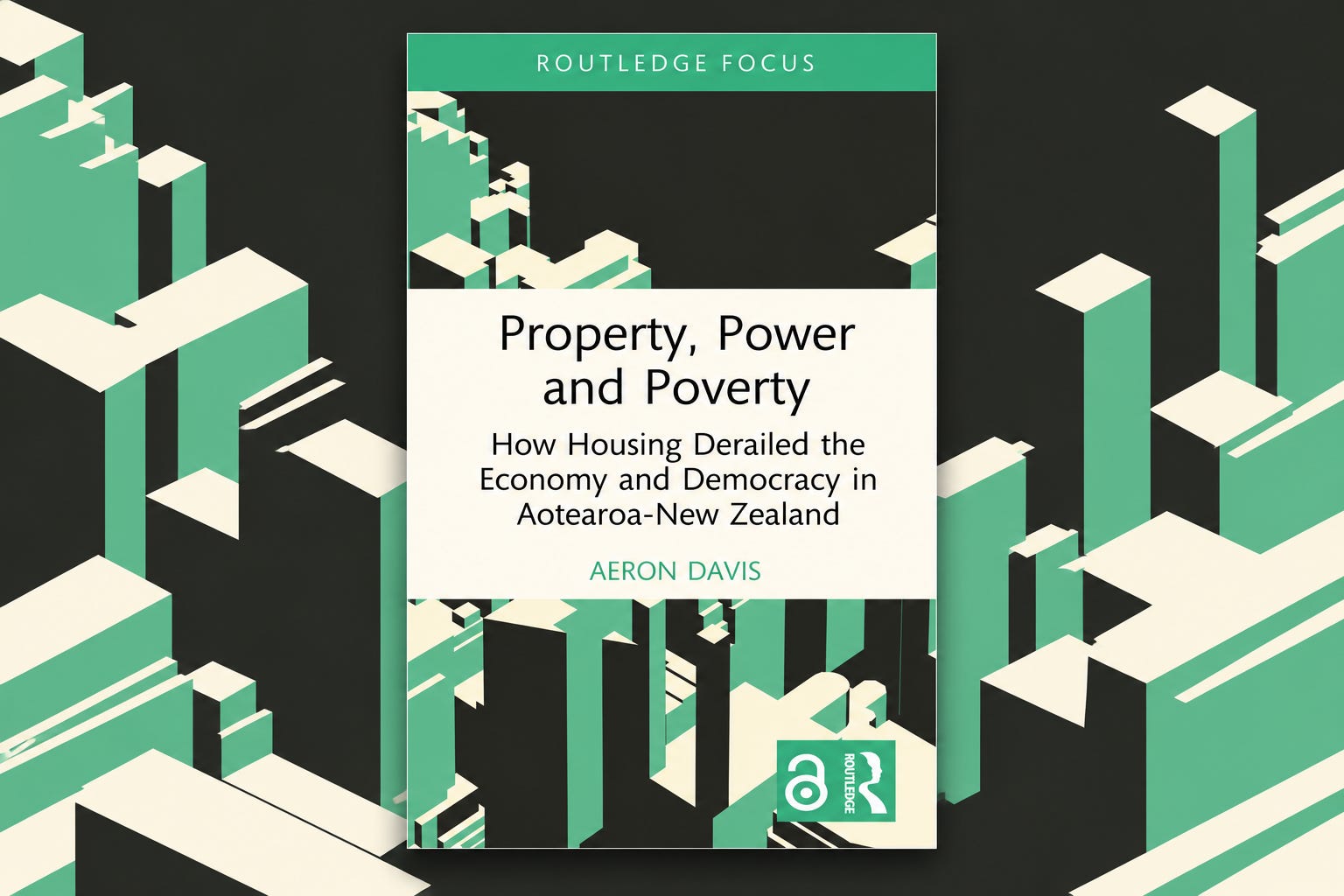
Why is New Zealand’s housing market so broken for ordinary people? How did it get this way, and why won’t anyone fix it?
If you’re interested in these questions, then it’s worth checking out a new book released today: Property, Power and Poverty: How Housing Derailed the Economy and Democracy in Aotearoa-New Zealand by Aeron Davis, a professor of political communication at Victoria University of Wellington. The book is free to download or read online.
It’s the result of three years that Davis spent interviewing people across New Zealand’s housing system. He conducted 80 interviews with 75 people. Bill English, David Parker, Phil Twyford, Megan Woods and former Reserve Bank governor Adrian Orr are quoted on the record, alongside lobbyists, developers and bankers.
He found almost nobody willing to defend what the housing market produces: “Throughout my interviews, the tax issue apart, I’ve never talked to anyone who is in favour of these outcomes”. As to why the status quo endures, his answer in the book is blunt. The crisis continues because the people who profit from high property values have a hand in making housing policy.
The book examines how housing became central to the accumulation of wealth, and how those benefiting from that arrangement acquired the political means to defend it. For anyone trying to understand “Broken New Zealand”, this is a valuable account of why a country can recognise a serious problem and repeatedly fail to fix it. The book should also be required reading for the next housing minister.
This Democracy Briefing is a short review of the book. In the “Further Analysis” section below, for paid subscribers, I look at what Davis found about how organised property interests and lobbyists get their way in the Beehive.
An economy built on houses
Adrian Orr told Aeron Davis: “Housing policy has been about housing as an investment or asset class, as opposed to a basic need.” This is a recurring theme in the book. Davis argues that New Zealand rebuilt its economy around property, tracing this to the reforms of the 1980s and 1990s under Labour and then National. Stamp duty was largely abolished in 1988 and the rest in 1999, death duties went in the early 1990s and gift duty in 2011, while the capital gains tax Labour planned in 1989 never arrived. By the end of 2025, according to Reserve Bank data cited by Davis, mortgages made up 65.5% of all bank lending.
Davis traces policy choices that encouraged borrowing against property and made capital gains attractive. For many, the family home became a retirement plan and a rental property the obvious investment. Renters, and anyone trying to save a deposit from wages, have paid the price.
Dominick Stephens, who chaired the official Housing Technical Working Group as the Treasury’s chief economic adviser (and was earlier Westpac’s chief economist), explained the problem to Davis: “In New Zealand at present, we allocate our resources to assets that yield capital gain such as houses or farms or large commercial property.” In his account, the tax treatment of those gains helps draw investment away from activities that produce taxable income.
The property Rich List
Davis’ audit of the 2024 NBR Rich List found that 91 of its 108 entries, or 84%, hold large interests in property and land. Property is the most common route to great wealth here, and, by Davis’ count, most who got rich another way have invested heavily in it too.
Checking the same 108 names against Electoral Commission returns for 2021 to 2023, Davis found 38 political donors, all but two giving to parties of the right. Adding RNZ’s analysis, which found property was the biggest donor sector before the 2023 election, he puts the total at $7.24 million, of which just 3.9% went to Labour and the Greens. Parliament is a property-owning club too: the Herald’s Chris Knox calculated last November that MPs hold interests in $379 million of property, as I discussed at the time.
Of course, a wealthy few could not sustain this on their own. The system survives, Davis argues, because it has the middle on side. Multi-property investors, together with the roughly two-fifths of the population who own a single home, form an electoral majority with a stake in high prices. What’s more, people who own their homes outright are far more likely to vote than renters, so neither National nor Labour wants to upset homeowners.
Lobbying for the status quo
A well-resourced lobby adds to that electoral weight. An unnamed senior Labour minister, describing Labour’s attempts to take on property investors and landlords, calls it “a classic case of elite capture of the political process”. “We lobbied them hard,” says David Whitburn, a former head of the Auckland Property Investors Association.
Geordie Rogers, who ran Renters United, estimates that the two main property investor associations spend over half a million dollars a year on communications. In the year he describes, Renters United spent “about $43”, not counting volunteer time.
Davis also tracked how often 79 organisations appeared in ministerial diaries from 2017 to 2025. Their recorded meetings rose from about 56 a year under Labour-led governments to about 121 a year under the National-led coalition, with corporate interests accounting for the increase.
Many lobbyists are former insiders: of 38 senior staff at 13 Wellington lobbying firms, 26 had worked in government as an MP, adviser or minister. Veteran lobbyist Mark Unsworth says of political functions: “The more you’re seen, the more you’re part of the furniture.” Another lobbyist describes persuading New Zealand First, as a coalition partner, to kill or slow unwelcome policies.
A problem of power
The book lands as the parties wait for the official election result on 27 November, after a campaign fought partly over Labour’s capital gains tax. Davis warns that without deeper change, New Zealand will be “run like a business for wealthy shareholders, rather than a publicly accountable political system”. That may sound alarmist, but the evidence in this book points that way. Until renters and first-home buyers have as much say over housing policy as those who profit from it, expect more reform of consents and zoning, and very little else.
Dr Bryce Edwards
Director of the Democracy Project
After the paywall, I drill down deeper into Aeron Davis’ account of how property interests influence politicians – see: “Further Analysis: How the property lobby gets its way in the Beehive”
----