

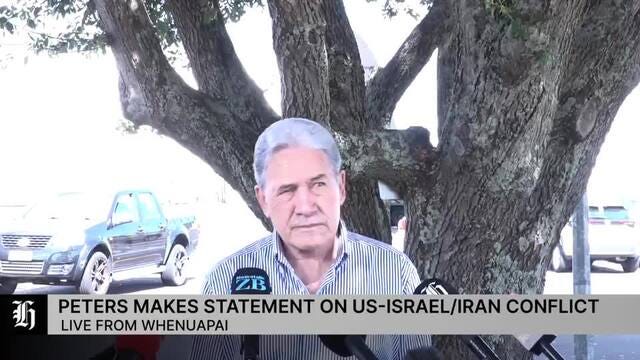
The United States has carried out what is clearly an illegal bombing of Iran, a brutal theocracy with a long record of repression at home and proxy warfare abroad. So how should New Zealand respond?
The Luxon-Peters Government put out a joint statement on Sunday that has been variously described as “balanced,” “careful,” and “a disgrace.” It is relatively positive towards the US actions and condemnatory towards Iran, but it doesn’t fully endorse Trump’s operation, and it calls for a resumption of negotiations. By this morning, Luxon was on the radio telling Mike Hosking “we won’t be mourning the loss of this leader” assassinated, and telling RNZ that New Zealand’s position is “the same as Australia”, while still refusing to say whether the strikes are actually legal.
The Government’s statements have drawn both praise and fury, and the debate it has triggered exposes real divisions in how New Zealand thinks about foreign policy, international law, and the price of staying in Washington’s good books.
Where NZ fits in the global picture
Every government in the world is grappling with how to respond to these strikes, and the results map out along a clear spectrum. New Zealand fits somewhere in the mushy middle, but leaning towards the end that is supportive of Trump.
At one extreme, Australia and Canada threw their weight fully behind the US. Anthony Albanese said: “We support the United States acting to prevent Iran from obtaining a nuclear weapon.” Canada’s Mark Carney used almost identical language. Neither country was given advance warning, and neither participated militarily, but both endorsed the operation without hesitation.
Then there’s the UK, France, and Germany, who issued a joint statement that analyst Eldar Mamedov, writing for Responsible Statecraft, described as “a master class in evasion.” These “E3” countries confirmed they hadn’t participated, condemned Iran’s nuclear programme and repression, but said nothing critical about the strikes themselves. As Mamedov put it: “by failing to condemn the strikes, the E3 has given the Trump administration and the Netanyahu government a blank check.”
On the other end are the dissenters. Spanish Prime Minister Pedro Sanchez rejected “the unilateral military action by the United States and Israel, which represents an escalation and contributes to a more uncertain and hostile international order.” Norwegian Foreign Minister Espen Barth Eide addressed the legal question head-on, noting that “another country does not have the right to attack so long as negotiations are under way.” Switzerland said it was “deeply alarmed” and called for “full respect of international law.”
And then the UN itself. Secretary General Antonio Guterres said the attacks “undermine international peace and security.” UN Human Rights Chief Volker Turk deplored the strikes: “Bombs and missiles are not the way to resolve differences.”
New Zealand’s statement is largely aligned with the UK-France-Germany approach: carefully worded not to upset Washington while making a token nod to international law. As political journalist Richard Harman noted in his daily newsletter, the statement exhibited “subtle differences” from both Australia and Canada. Neither of those countries called for a resumption of negotiations. And New Zealand stopped short of formally “supporting” the United States in the way Albanese and Foreign Minister Penny Wong did. But in practice, that’s a distinction without much of a difference.
Luxon doubles down
By today, any remaining ambiguity about where the Government stands was rapidly disappearing. Speaking to Newstalk ZB’s Mike Hosking, Luxon declared: “We think Iran has been repressing its own people. We think it’s been arming proxies and terrorist organisations. We think it has been developing its ballistic and nuclear programmes and years of diplomacy haven’t borne fruit. We understand fully why the Americans and Israelis have undertaken the independent action that they have taken.”
That’s about as close to endorsing the strikes as you can get without using the word “support.” And when asked directly whether the bombing was legal, Luxon sidestepped: “Ultimately that’s up to the Americans and the Israelis to assert.” He noted they had invoked Article 51 of the UN Charter at the Security Council, but wouldn’t say whether he agreed with that claim. On RNZ’s Morning Report, pressed further, he said New Zealand’s position was “the same as the Australian position”, a telling alignment, given Australia explicitly backs the strikes.
Helen Clark, also on Morning Report, wasn’t having it. “The whole point of international law is to put rules around when force is legitimate,” she said. “A strike is justified if there is an imminent threat of attack, which clearly there was not.” She described the Government’s approach as “a steady drift in New Zealand foreign policy to realign strongly with the United States, which at this particular time seems even more questionable as a strategy.”
Helen Clark’s “disgrace”
Clark’s intervention over the weekend was the sharpest and most significant New Zealand response to the crisis. On X, she posted: “The statement on the US & Israel attacks on Iran by NZ Govt is a disgrace. The Govt knows full well that international law has been breached even though negotiations were under way. It knows that US walked away from the last nuclear agreement with Iran. Why the servility? I guess we know.”
It’s that word (“servility”) that cuts deepest. Clark is accusing the Government of subordinating New Zealand’s independent foreign policy tradition to the desire not to annoy Donald Trump. And there’s a strong case that she’s right.
In a separate post, Clark made the key legal argument: “The Iranian regime is a vicious theocracy which has caused huge trauma to its people. But that isn’t a reason for a breach of Iran’s sovereignty.” It’s a distinction that much of the commentary is wilfully blurring. You can think the Iranian regime is monstrous and still recognise that bombing another country into regime change is both illegal and deeply reckless. Clearly, you can despise the regime and still oppose an illegal attack on Iran’s sovereignty.
Retired senior diplomat Carl Worker has been vocal on X too, questioning the wisdom of aligning so closely with Washington. Worker, who served as Ambassador to China and Argentina and Charge d’Affaires in Washington DC, has warned that New Zealand risks complicity in the erosion of the UN Charter. Writer Donna Miles tweeted that Peters must “clearly tell New Zealanders whether his government supports this illegal war on Iran or not.”
The Opposition parties weigh in
The opposition parties were, to varying degrees, more willing to criticise the US strikes than Luxon and Peters.
Labour leader Chris Hipkins said both the attacks and the retaliatory strikes “undermine international peace and security and put civilian lives at risk.” He urged New Zealand to call on “all parties – including close allies – to show restraint.” That phrase “including close allies” is significant. It’s as close as Hipkins got to pointing the finger at Washington. Careful and measured, but it acknowledged both sides bear responsibility.
The Greens went harder. Co-leader Marama Davidson called the US-Israeli attacks “an illegal and unprovoked act against the people of the region and any genuine pathway to peace.” She accused Luxon of lacking “leadership or moral courage” and called on the Government to rule out any participation in the conflict or AUKUS involvement. “The idea that it’s okay to bomb other countries because you don’t like their leader is reprehensible,” she said.
Te Pati Māori released a statement that cut through diplomatic niceties entirely: “We reject the idea that bombing, invasion, or unilateral military strikes create peace. History shows us the opposite.” They added: “Two truths can exist at once. Authoritarian regimes can be oppressive. And foreign military intervention driven by geopolitical interests does not liberate ordinary people.” Co-leader Rawiri Waititi linked the crisis to AUKUS, calling it “the next phase of global colonisation.”
Legal scholars backed up these criticisms. Professor Alexander Gillespie from Waikato University called it “an illegal war” and said: “There’s nowhere in the UN Charter that says you can bomb someone who won’t negotiate with you.” He assessed that New Zealand’s caution stemmed from fear of “a backhand from the United States.” Otago’s Professor Robert Patman stressed that for a country like New Zealand, which critically depends on a rules-based international order, “you cannot simply turn a blind eye when countries break the rules.”
The Case for the strikes
There is clearly significant support for what the US and Israel have done. And this is backed up by a serious argument that deserves a fair hearing.
The Iranian regime has machine-gunned tens of thousands of its own people in recent months. Iran has funded Hezbollah, Hamas, and the Houthis, fired missiles at its neighbours, and spent decades pursuing nuclear weapons while playing the international community for time. For many Iranians, both inside Iran and in diaspora communities here in New Zealand, the regime’s fall is cause for celebration. At rallies in Auckland and Christchurch, Iranian-Kiwis danced, hugged each other, and burned pictures of Khamenei. “We have wanted this change for many, many years,” Leila Dadian in Christchurch told the Post. Auckland barrister Samira Taghavi said she was “thrilled” and that military force was “the only way for Iranian people to be able to get rid of the current regime.”
Not all Iranian-Kiwis agreed. Donna Miles, who describes herself as “anti-regime and anti-war,” said the strikes are illegal and won’t benefit anyone: “We look to the experience of Iraq and Syria and Afghanistan and we understand that things can get worse.” Former Green MP Golriz Ghahraman told RNZ there’s “no such thing as a lawful pre-emptive attack on a sovereign nation” but acknowledged that many Iranian expats share the desire for regime change. The community is deeply divided.
On the right, David Farrar wrote on Kiwiblog that “the death of Khamenei is something to celebrate,” while cautioning that possible outcomes range from a democratic monarchy to civil war. Former National MP Simon O’Connor went further on his Substack, writing that “the Islamic regime is evil, and it is right, good, and proper to eliminate it.” Matthew Hooton called Khamenei’s death “good,” comparing it to the execution of Romania’s Ceausescu. He also praised the Government’s statement arguing that it “avoids lecturing the United States about the rule-based order, which is now both redundant and risks pointlessly infuriating the Trump Administration.”
Chris Trotter, writing for Interest, took the most interesting “realist” line. He acknowledged that “viewed through the lens of international law the attack is unequivocally illegal” but argued it was always going to happen, as a nuclear Iran is very clearly an existential threat to Israel. Peters understands that “in relation to the Trump Administration silence is golden,” Trotter wrote. Luke Malpass at the Post put it even more bluntly: “International law has only ever been an idea that reaches as far as hard power allows it to.”
The realists aren’t wrong to note that Iran has been storing up trouble for decades. Nobody should mourn Khamenei. The celebrations in Tehran are real. But the realists never quite answer the fundamental question: if one country can bomb another into regime change because it disapproves of the government, what’s the limiting principle? Who’s next?
The Iraq parallel
Geopolitical analyst Geoffrey Miller said on Newstalk ZB that “Donald Trump has unleashed forces that he may not be able to control.” He compared the situation to George W. Bush’s “Mission Accomplished” banner in 2003 and asked: “What came after that was just chaos and destruction in a brutal civil war. So my question is what’s going to come after this death of the Supreme Leader of Iran.” Quite simply, a vacuum often leads to worse outcomes than the regime it replaces.
Miller described the Government’s statement as having “implicitly condoned the US and Israeli strikes” and called it “the wrong strategy to take.” He pointed to Spain as a better model.
Professor Patman was especially pointed: the US overthrew an unpopular regime in Iraq too, but “it was not greeted with flowers.” He warned that “Trump is in danger of actually boosting the clerical regime in Tehran at a time when it was facing considerable domestic problems.” The strikes might, paradoxically, resuscitate the very regime they aimed to destroy.
Even those sympathetic to removing Khamenei see the risks. Farrar acknowledged that possible outcomes range from “a democratic constitutional monarchy” to “a military dictatorship under the IRGC.” Trotter warned that the US and Israel tend to “simply walk away from the messes they had made of other people’s countries.” Australian Nationals’ senator Matt Canavan put it bluntly: “Not a single regime change war has left the world a better place in my lifetime – not sure why this would be any different.”
Trump himself inadvertently made the case against his own operation. He urged Iranians to “take over your government”, as if 90 million traumatised people can just self-organise into a functioning democracy while missiles rain down around them.
What this means for New Zealand
The Iran crisis has stripped back the veneer of New Zealand’s independent foreign policy, revealing something far more compliant. The Government has, in effect, stopped speaking with an independent voice.
Sam Sachdeva in Newsroom today, captured the dynamic: “The Government’s response to the strikes is of a piece with its broader approach to the Trump administration, keeping New Zealand’s head below the parapet to avoid the president’s ire and any potential retaliation.” Catherine McGregor at the Spinoff noted that the Government’s joint statement reserved condemnation for Iran’s retaliatory attacks while offering only an “acknowledgement” of the initial strikes, which is not enough for critics.
As Miller pointed out, the consequences are real and material. Oil prices are already above $70 a barrel. Dubai Airport is shut down. Shipping through the Strait of Hormuz – through which nearly 20 percent of the world’s oil flows – is being disrupted. When you couple higher oil prices with a weak New Zealand dollar, petrol prices here could head north fast. New Zealand has good trading relationships with the Gulf states too: Luxon was in the UAE last year signing a trade deal. Those countries are now under Iranian missile fire.
But for many the bigger question will be about who we are. New Zealand is said to have a proud tradition of standing up to powerful allies when it matters: the nuclear-free policy, the refusal to join the Iraq invasion, the willingness to call out breaches of international law regardless of who commits them. That tradition is now in suspension. International law isn’t just a nice idea for small countries; it’s the architecture that keeps countries like New Zealand safe. Once you accept that powerful countries can launch preventive wars whenever they decide negotiations aren’t going well, everyone gets to claim that right, including the states we least trust.
I’m with the critics here. The Iranian regime is abhorrent, and Khamenei’s death may open real possibilities for the Iranian people. But the way this was done, with diplomacy used as cover, international law tossed aside, and allied governments bullied into silence, is a template for a world nobody should want to live in.
Clark showed that former leaders can say what current ones cannot or will not. The question for the rest of us is whether we’re comfortable with a foreign policy reduced to keeping our heads down and hoping nobody notices.
New Zealand should have said so. Loudly.
Dr Bryce Edwards
Director of the Democracy Project
Further Reading:
