

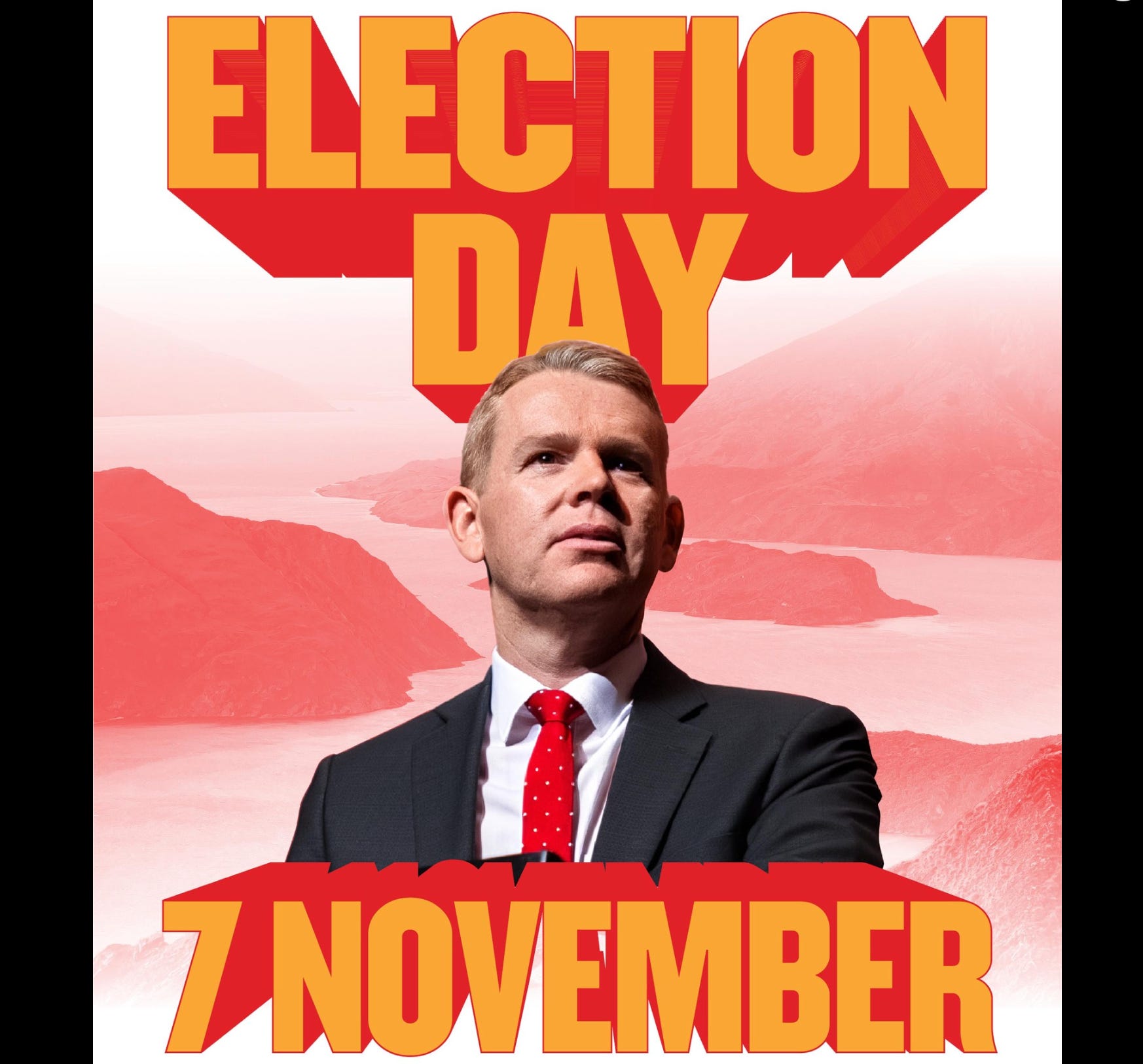
This week Chris Hipkins gave us the clearest picture yet of how Labour plans to fight the 2026 election. His speech at the party’s caucus retreat in West Auckland, and then a rally-style address to party activists, revealed a strategy that combines class-based attack lines, relentless positivity, and a narrowed focus on kitchen-table concerns.
But can this rebranded Labour convince voters it’s genuinely different from the party they rejected so decisively three years ago?
The Class politics pivot
Labour’s chosen venue for the caucus retreat told a story in itself. As Joel MacManus noted in The Spinoff, Labour’s MPs gathered at “the world’s most depressing four-star hotel: Quality Hotel Lincoln Green in West Auckland.” Fluorescent lights, beige walls, constant grey drizzle outside. MacManus quipped that the dreary setting “only made Hipkins seem more dynamic, like an enthusiastic Michael Scott.” It was a stark contrast with Christopher Luxon’s flashier state of the nation event two days earlier – though Luxon’s was decidedly more dour in tone.
The choice was clearly intentional. Labour didn’t choose a glitzy convention centre in the CBD, nor a sun-drenched winery in Hawke’s Bay. They chose a venue that screams “budget-conscious”, “suburban”, and “underdog”.
Most importantly, it symbolised Hipkins’ willingness to engage in something resembling class politics. Henry Cooke at The Post captured something significant in Hipkins’ rhetoric this week, arguing that although Labour don’t always act like the party of “labour”, Hipkins was dipping his toe into working class rhetoric.
Hipkins told his audience: “We are up against some very powerful interests. The wealthy donors who’ve done very well under this government and want to keep it that way. They will spend millions of dollars to stop us. They will throw everything at us. They will try to scare people. They will twist our words and misrepresent our plans.”
When Cooke pressed him on who these powerful donors were, Hipkins pointed to “property speculators” as big National Party funders. Hipkins also talked about wanting his kids to grow up rewarded for hard work, not “inherited wealth.”
The rhetoric channels the Zeitgeist of leftwing politics at the moment, especially that of Zohran Mamdani, the new socialist mayor of New York whose campaign energy Labour seems keen to emulate. However, Cooke explores some of the contradictions or inconsistencies in Hipkins’ class pivot, concluding it’s more about rhetoric than substance: “In other words, the branding may look like Zohran Mamdani’s, but the policies don’t.”
For example, Labour’s capital gains tax excludes family homes, businesses, and farms. The “Future Fund” will apparently take money from public companies to invest in private business. Finance spokesperson Barbara Edmonds has made clear the party won’t be spending big.
Auckland: The key battlefield
Simon Shepherd at the NBR reports that Labour will target “grumpy” Auckland voters who didn’t turn out at the last election. Hipkins told journalists the party has been “working on the ground here for the last two years; started with a lot of intensive listening, then a lot of ongoing work around policy.” He identified three target groups: people who don’t engage in politics and stayed home in Labour areas, those generally disaffected at the last election, and “those who were particularly grumpy with Labour.”
The focus on Auckland makes electoral sense. As the Herald’s editorial bluntly put it this week: “This is a no-brainer if Labour wants to return to Government. You can’t win an election without winning Auckland.” In 2023, Labour lost supposedly safe seats like New Lynn and Mt Roskill, and nearly lost Mt Albert — the old electorate of Helen Clark and Jacinda Ardern.
The Herald editorial identifies Covid management as the source of Auckland’s alienation from Labour: “It was clear that Aucklanders were severely punishing the former Ardern and Hipkins Government for its policies and action during the Covid years.” Many Aucklanders felt the opposite of the empathy Wellington professed. The newspaper says: “For many Aucklanders, they will not forget, nor will they forgive the politicians in charge at the time.”
Richard Harman points out a timing problem for Labour’s Auckland rehabilitation: the Royal Commission into Covid will release its Part Two report in late February, focusing on vaccines, procurement, lockdowns, and managed isolation. Harman says: “Hipkins was Minister of Health and Minister for the Covid Response during most of the relevant period, so the report is unlikely to be helpful for him.” Labour’s Covid legacy will be thrust back into public debate precisely when they’re trying to move past it.
“Better is possible”
Joel MacManus observed Hipkins testing what might become Labour’s campaign slogan: “Better is possible”. Hipkins is reported saying: “We will also make sure that we’re offering New Zealanders a real and compelling alternative, because better is possible”. MacManus notes he “repeated some variation of ‘better is possible’ three times throughout his speech — perhaps testing a campaign slogan?”
The theme positions Labour as optimistic against what Hipkins characterises as Government pessimism: “It’s pretty clear that New Zealanders are looking for one thing this year more than anything else, and that is a sense of hope. Because they’re not getting it from this current government”. He painted the Government as telling voters “this is as good as it gets”.
Simplified messaging
Labour’s campaign messaging is radically simplified: jobs, health, homes. The pull-up posters feature just those three words in minimalist design. Hipkins says: “We heard very clearly from people at the last election that they didn’t think we were focused enough on the things that matter to them”.
MacManus summarises Labour’s strategy: “use clear language, a limited set of talking points, and focus on kitchen-table issues while your opponents are distracted by esoteric reforms.” It’s basically National’s 2023 playbook turned back on them.
A “very different” Labour Party?
Thomas Coughlan at the Herald reports Hipkins promising “a very different Labour party” with “a different slate of candidates” and “some new faces but there will also be new ideas.”
Hipkins insisted: “We understand why New Zealanders didn’t vote for us at the last election, we understand they were looking for something different from us. We have refreshed ourselves. We’ve re-energised ourselves. We’ve changed and we are offering a very different Labour party at this election to what we were offering last time.”
But how different is it really? Journalist Graham Adams argues it’s essentially a repeat of 2023’s failed strategy. When Hipkins replaced Ardern in January 2023, he adopted a “smaller target” strategy, ditching contentious policies like the RNZ-TVNZ merger and hate speech laws to focus on “bread-and-butter issues.” Adams argues that Hipkins never rejected co-governance, “arguably the most polarising of all the policies stealthily adopted by Labour,” and tried to pretend he was making significant changes to Three Waters. He led Labour to a crushing defeat.
“Now he’s trying a variation on the same tactic,” Adams writes. “He is again trying to persuade voters that a government he leads would be focused most keenly on ‘jobs, health, homes’ — which is simply a repeat of 2023’s ‘bread-and-butter’ issues.” Adams notes that Hipkins never mentioned climate change in his December speech to the party conference, nor did he mention Te Tiriti or co-governance. Yet senior Labour MP Peeni Henare has promised to “reinstate the Māori Health Authority and resurrect the compulsory schools Aotearoa Histories curriculum” introduced during Hipkins’ tenure as Education Minister. Adams suspects “the Treaty ‘partnership’ and attendant co-governance policies will be enthusiastically revived in some form if Labour leads the next government”.
The NZ First threat
Matthew Hooton has identified a significant threat to Labour’s working class recovery plan: NZ First is hunting in the same territory. Winston Peters “has already begun referring to NZ First as New Zealand’s only true ‘workers’ party,’“ Hooton reports. “By this, he primarily means manual workers but also includes the likes of teachers and nurses who just want to get their day’s work done rather than attend union meetings to argue over gender identity or Gaza. In contrast, Peters mocks Labour as ‘the wokesters’ party.’“
Hooton notes that “since the mid-2010s, Labour’s and NZ First’s polling has tended to move inversely, suggesting they compete for the same voters.” NZ First strategists are explicitly aiming to “gut Labour over wokeness” in 2026.
Labour faces another problem with NZ First: the India free trade agreement. Hooton reports that “NZ First strategists can’t believe their luck in National handing it the open immigration provisions of the proposed free-trade agreement with India without having locked in Labour’s support, meaning that issue will dominate the early part of the year.” Labour is expected to ultimately support the deal “for fear of losing its Kiwi-Indian vote”. This puts Labour in an awkward position, vulnerable to NZ First attacks on immigration while trying to hold its multicultural support base.
Curiously, RNZ’s Lillian Hanly noted that in Hipkins’ campaign speech, “he name checked both National and Act.” But “New Zealand First escaped a mention.” Is Labour trying to avoid giving Peters oxygen, or does it not yet have an answer to the NZ First threat?
Can Hipkins pull it off?
Hipkins says Labour intends to do “significantly better” than 40% in the party vote. That would represent a near-doubling of their 2023 result.
Most observers remain sceptical. Writing in the Herald today, Hooton predicts “Christopher Luxon’s coalition will sneak back in by a seat or two,” which would trigger Labour civil war between centrists like Hipkins and Barbara Edmonds versus challengers from the left like Craig Renney and Michael Wood.
Richard Prebble at the Herald notes “Labour does not have a charismatic leader nor a programme of reform” and is instead “borrowing a playbook perfected elsewhere” — specifically, the Australian Labor Party’s “policy-light campaigns that make the party a small target.”
MacManus acknowledges the fundamentals favour the government: “most polling shows the coalition government with a narrow but consistent lead. Economists are predicting improvement this year, which should benefit the incumbents. And Labour’s two potential coalition partners, Te Pāti Māori and the Greens, have spent the last year or so in various states of meltdown.”
What this all means
What’s become clear from Hipkins’ speeches and statements this week is that Labour has settled on a coherent campaign strategy, even if the authenticity of the underlying transformation remains questionable. The strategy has four main elements:
First, adopt class-based rhetoric that attacks wealthy donors and property speculators, channelling populist energy even if the actual policies remain centrist. Second, radically simplify the message to jobs, health, and homes — basic cost-of-living issues voters said Labour neglected last time. Third, position Labour as optimistic hope against Government pessimism and negativity. Fourth, wage a massive grassroots campaign, particularly in Auckland, to rebuild trust with voters who feel betrayed by Covid-era decisions.
The contradictions are obvious. The class warrior rhetoric doesn’t match the moderate policies. The “very different” party still has many of the same faces and appears ready to revive the same policies on co-governance that alienated voters. The positive messaging will struggle against the incoming Covid Royal Commission report. And NZ First is aggressively competing for the same working-class voters Labour needs to win back.
But Labour has at least given itself a fighting chance by learning one lesson from 2023: voters want clarity about what you’re offering and focus on issues that matter to their daily lives. Whether the package Hipkins is selling is genuine renewal or clever rebranding will be the central question of the 2026 campaign. And whether voters are willing to give Labour another chance so soon after such a comprehensive rejection remains very much an open question.
Dr Bryce Edwards
Director of the Democracy Project
Further Reading:
