

Winston Peters has just promised to break up the supermarket duopoly. It’s the latest economic populist policy he’s thrown into the 2026 election campaign. Also today, the Greens used their State of the Planet speech to urge the Government to electrify the economy.
If you had to bet which one cuts through, it’s Peters’ supermarket breakup line. That’s the kind of thing voters instantly understand. The Greens’ electrification pitch, by contrast, barely registers.
That contrast captures the whole campaign so far. NZ First is the only party effectively tapping into public discontent
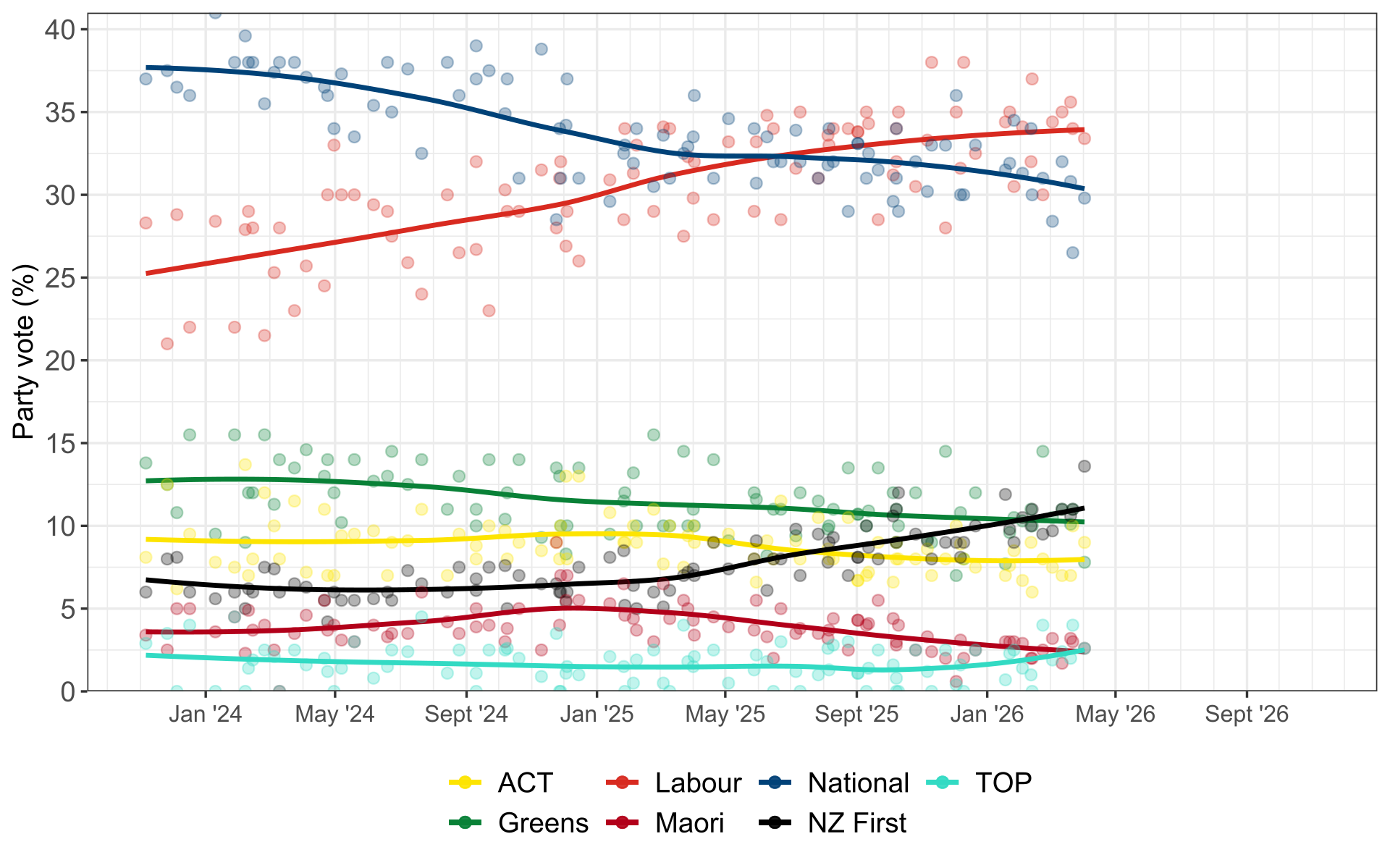
The latest two published polls have put the party on 15% and 13.6% - increases that clearly relate to NZ First’s recent policy announcement that it will break up the “Big Four” electricity gentailers that are widely seen as making mega profits in an uncompetitive market involving fast rising prices for consumers.
Also, Peters’ preferred-prime-minister score is now 12.1%, almost three times David Seymour’s 4.6%. Commentators are increasingly forecasting that NZ First might hit the high teens or even 20% by November and that Peters could demand the top job as the price of any post-election deal. Matthew Hooton, unusually well plugged into NZ First’s strategists, has been explicit about the ambition: build the party into “medium-sized” status, then leverage that to make Peters the next Prime Minister.
Peters’ audacity is nothing new. What’s remarkable is that none of the other party leaders seems to have a plan to stop him
Why only Peters is reading the mood
For the last year I have been writing about what I call “Broken New Zealand”, based on the idea that our economy and polity have been captured by incumbents. We’ve ended up with markets dominated by a handful of players (supermarkets, banks, power companies) where everyone knows the game is rigged, even if they can’t quite explain how. Prices go up, service doesn’t improve, and yet nothing really changes. As a result, everything from the public service through to infrastructure seems to be in decline, while elites profit.
We keep seeing further evidence of this. Opinion polls keep showing that more New Zealanders think the country is going in the “wrong direction” than think it’s headed in the “right direction”. The 2026 Edelman Trust Barometer found only 17% of New Zealanders believe the next generation will be better off, one of the lowest scores in the OECD and down nine points in a year. Net citizen departures have hit record highs. Consumer NZ keeps finding the same thing on groceries. The Commerce Commission keeps issuing report after report on structural market failure.
NZ First is surging in support, because Peters is the only party leader to have noticed this discontent and is responding with big populist policies. It does not actually matter that NZ First is itself deeply embedded in the Establishment, sits inside the current Government, takes corporate money, and has delivered almost nothing on any of this during the parliamentary term. The “feeling” is what matters. He is the one naming the villains and promising to swing a hammer at them.
He’s winning because the field is empty. The 15% poll result says less about him than it does about everyone else’s failure to show up and fight for the votes of those that are discontented with the state of life in New Zealand.
The Tribes the political class forgot
Danyl McLauchlan’s recent Listener cover story on the five voter “tribes” is the sharpest political analysis published this election year, and I’ve written about it in a previous Democracy Briefing. The bit that matters most for this election is simple.
Two of McLauchlan’s five tribes account for roughly 35% of the electorate. This is the Precarious Left (around 18%, younger, disproportionately female, Māori and Pasifika, mostly renters working in aged care, early childhood education, community health) and the Alienated Conservatives (around 17%, older, predominantly male, often a tradie or self-employed, home ownership among his cohort collapsed from 78% in 1990 to 30% today).
McLauchlan says that these two forgotten tribes have a lot of similarities. Ideologically they disagree on almost everything — redistribution, immigration, the Treaty. But they share a conviction that cuts through all of that: the system isn’t built for people like them
Between them, these two discontented tribes are larger than the centrist Middle New Zealand tribe that both major parties build their campaigns around. Neither of the discontented tribes are properly represented in the current Parliament.
Labour and the Greens have drifted, across the last two decades, into what Thomas Piketty calls the “Brahmin Left” (or what McLauchlan calls the “Educated Progressives”) — the party of university-educated public-sector professionals whose interests and ideals conveniently align. National and Act speak for the “Establishment Right” (or what Piketty calls “the Merchant Right”).
This means that the 35% at the bottom end of the economic ladder, who don’t trust any of them, are politically orphaned. And Peters is increasingly positioning himself to adopt them.
Labour: timidity dressed as pragmatism
Labour is the party most exposed to this. Peters is hunting its traditional vote, and catching a lot of it.
Chris Hipkins can at least see the mood. He has talked about the “supermarket duopoly,” the “big four Australian-owned banks,” the electricity and insurance oligopolies. He’s willing to name the villains, but then he pulls his punches. Structural break-ups are “a big step to take.” The answer, in his telling, is “better regulation” and “opening up space for new players.” A code of conduct. A working group.
The two big policy announcements of the past year tell the story. Labour’s capital gains tax, leaked quietly over a long weekend late last year, carves out the family home, farms, KiwiSaver, business assets and inheritances. The projected revenue is triangulated into three free GP visits a year under a so-called Medicard. It’s a pale shadow of the David Parker tax overhaul Labour once considered.
Then there is the Future Fund. Rob Campbell dismissed it in public as “at best a derivative concept” that “does not suddenly find any new money but takes from one place to put it in another.” Finance spokesperson Barbara Edmonds has locked Labour into the same debt and surplus tramlines as Nicola Willis, and publicly dismissed the Greens’ alternative budget as a “huge spend-up” that she conceded she hadn’t read.
Labour is not, on current evidence, a party preparing to break anything up.
To outflank Peters, Labour would actually have to take risks. It would mean backing supermarket divestment instead of another code of conduct, structural separation of the gentailers, a real capital-income tax rather than a CGT written by the exemption lobby, a serious intervention in the housing market. And it would mean abandoning the “small target” strategy that is slowly strangling them. If Labour wants to blunt NZ First’s rise, it has to be much clearer and much bolder. It needs to abandon its centre-left managerialism.
If Labour doesn’t do any of this, NZ First will keep eating its base. A big chunk of the Alienated Conservatives are already gone to NZ First. Without a change of tack, the Precarious Left will follow.
The paywall now starts at halfway through all Democracy Project newsletters. Please take out a paid sub if you want to support this service and access the full content, including the following sections: “The Greens: stuck in the wrong fight”, “National: a CEO in a reformer’s moment”, “Act: from market freedom to donor protection”, “Te Pāti Māori”, “The one card Peters can never play”.
