

For most of the past thirty years, immigration has been a remarkably quiet topic at New Zealand elections. Winston Peters has periodically made noise about it. The main parties have treated migration as a technical lever for managing the economy. Turn the tap up when growth flags, ease it back when housing or wages get squeezed. It has not been a defining battleground.
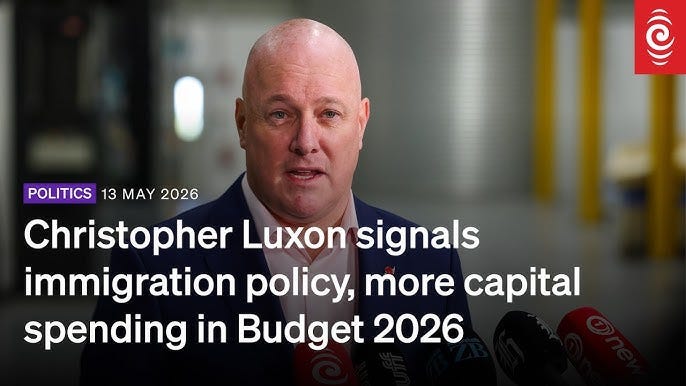
Something has shifted. In the past two weeks all three coalition parties have decided immigration is the issue of the 2026 election. Act first. Then NZ First sharpening its rhetoric. And now, most strikingly, Christopher Luxon himself. The Prime Minister’s address to BusinessNZ on Wednesday was the moment National finally crossed the line into the new politics. Matthew Hooton, no fanboy, called it Luxon’s most substantive prime ministerial speech to date. The immigration section is why.
“My message to the business community,” Luxon told the assembled CEOs, “is that when it comes to immigration, when faced with a choice between social cohesion and stability or your bottom line, I will choose the former every single time.”
You will not find a sentence like that in any previous National PM’s address to BusinessNZ. Three decades of orthodoxy overturned in two lines.
Luxon went further. He warned that “at least some of the political fracturing evident in Europe in recent years is the result of politicians refusing to implement the preference of their voters on immigration.” He pointed to “failed immigration policies in Europe and North America” that had “stoked a politics of division online.” Immigration, he conceded, “now seems to be an emerging political issue in New Zealand, too.” Voters could “expect to see careful policy on immigration from National as we get closer to the election.”
Why now?
Immigration has rarely been a decisive election issue in New Zealand. Political scientist Sam Crawley has done some of the most useful analytical work here. His reading of New Zealand Election Study data shows that a large share of voters — often a majority — have wanted immigration reduced in most election years since the 1990s. But wanting something and voting on it are different things. “Salience” is what matters politically. And on that measure, immigration has almost never cracked the top tier of concerns.
The one exception was 2017, when New Zealand First made immigration central to its campaign and Andrew Little’s Labour briefly chased the same vote. Even then, Crawley notes, immigration sat well below housing, poverty, and the economy in the hierarchy of voter concerns.
Danyl McLauchlan, in a March piece for the Listener, found even starker evidence of the mismatch between political rhetoric and public attitudes. In the 2023 election study, just 0.4% of respondents named immigration as the most important problem facing the country. More striking still, the share of New Zealanders wanting more immigration nearly doubled between 2017 and 2023 — the precise years when New Zealand’s peer democracies were lurching in the opposite direction.
As McLauchlan put it, New Zealand was becoming more pro-immigration just as the Western world was becoming less so. The Covid border closure, he suggested, had made the costs of cutting migration painfully concrete.
None of this means the question is off the table. The latest Ipsos New Zealand Issues Monitor puts immigration as the 12th most pressing issue, named by 8% of respondents. That is still well outside the top ten. But it is climbing, up from 5% a year or two ago. Both Act and NZ First are now trying to push that higher.
Chasing the anti-immigration vote
The political dynamics within the coalition are worth considering, because they help explain why immigration is suddenly everywhere. This isn’t primarily a story about a public groundswell. It is a story about parties chasing votes and responding to each other.
Peters has been talking about social cohesion and migration for thirty years; it is the issue he built his career on. What is different in 2026 is the language. At the party conference in Palmerston North last September, Peters announced NZ First would campaign on requiring all new migrants to sign a “Kiwi values document” covering flag, freedom of religion, democracy and “traditional New Zealand values.” His framing has tilted sharply toward UK and US discourse. He told the Herald late last year that he found Nigel Farage’s Reform UK programme “compelling.” He pointed to Britain, where, in his telling, “careless immigration policies” had transformed cities and produced people who “don’t salute the flag, don’t salute the values of the country.”
More recently, Jones tried to turn the India free trade agreement into an immigration scare story, warning of a “butter-chicken tsunami” of migrants — a comment so crude that Luxon was left publicly disavowing it.
Act then followed early this month with a six-point immigration policy. Tougher enforcement, a dedicated unit to deal with overstayers, higher English-language requirements, a $6-a-day infrastructure surcharge on temporary visa holders, a new citizenship test, and a ban on new residents receiving welfare for five years. Immigration Minister Erica Stanford called it “dog whistling,” “kneejerk,” and “populist.” She conceded, that Act was simply trying to match NZ First.
And then Luxon stepped in with his BusinessNZ speech this week, attempting to occupy the middle ground before his coalition partners defined it for him. The political logic is transparent. If National is going to be dragged into this debate by its coalition partners — and it clearly is — Luxon wants to be the reasonable voice in the room rather than the one still talking about economic inputs and labour demand.
Whether that works is another matter.
The data problem
Liam Dann, writing in the Herald today, makes the point directly, and it’s worth taking seriously. The coalition government is currently presiding over one of the lowest net migration rates in more than a decade. In August 2025, annual net migration dropped to around 10,000 as young New Zealanders departed in large numbers. The current figure sits at about 24,000 — below the long-run average of 31,000 between 2002 and 2025. Migrant arrivals have fallen by 100,000 since November 2023. “If we exclude the bit where our borders were closed because of Covid,” Dann writes, “you have to go back to 2013 before you see net migration as low as we’ve seen in this political cycle.”
Immigration is not rising. If anything, New Zealand is losing the battle to attract the skilled workers it needs.
Paul Spoonley, the Koi Tū demographer who has spent decades studying these flows, was blunter on RNZ. He said: “We are one of the most super-diverse countries in the world… By and large, it works really well. So what is the problem, or what is the issue here that the prime minister thinks we need to address?” His diagnosis: the PM “is beginning to react to his two coalition partners both of whom seem to want to make immigration a central issue for the coming election.”
This is Dann’s central charge too. National and Act “have traditionally favoured a neoliberal approach to immigration, which, if not quite ‘the more the merrier’, did at least assume that more people equalled more growth and more wealth.” Now they have “decided to jump on the populist immigration debate.”
Dann’s diagnosis of the politicians’ motive is sharp: “Perhaps they’ve seen how well the issue is playing for populist politicians in Australia, the United States and the United Kingdom. Perhaps it is because they have noticed that the biggest dent in their own polling seems to be coming from the rise of their coalition partner.”
Yet his sharpest line concerns the “social cohesion” framing that Luxon reached for, and that Act has built into its citizenship test: “It involves projecting international issues that don’t really exist in New Zealand onto a political landscape that is unfortunately vulnerable to culture wars and tribalism.” The appeal to social cohesion, he says, “is a bit sinister.”
That is a strong claim. But it is not baseless. New Zealand is not the UK. There is no crisis of asylum seekers and no Nigel Farage equivalent commanding a third of the vote. Our immigration system is points-based, economically focused, strictly managed. Spoonley points out that 30% of New Zealanders were born overseas — 43% in Auckland — and by and large it works. The Helen Clark Foundation’s recent social cohesion report found that 36% of New Zealanders think immigration levels are too high, and 43% think they are about right. That is not a country convulsing with anti-immigrant sentiment.
The paywall now starts at halfway through all Democracy Project newsletters. Please take out a paid sub if you want to support this service and access the full content, including the following sections: “The old bargain”, “Up The democratic deficit”, “Labour’s silence”, and “What kind of debate?”.