

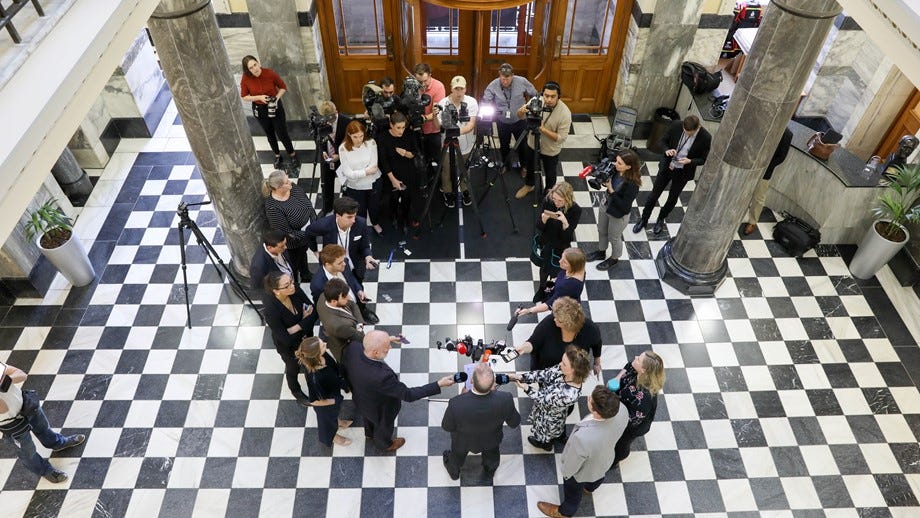
The latest Beehive-media scandal about journalists fighting amongst themselves is grubby, personal and, in parts, overblown. But it should not be dismissed as gossip. It tells us something about the small world inside Parliament, and why that world is starting to look unhealthy.
I’m going to write a few Democracy Briefings on the general subject of political media in New Zealand, because there are a number of important stories around this topic at the moment. But I want to start with the messiest of the recent stories: the year-long silence over an ugly row between two press gallery journalists in a finance minister’s office, and the strange way that silence finally broke. On the face of it the episode is about one bad row at a drinks party. It is also a glimpse into the Parliament village.
The Drinks party that became a scandal
Government ministers regularly host press gallery journalists in their offices. Nothing unusual about that. Nicola Willis invited the gallery to hers ahead of the May 2025 Budget. The drinks went long. Tempers flared. According to the Substack writer Ani O’Brien, who broke the story on Tuesday, Stuff political journalist Lloyd Burr said something personally provocative to TVNZ political editor Maiki Sherman, and Sherman responded by repeatedly calling him a homophobic slur. There is also a contested claim that a racial slur was used in the exchange, which Burr and Stuff firmly deny.
Willis has confirmed she “returned to hear offensive language being used” and ended the event “at that point”. She says she checked on Burr the following day and respected his wish not to take it further. Stuff’s response is to back Burr’s account in full. TVNZ’s response, repeated daily and verbatim, is that it “does not comment on employment matters”.
Until O’Brien’s piece, the press gallery and the major newsrooms had largely sat on an allegation that one of the country’s most senior political journalists used a homophobic slur against a colleague in a minister’s office.
Lawyers from a state broadcaster
The most revealing admission about the silence came from Mike Hosking on his Newstalk ZB Breakfast show. Hosking’s producer Sam Carran had been quietly chasing the story for months. They thought they had it. Then, Hosking says, TVNZ’s lawyers arrived. “We got the big, broad-based fat letter from the lawyers… It had a chilling effect.”
The legal letter was reportedly from Russell McVeagh, one of the country’s largest commercial firms. A state-owned broadcaster used a major corporate firm to discourage another newsroom from reporting on its political editor. Hosking was blunt about what it meant: “The political editor of the state broadcaster allegedly saying what she did is unacceptable, I think in most people’s minds.”
Heather du Plessis-Allan, on her Newstalk ZB Drive show yesterday, was sharper still. She knew the story. She had been involved in editorial conversations about whether to run it. She conceded that the public’s perception that the New Zealand media had been “protecting one of their own” was not imagined. “I can tell you that perception is true. It’s not imagined — it is true.”
Du Plessis-Allan also said members of the press gallery had pushed back against ZB running anything because, she said, they were worried it would breach a “long-held convention” about reporting what happens at ministerial drinks. They feared losing the access to such ministerial drinks. Her own view was unsparing: “That crossed the line, in my opinion. That was actively trying to stop media outside Wellington from reporting on what happened in Wellington, involving one of their own.”
For a state broadcaster to have its lawyers warning off another newsroom from a story about its own staff conduct would in most countries be a scandal in itself. Massey University’s journalism programme leader James Hollings put it mildly: “It’s not a good look, really, when you’re a public broadcaster, to be telling another news outlet not to run a story about something.”
The Government’s wider campaign against TVNZ
The timing of a year-old Sherman story suddenly arriving in public is suspicious. The political context matters.
In early March, broadcasting minister Paul Goldsmith confirmed that TVNZ board chair Andrew Barclay, a National-affiliated appointee and a former Goldman Sachs boss, had phoned him at the weekend to raise a 1News story by Sherman’s gallery colleague Benedict Collins, on rising gang numbers. Police minister Mark Mitchell had publicly trashed the same story on Facebook as “absolutely unbelievable”. Marian Hobbs, Labour’s former broadcasting minister, told RNZ she found Barclay’s call “dangerous”. The TVNZ Act 2003 explicitly prohibits ministerial interference in news, and board members are not supposed to be ringing ministers about which stories irritated the Beehive.
Then Thomas Coughlan’s Herald piece landed: a detailed account of internal National caucus dissent, three sources, with reports that Christopher Luxon had been ghosting his own chief whip, Stuart Smith, over wavering caucus support. Luxon survived a confidence vote and emerged spitting tacks at the press gallery, declaring it had whipped up a “media soap opera” he would no longer engage with.
Days later, Simeon Brown, National’s newly appointed campaign chair, took to social media to complain that TVNZ reporters, Sherman among them, had broken parliamentary rules pursuing Smith for comment late at night.
A few days after that, Luxon cancelled his weekly Breakfast slot with the show’s new co-host Tova O’Brien, after a couple of bumpy interviews went viral.
And then, on Tuesday morning, came O’Brien’s Substack piece. A former National Party press secretary, suddenly publishing a year-old slur story.
O’Brien insists her source was not a politician or a staffer. Maybe so. But it is worth knowing who O’Brien is: she works for Jordan Williams’s Campaign Company, runs in tight National-aligned circles, and used to be on Judith Collins’s parliamentary staff. The story did not appear out of nowhere by itself.
Her story was genuinely newsworthy. It is also, conveniently, a missile aimed at a state broadcaster the Government has decided is the enemy. That does not prove the Beehive planted the story. It doesn’t need to. The point is that the story now sits inside a wider campaign of pressure on TVNZ.
The paywall now starts at halfway through all Democracy Project newsletters. Please take out a paid sub if you want to support this service and access the full content, including the following sections: “The Year of silence”, “The Press gallery as a club”, “The Chilling effect from inside the house”, and “A Small ecosystem turning on itself”