

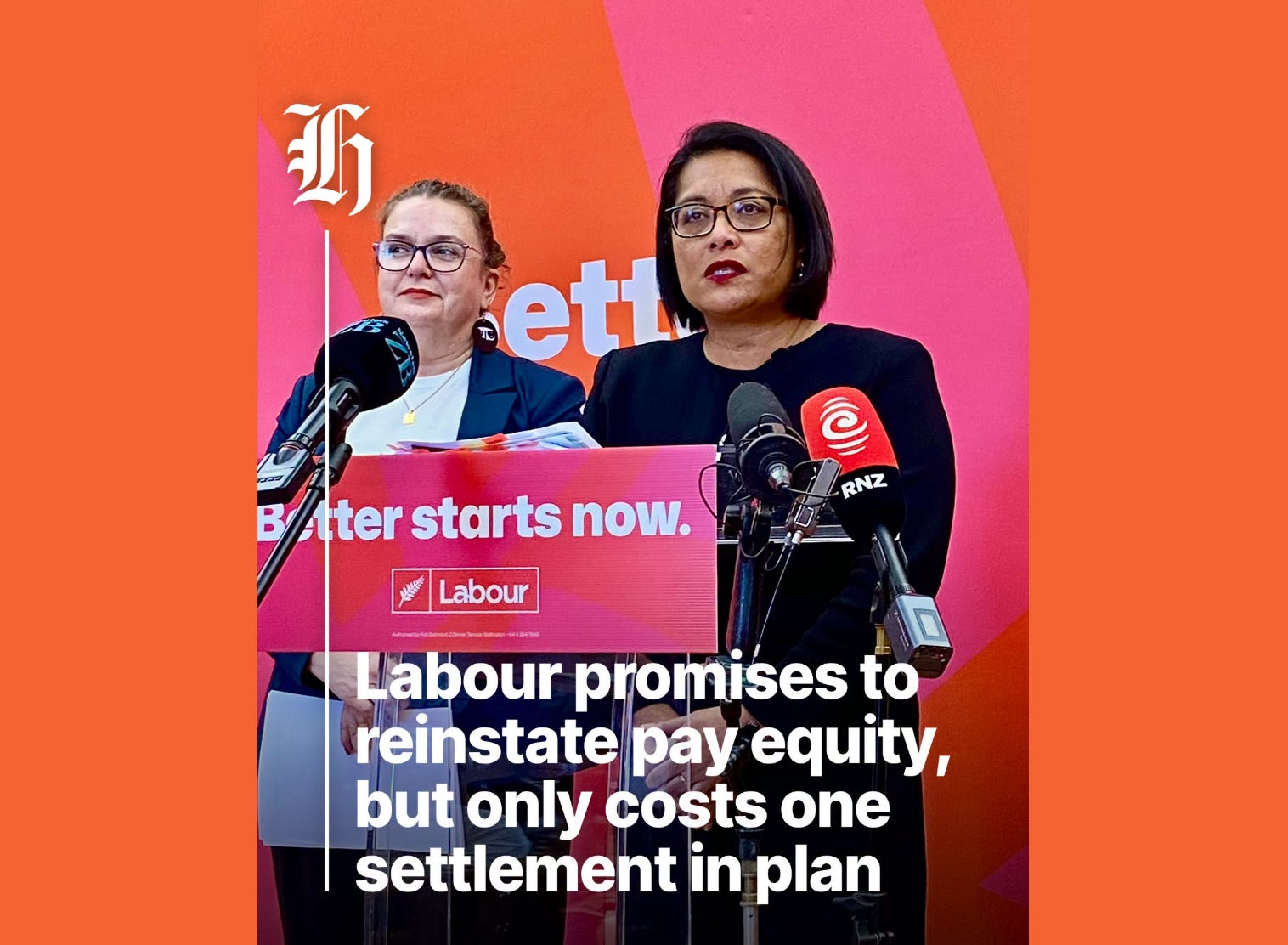
Chris Hipkins has described the coalition’s decision to cancel pay equity claims under urgency as “probably the most reprehensible thing I have seen in my time as a member of Parliament”. He accused ministers of “robbing Paula to pay Paul” and of “sacrificing equal pay for women in order to balance the budget”.
For more than a year he and Barbara Edmonds told voters that Labour’s fiscal plan would show how it intended to pay for restoring pay equity. On Sunday Labour finally showed us the money. There wasn’t nearly enough of it.
Labour has funded a $4-an-hour interim increase for about 65,000 care and support workers, costing roughly $2.5b. That is real money and should not be dismissed. But the remaining claims get no publicly identified or ring-fenced fund. Labour instead says future settlements “will be funded responsibly through future Budgets as agreements are reached and their costs become clear”.
Labour hasn’t formally abandoned its pledge to restore pay equity, and it says it would restore the law within 100 days. But by locking itself into Nicola Willis’ tight spending limits and declining to set money aside for the remaining claims, it has made full delivery very unlikely. In practice, that amounts to reneging on its promises. A Labour government will face a choice between honouring pay equity and imposing a funding freeze on much of the public service, and it should tell voters now which one it would choose. Yesterday’s Democracy Briefing, “Labour’s austerity problem”, showed how closely Labour’s plan follows Willis’ numbers.
Sixteen months of waiting for the fiscal plan
Labour could defend its current position much more easily if it had always been this vague. It wasn’t.
The day after Budget 2025, Hipkins promised Labour would “set out how much that will cost and how we will pay for that in our fiscal plan”. A month later he said the party would calculate what the claims were worth “and we’ll make sure that we’ve set aside funding to pay for that”.
By 29 September, less than a week before the fiscal plan was announced, Hipkins was saying pay equity “won’t be a specific line item”, a shift the Herald’s Jamie Ensor called a “U-turn”. Edmonds promised instead that “We will have a sufficient contingency and we’ll show that as part of our fiscal plan.”
By Sunday there was no separate contingency either. Henry Cooke reported in The Post: “There is no ring-fenced fund to meet the costs of these settlements.” Instead the party points to $10.5b of unallocated spending, which Hipkins says is “plenty of headroom”.
Labour argues that it can’t publish the full cost because each settlement has to be negotiated, and Thomas Coughlan of the Herald thinks that’s “entirely reasonable”, and Nicola Willis also keeps the Government’s own provision confidential. The issue is not whether Labour tells unions its maximum offer. It is whether its fiscal plan contains enough space to negotiate seriously. At the moment, that is far from obvious.
A pay rise isn’t pay equity
The $4 rise is still significant. Max Rashbrooke profiled Napier care worker Tamara Baddeley last year when she was earning $26.94 an hour. Someone on that wage would gain $8,320 a year before tax from Labour’s interim increase.
But Labour itself calls the payment interim. 1News described it as about half the roughly $8 an hour the unions had pushed for. The PSA and NZNO say the completed work showed care and support workers were owed increases of between 24% and 38%, depending on seniority. The Greens have put aside about $1.1b a year for the same care and support claim, just under $4.5b over four years.
There will also be no back pay for the years workers have already spent waiting. Hipkins says the eventual settlement “could still take... a year, maybe” to negotiate and complete. The PSA’s Fleur Fitzsimons has a rather different view: “We anticipate a settlement could be reached through a one-day meeting if the funding is available and the political will is clear.”
NZNO put the larger point most simply on Sunday: “a pay rise isn’t pay equity”.
And care workers are only one part of the problem. The 33 claims extinguished by the coalition covered about 180,000 workers, including people in health, education, early childhood, universities, libraries and the public service. If Labour restores those claims, sooner or later the bills arrive, and there’s no money earmarked for any of them.
The $10.5b that has to cover everything else
Labour has adopted Willis’ $2.4b annual operating allowance, which, as I noted yesterday using Coughlan’s figures, is already below the $2.5b a year Treasury last estimated is needed just to maintain existing services. As Coughlan explains, every pay round for teachers, police and corrections officers has to come out of that allowance before anything new is funded.
Over four years, this $10.5b in unallocated spending will have to pay for a lot of different demands, of which pay equity will be only one under Labour.
The pay equity plan has previously been costed at $11bn, but there’s no consensus on this. Nobody really knows the final number. But Labour has not produced a convincing alternative showing why $10.5b would be plenty to pay for the cost.
On Thomas Coughlan’s arithmetic, if the $11b is a fair guide, about 80% of Labour’s $10.5b headroom would go on pay equity, leaving about $2b over four years to cover rising costs in every part of the public service except health. “Read literally,” he writes, “Labour’s pay equity funding suggests a near funding freeze in almost every sector beyond health to fund settlements.” As Coughlan points out, that would mean Labour imposing the very austerity it has spent three years attacking.
Coughlan also thinks it “stretches fiscal credulity to believe that Labour can find about $8.5b from the money it has set aside for pay equity settlements, particularly given that money is also tagged for other things.” Newsroom’s Sam Sachdeva is just as sceptical, saying the plan makes “heroic assumptions about how far unallocated spending can stretch”.
Hipkins points to the separate health funding track and notes that many pay equity claims sit inside health. Fair enough. But Labour has essentially matched National’s health cost-pressure provision and is already using some of that money for policies such as its graduate nurse guarantee ($526m). Extra settlements drawn from the same pot still displace something else.
It’s hard to see how $10.5b can restore pay equity and also keep schools, hospitals, police and prisons properly funded. If Labour had left itself something like $20b of headroom, Hipkins’ confidence might be believable. At $10.5b, a Labour government will have to choose between keeping its pay equity promise and freezing funding across much of the state.
Which will it be? Voters, and especially the women waiting on those claims, are entitled to an answer before 7 November.
The paywall now starts partway through all Democracy Project newsletters. Please take out a paid subscription if you want to support this service and access the full content, including the following sections:
“How pay equity gets watered down”
“Robbing Paula again?”
“Labour has been here before”
“The unions need to turn up the heat”
“What this all means”