

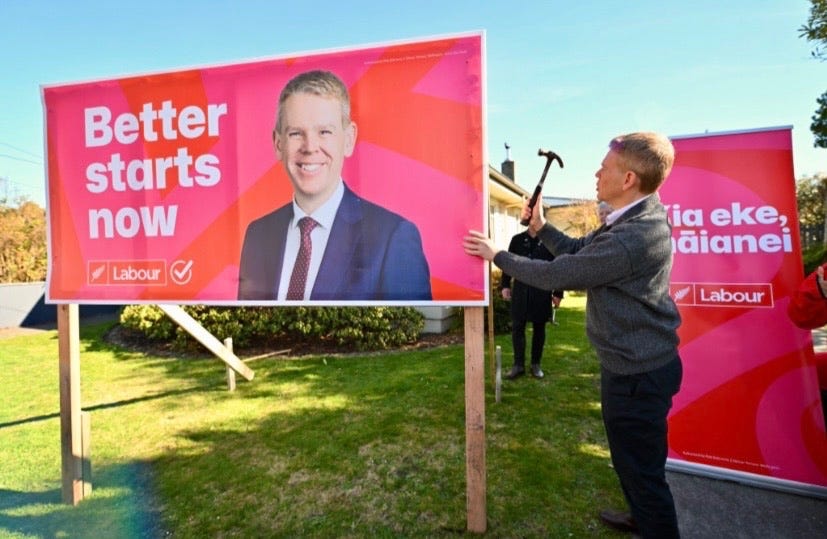
Labour’s election campaign slogan is “Better starts now”, a line that sounds as though it survived a focus group rather than sprang from a conviction. Toby Manhire noted in The Spinoff that it it “hardly rolls off the tongue, even if it could make a decent motto for an early childcare centre”. Michael Swanson, writing on his Substack, was blunter, calling it boring, underwhelming and a bit empty, a slogan engineered not to offend.
National’s campaign manager got the best line of the day by taking the words literally. “Better Starts Now” is the closest thing to a confession we will ever get from Chris Hipkins, Simeon Brown said, because with ten weeks until the election, he had better start now.
Brown was scoring a cheap point, but he was pointing at something real. The slogan promises immediacy from a party whose campaign seems missing in action, or as Ben Thomas put it in The Post yesterday, Hipkins’s current status is “missing, inaction”.
A party campaigning on the promise that “better starts now” might be expected to say what better involves, and against whom. Labour’s answer so far is hard to distinguish from National’s.
The past week has not made it any clearer. Over four days Labour agreed to support National’s under-16 social media ban, agreed to support National’s rates capping legislation, and promised not to raise fuel excise for an entire parliamentary term.
Individually, each decision can be defended. But a pattern is becoming hard to miss: whenever National finds a popular pressure point, Labour moves towards it.
The week Labour hugged National
Henry Cooke gave the week its title in Friday’s Post politics newsletter: “Labour hugs National, National pretends it isn’t happening.” On the social media ban, Cooke noted, Labour took less than a day to say it would back the bill to first reading, which matters because National doesn’t have its coalition partners on board. On rates capping, Labour also moved quickly, in what Cooke called “a larger turnaround after some months of opposing the bill”.
Then came the fuel tax. Labour promised not to raise fuel excise for the whole 2026-2029 term, much as National promised not to raise it for the 2023-2026 term. Both parties, Cooke wrote, “have decided at different times to just put their fingers in their ears and pretend this isn’t happening”.
The Herald’s political editor Thomas Coughlan reported that the promise implies around $2 billion in transport cuts, which Hipkins said would be paid for by “scaling” transport spending to fit available funding. In ordinary language, projects, maintenance or services will have to be cut or delayed.
The pattern extends beyond last week’s public announcements. Hipkins has been making the same accommodation in less public settings. The Otago Daily Times’ political editor Mike Houlahan sat in on a Business South breakfast in Dunedin just over a week ago, where the Labour leader set out the four issues his party will campaign on. Houlahan reported that the second lesson Hipkins drew from his year as prime minister was that the job should not be treated as a licence to repeal everything a predecessor did that you happened to dislike.
Hipkins painted the Luxon Government as too eager to tear up the achievements of the previous administration, and he vowed that this wouldn’t be his approach if he won power this year. According to Houlahan, Hipkins argued that “Kiwis liked continuity” and he would emulate PMs like Helen Clark and John Key who retained much of the reforms their opponents had implemented.
A Hipkins government, in other words, would leave a good deal of the Coalition’s programme where it stands. At the same breakfast he ruled out a grand coalition with National, which by the end of last week was starting to look like a technicality.
Will Labour be different to National on fiscal policy?
Gordon Campbell describes Labour’s fiscal position as a “National-lite” approach. His charge is that the party now treats a balanced set of books as the primary test of good government, ahead of whether the health system functions or whether people can afford somewhere to live.
Marc Daalder put the two parties’ fiscal rules side by side for Newsroom. Parts of Labour’s, he found, “are in effect identical to the National Party’s fiscal rules announced earlier in the month, when accounting for different measures used”. Labour wants to achieve a surplus in 2029/30 on the traditional operating balance measure, roughly equivalent to Nicola Willis’s pledge for 2028/29 on the measure that excludes ACC losses. On debt, The Post’s Tom Pullar-Strecker concluded that there is “little if any daylight” between the parties. The targets look far apart at first glance, but Daalder calculates that once the different measures are converted they sit within a percentage point or so of each other.
One number does separate them. Labour’s finance spokesperson Barbara Edmonds has set the party’s core Crown expenditure and revenue target at 33% of GDP, against National’s 30%, which suggested for a moment that the size of the state would be substantially larger under Labour.
Henry Cooke read the figure as a statement of identity: “It is a social democratic party. It wants the state to be a larger part of the economy and to worry more about unemployment. It wants to tax more and spend more.” Every 1% of GDP, he calculates, is worth around $4.35 billion, which is “not money you find down the back of the couch”. Thomas Coughlan read the same announcement as a departure, arguing that Labour had “well and truly abandoned its small target strategy” by admitting it would spend, tax and borrow more.
Labour’s announced revenue policies, however, do not explain how it would reach its own fiscal target. The party has identified only a capital gains tax, the scrapping of Investment Boost and a possible restoration of restrictions on residential-landlord interest deductions. Willis put the arithmetic in the terms most useful to her: reaching 33% of GDP in revenue means that by 2031 Labour “would need to be collecting an additional $10.3 billion in revenue every year — far more than the $1.35 billion they say their capital gains tax will raise in that same year”.
Liam Hehir made the point from the right in his Substack column by asking readers to imagine a person who sits down and writes a plan to get fit. The plan reads: reduce BMI from 33 to 20, increase daily calories from 1900 to 2300, and add a brisk five minute walk. “Would you really call that a health and fitness strategy?”
Peter Dunne reached much the same place in his Newsroom column. It would be a mistake, he wrote, to treat Labour’s fiscal strategy as a definitive plan of action: “At best, it is a very broad statement of intent.” He also punctured the idea that 33% represents any great expansion, pointing out that government spending for 2026/27 is already forecast at 32.6% of GDP. Richard Harman’s verdict in Politik was that the whole thing is “best described as aspirational”.
The most leftwing element of Labour’s programme, then, is a number with no demonstrated means of being reached and no date by which it must be. It reads to me as reassurance for a restive base. Nobody outside the party could hold Labour to it.
The paywall now starts partway through all Democracy Project newsletters. Please take out a paid sub if you want to support this service and access the full content, including the following sections: “Labour’s small target strategy doesn’t seem to be working”, and “Why the bold champions of the left are missing from Labour”.
