

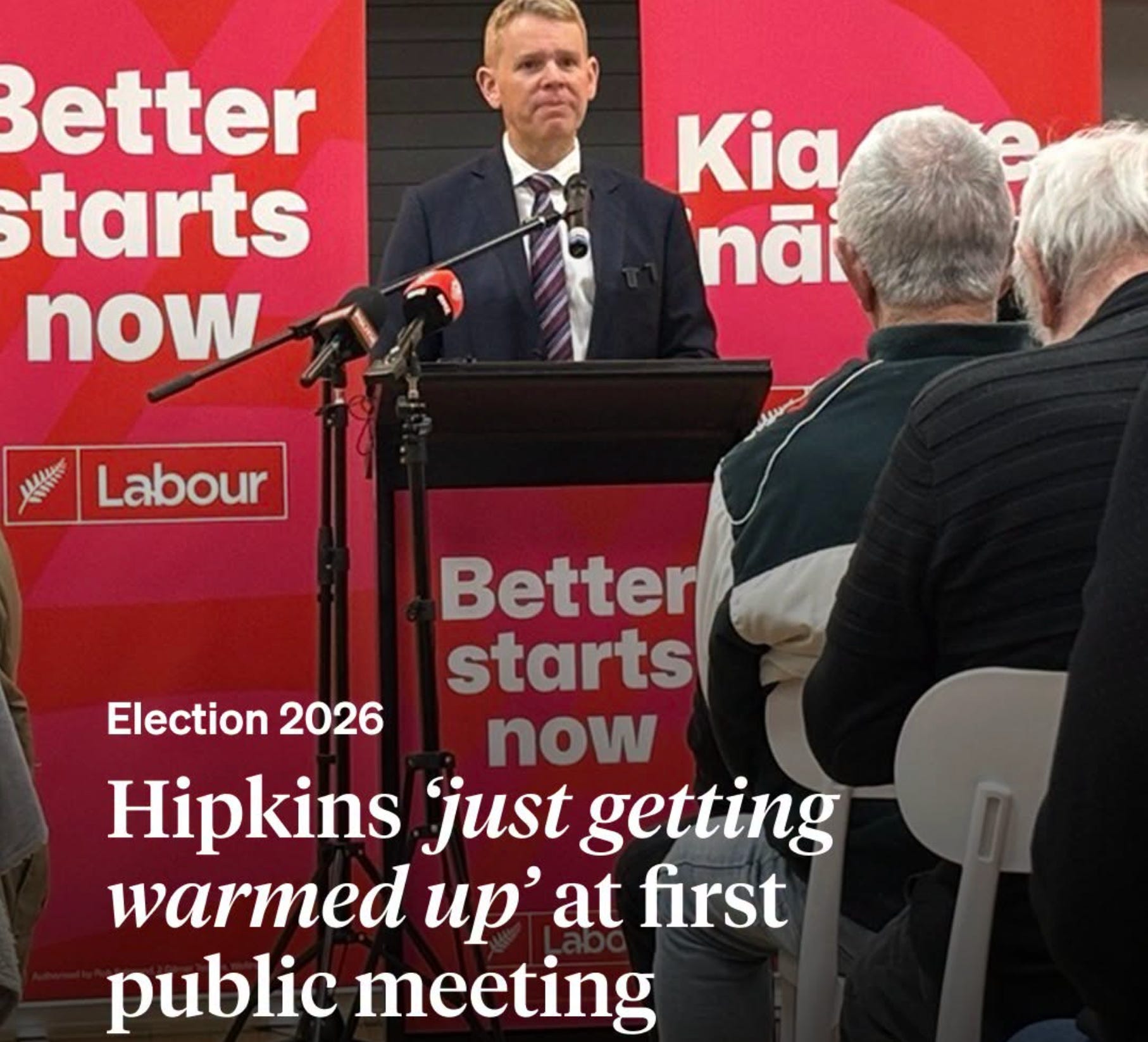
Chris Hipkins was having a pretty good night holding his first election meeting in Naenae last Wednesday when a supportive woman in the audience inadvertently handed him the line that may come to define Labour’s election campaign. The woman, who had been out door-knocking, told Hipkins that people kept asking where Labour’s policies were. Yet seeing him in person was different. “Tonight I hear someone with fire in his belly and fire in his voice,” she told him. “I don’t know why some of that just isn’t getting cut through.” Hipkins replied: “Well, you’ll be pleased to know I’m just getting warmed up.”
It got the desired response in the room. Hipkins was telling Labour supporters there was plenty more to come, and by all accounts he was good that night: energetic, comfortable and much more obviously engaged than the version of him voters often see in short television clips. But once the “just warming up” quote escaped Naenae it sounded rather less reassuring. There are now under eight weeks until election day. Hipkins has had almost three years as Opposition leader. Why exactly is Labour still warming up instead of actually running?
Stuff political editor Jenna Lynch immediately seized on the remark. “A newsflash for Chris Hipkins – the warm up is over,” she wrote. “Everyone else has been campaigning all year, if not for the last three.” Lynch argued Labour had spent most of the term listening, rebuilding trust, keeping its powder dry and deliberately making itself a small target. But, she says, “small-target politics only works if, eventually, you take aim. And Labour is failing to fire.”
That criticism resonates because Labour supposedly started firing some time ago. At the Christchurch launch of the “Better Starts Now” slogan last month, Hipkins declared: “Our campaign is kicking up a gear today.” More recently, however, he was still saying the election campaign was “sort of getting underway now”. There is a recurring problem with Labour’s promises of imminent political action: Better starts now; the campaign starts now; the fight is coming; Hipkins is just getting warmed up. At some stage, now actually has to arrive.
Labour’s support was softer than it looked
Two weeks ago I argued that Labour’s small-target approach was running out of road. I still think that, but the past fortnight has made me think Labour’s more immediate problem is slightly different. I think the party has confused dissatisfaction with the Government for enthusiasm for Labour. For much of the last year that was an easy mistake to make. Labour recovered remarkably well from its 26.9% defeat in 2023, at times polling comfortably well into the 30s. National had leadership turmoil, Christopher Luxon was unpopular, the economy remained weak, unemployment rose and households continued to complain that the cost-of-living crisis hadn’t gone away. Labour could sit back and watch.
Lynch puts it nicely: the party “had its feet up, grabbing the popcorn as National panicked itself into two failed coups”. Perhaps Labour did begin to believe that National would eventually hand back the Beehive keys without requiring too much effort from the Opposition. Heather du Plessis-Allan’s version yesterday in the Herald is much harsher. Labour’s earlier polling strength, she argues, came because Hipkins wasn’t saying enough to upset anybody, allowing the party to become “a blank canvas that voters could paint their own version on to”. Then, she says, “the minute Labour was forced to start delivering a few policies here and there, the beautiful, projected image got broken up by static.”
There is something important in her argument. Plenty of people who told pollsters they would vote Labour were probably expressing a desire to get rid of Luxon rather than declaring themselves enthusiastic Hipkins converts. That sort of support doesn’t necessarily stay put. Sooner or later Labour had to give those voters a positive reason to stick around, and the polling suggests some have instead begun looking elsewhere.
The latest Taxpayers’ Union-Curia poll put Labour on 25.9%, below even its disastrous 2023 election result. That poll may well be at the low end: Hipkins says Labour’s own polling has it above 30%, while other published polls have produced considerably better numbers. But even Hipkins now concedes there has been a downward trend. When that was put to him on Morning Report, he said Labour’s goal was “to obviously turn that trend back around”. Peter Dunne says the decline has been visible since around April, and Newsroom’s Raw Politics team reached much the same conclusion last week. One poll can be dismissed fairly easily. A pattern is harder. And tomorrow morning The Post publishes its own latest Freshwater Strategy poll, which will give further sense of the trend for Labour.
What makes all this remarkable is the political environment. As du Plessis-Allan notes, Labour is heading backwards against a Government presiding over a difficult economy, widespread dissatisfaction and a coalition that has spent a fair amount of time fighting itself. “How a party is not soaring in the polls against that backdrop,” she writes, “is actually quite an achievement in being bad.” That is characteristically severe, but the underlying question is reasonable: if these conditions aren’t enough to send voters towards Labour, what exactly will be?
Where has Hipkins been?
Anneke Smith in The Post offers one of the better explanations. Hipkins, she says, hasn’t been sufficiently visible or “earning enough currency in the attention economy”. That phrase is useful because voters aren’t sitting at home waiting for Labour policy PDFs to arrive. If Hipkins isn’t in front of them – in halls, on television, in social-media clips, having arguments and telling a story – somebody else will be.
Christopher Luxon has completed 20 town-hall-style meetings as part of National’s Building the Future Tour, which his team estimates attracted about 8000 people. Winston Peters and Shane Jones have been touring. Act has taken Paul Henry around the country. By contrast, more than 100 people and a cat turned up to Hipkins’s first public campaign meeting in Naenae. There is nothing inherently wrong with small meetings – sometimes they are better political events than stage-managed rallies – but the difference in accumulated public exposure is significant.
The interesting thing is that Hipkins apparently did very well. RNZ spoke to attendees who were impressed by his command of the room; one supporter said he “spoke with passion”, while another voter, who plans to give Labour only her electorate vote, said she was “pleasantly surprised” by how articulate and passionate he was. Yet she also indicated that none of this had previously come across. That is Labour’s problem: Hipkins may have more political energy than his public image suggests, but elections are won on the version of politicians that voters actually encounter, not the one familiar to caucus colleagues or supporters sitting in a community hall.
Smith notes that Hipkins has always been better at explaining things than performing them. In Parliament he is quick, confident and often very effective. Public campaigning is different, and Labour insiders, she reports, worry that he can look as though he “just isn’t that pumped to be there”.
There are some fair excuses for the late public-meeting campaign. Thomas Coughlan has reported that one consideration for Labour’s timing was when an Opposition leader becomes able to use the Diplomatic Protection Service during an election campaign. Given increasingly ugly behaviour at political meetings, that is hardly trivial. But really explain Labour’s inaction for three years.
Labour insider and corporate lobbyist Neale Jones was blunt about that on RNZ’s Nine to Noon Politics panel this morning: “You can’t fatten the pig on market day, and you need to be making your case strongly and stridently for the years leading up to the election campaign. And Labour hasn’t taken that approach.” Coming from someone in the Labour camp and familiar with how its campaigns operate, that is a fairly damning assessment.
The paywall now starts partway through all Democracy Project newsletters. Please take out a paid sub if you want to support this service and access the full content, including the following sections: “Labour has policies, but National has the story”, “The PREFU excuse”, “Hipkins has made this mistake before”, and “There is still time”.