

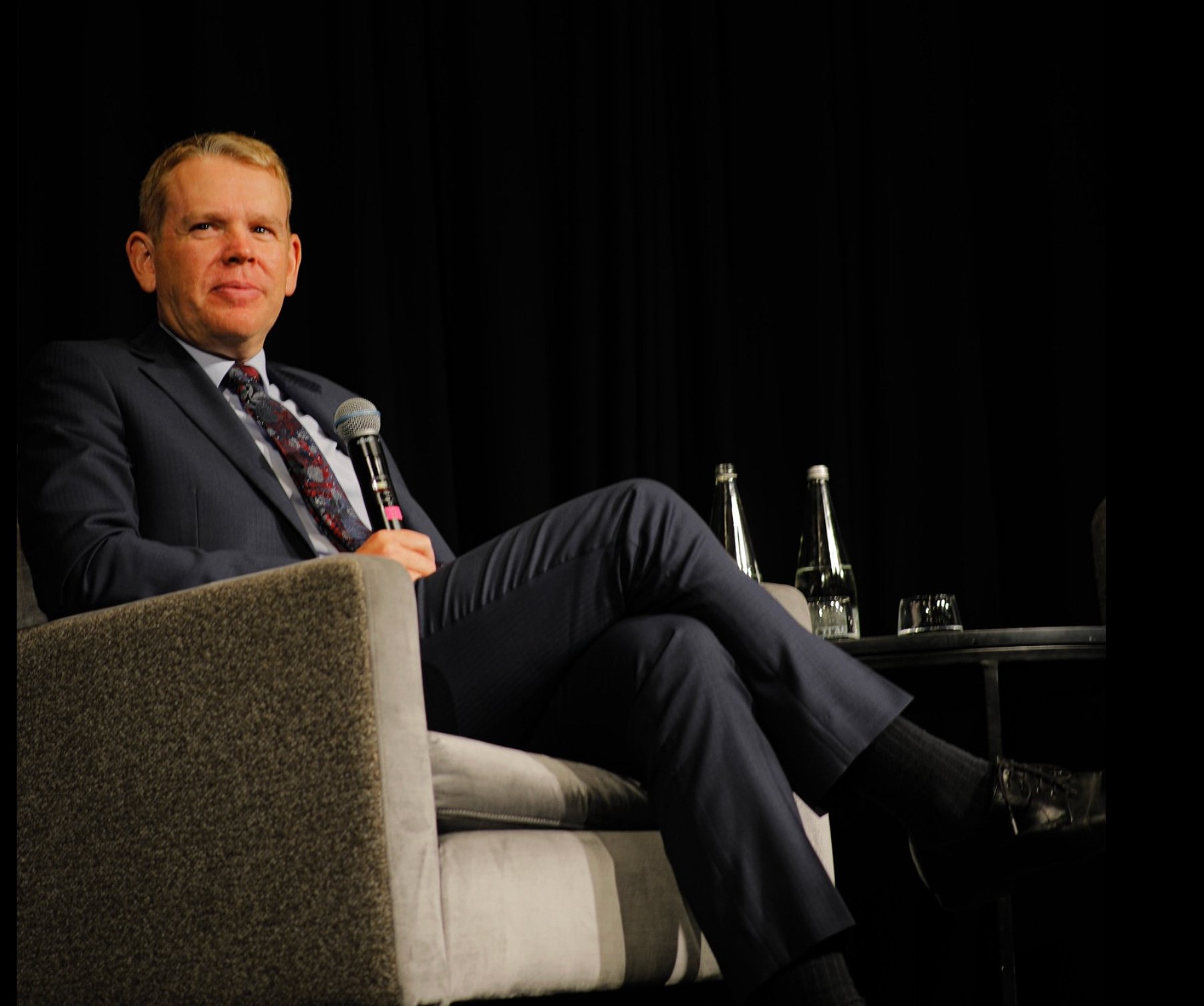
As Labour convenes in Auckland this weekend for its annual conference, the political atmosphere is almost unrecognisable from the despondent aftermath of the 2023 election defeat. The party that won just 26.9% of the vote less than two years ago now sits between 32-38% in recent polls. One-term governments are no longer unthinkable. Chris Hipkins, improbably, remains secure in his leadership without any meaningful challengers circling.
Yet this surface recovery masks deeper tensions that could yet derail Labour’s comeback before voters get a chance to render their verdict in 2026. The big questions facing the party are structural ones.
How far left should Labour lean on tax and spending? Can it maintain party unity while internal factions fight over whether a capital gains tax is progressive enough? How will it navigate the increasingly fraught question of Te Pāti Māori as a coalition partner? Could it mend fences with NZ First? And perhaps most crucially for a party that has spent the past two years rebuilding: has Labour actually learned anything from its turbulent final year in office, or is it simply repeating old patterns with a slightly chastened veneer?
The Stability paradox
Hipkins’ survival as leader after taking Labour to one of its worst modern defeats is genuinely remarkable. In New Zealand political history, prime ministers typically carry the can for electoral disaster and step aside, allowing their party to rebuild under fresh leadership. Hipkins has defied that gravity entirely.
Thomas Coughlan of the New Zealand Herald observed today that Hipkins heads into his second conference in opposition with the party in “unexpectedly good shape”. More than that, Labour has avoided the kind of internal civil war that typically ravages first-term opposition parties. There is no open coup attempt, no destabilising leaks, no factional bloodletting of the type that defined Labour’s opposition years in 2011-2014.
This stability is partly real and partly constructed. Hipkins has managed his party by creating “plenty of space for good internal debate”, particularly on the contentious issue of tax policy. But underneath that unity lies something more complicated: an agreement to unite around caution rather than ambition.
Some party insiders grumble, according to reports, that Hipkins has “smothered” bolder ideas like a wealth tax much as he did in 2023. The CGT versus wealth tax debate that consumed caucus for over a year was described by Coughlan as not without “rancour and hurt feelings”.
A “Win the Wealth Tax” ginger group in the party continues pushing for more progressive taxation despite Labour’s commitment to the narrower capital gains tax. Side events at this weekend’s conference on Palestine will push Hipkins to campaign on sanctioning Israel, a position he explicitly endorsed in September when describing Gaza as “a genocide”. These internal fractures are not visible in the daily media narrative but they are real nonetheless.
The Centrist question
This raises the deeper ideological question facing Labour. Is it trying to resurrect a centrist management, or is it moving toward a more transformative left-wing vision?
Leftwing commentators argue Labour still looks like a “centrist managerial machine,” offering what one critic called technocratic tinkering inside a neoliberal framework rather than any serious redistribution. The new policy platform seems modest by comparison to the Ardern government’s ambitions. A Future Fund, a capital gains tax with significant exemptions, a gaming rebate. It reads, on this interpretation, more like tidying the edges of an unfair system than challenging it fundamentally.
Veteran leftwing columnist Chris Trotter has been particularly scathing. He argues that Labour has abandoned its socialist soul and become dominated by university-educated activists for whom identity politics eclipse bread-and-butter class concerns. His critique cuts both ways: at the very moment when economic leftism has made a global comeback (Bernie Sanders, new socialist mayors abroad, a renewed focus on inequality), Labour is stuck fighting yesterday’s battles over pronouns and cultural representation. Worse, Trotter argues, the party has alienated its traditional working-class base in the process, leaving blue-collar voters convinced Labour cares more about virtue-signalling than the price of milk.
Similarly, in departing this year, MP David Parker advised the party to shift towards more class politics. Reporting on Parker’s departing advice, Newsroom’s Sam Sachdeva says: “Parker has also moved away from identity politics and towards the politics of class, citing debates about the role of transgender people in sport and the use of pronouns as potential distractions from more pressing concerns.” Parker was quoted: “I’m not denying the importance of those issues to the people involved, and I don’t want to appear unsympathetic to the aims, but I think too much political capital is squandered on those issues relative to the economic issues, which I think lie at the heart of a settled and fair society.”
Hipkins has tried to straddle this line. As prime minister he conspicuously downplayed contentious identity issues, projecting a more moderate image than his Ardern-era persona. In opposition, he has continued that cautious positioning. He talks about grocery prices and hospital wait times far more than pronouns or historic grievances. But whether he can satisfy a base demanding real redistribution while also reaching the centrist voters whose support is essential for 2026 remains genuinely uncertain.
Henry Cooke of The Post has posed the central strategic question: is Hipkins trying to bring back the Ardern era, or take Labour somewhere else? So far the evidence suggests he is committed to a restoration project, not a revolution.
The Policy moment
Labour has largely concluded its post-election policy review and is now shifting into campaign mode. After nearly two years of consolidation, the party is finally emerging with something substantive to say.
The capital gains tax represents the resolution of fierce internal debate. Labour’s base, demoralised by years of timidity on tax reform, appears energised to see the party finally champion a CGT. One particularly striking data point came from the Talbot Mills poll, which showed Labour’s support leaping upward to 38% immediately after it unveiled the tax. That boost suggests the policy has cut through to at least some voters.
But the CGT is modest. The exemptions are substantial. Multiple assets that would seem natural targets remain protected. And there is still ambiguity about revenue, with a rumoured new Digital Services Tax (on the likes of Google and Facebook) likely to raise considerably less than the $479 million the previous government had estimated would be possible.
The bigger fiscal problem is pay equity. The National-led government’s early decision to cancel many pay equity claims for nurses, teachers and other female-dominated professions handed Labour a potent weapon. It allowed Hipkins to cast the coalition government as callous and anti-worker. Labour has vowed to reinstate those pay equity agreements and Hipkins has accused the government of making misogynist decisions.
But here is the catch. Treasury estimated that undoing these changes would cost $12.8 billion. That is a staggering figure, roughly 25 times the annual revenue of the proposed Digital Services Tax. Hipkins has been evasive about the actual cost, saying repeatedly that Labour’s commitment to full pay equity is “unequivocal” but that the full policy and cost will be set out “next year.”
This evasiveness has been noted by journalists and opponents alike. Thomas Coughlan points out that Labour will find it difficult to fund the policy as it is without significant cuts elsewhere, yet if it tries to trim the promise, it could face a members’ rebellion from unions and the party base. It is an exercise in political cakeism: telling the base you’ll fix the problem, but not spelling out the painful trade-offs such a fix would require.
This is a significant strategic problem. Finding an extra $12.8 billion would require either massive spending cuts elsewhere or tax increases far beyond what Labour has proposed. Yet failing to fully fund restoration of pay equity risks what could be a “war between the party and its base”, particularly with the public sector unions. Hipkins appears to be hoping that a modified policy costing less than the original estimate might square this circle, but the ambiguity leaves Labour vulnerable to attacks on its fiscal credibility from the right and accusations of betrayal from the left.
The Candidate selection test
If Labour wants to present itself as a genuinely renewed force, its choices about candidates matter. After the heavy cull of experienced MPs that followed the 2023 defeat, who the party recruits will tell a story about where it is headed.
The selections reveal a mix. Craig Renney, an economist and policy director at the Council of Trade Unions, has been chosen for Wellington Bays. He is a quintessential Labour pick: a trade unionist with serious policy chops, but also a former Beehive official behind Grant Robertson’s finance decisions.
Ayesha Verrall, one of Labour’s most effective ministers, has won nomination for the new Wellington North seat, defeating sitting MP Greg O’Connor. It secures Verrall’s position as a future leadership contender and signals the party’s intent to aggressively contest the urban liberal vote against the Greens.
Similarly, Sophie Handford, known for organising School Strike 4 Climate, has been selected for Kāpiti as a direct challenge to the Greens, aiming to capture the climate-conscious youth vote that has drifted away from Labour.
Long-serving MP Phil Twyford is resisting suggestions that he make way for new blood, saying he has “no intention” of standing down and believes he is doing “some of my best work.” Hipkins has indicated he expects “a few retirements and some hotly contested nominations” before 2026 and frames this as evidence of renewal.
One notable observation from political commentators is that Labour has lost genuine centrists. Stuart Nash’s defection to NZ First in September prompted Heather du Plessis-Allan to observe that he was “a proper centrist in the Labour Party”. She asked: where are Labour’s centrists now? “Back in the day, Labour had heaps of them. They had Phil Goff, David Shearer. Now, name one for me.” Of course, some on the left of the party would immediately answer: “Chippie”.
The Michael Wood problem
The most controversial personnel decision of the cycle is the re-selection of Michael Wood as Labour’s candidate for Mt Roskill. Wood resigned as Transport Minister in June 2023 after failing to declare shares in Auckland Airport while holding a relevant ministerial portfolio. The Cabinet Office had reminded him or his office 12 times to sell the shares. Further revelations exposed additional undisclosed holdings in Chorus, Spark and National Australia Bank held in a family trust. He resigned from Cabinet in disgrace, but has never fully explained his integrity failure.
Hipkins has publicly supported Wood’s return but with significant caveats, saying Wood “needs to regain the trust of his electorate, and then he needs to regain the trust of his colleagues” before he could hold a role in a future government. Wood himself frames his candidacy as personal redemption, telling the NZ Herald Front Page podcast this week: “I made an error and there are no excuses. I apologised, accepted the consequences, and I’ve taken that lesson seriously.”
From an integrity point of view, this move is genuinely risky. It needs to be remembered that Labour’s 2023 defeat wasn’t just about policy; it was also a referendum on competence and integrity. The final year of the Ardern/Hipkins government was marred by ministerial scandals, so the return of Wood could be damaging.
Labour is asking voters to believe it has changed since a period of rolling ministerial scandals (Kiri Allan, Stuart Nash, Michael Wood himself). Then it promptly re-elevates one of the key figures associated with that era of carelessness around ethics rules. Mt Roskill is safer ground than many seats, but National’s Carlos Cheung now holds it and boundary changes give National some advantage. If Wood wins convincingly and behaves impeccably, Labour will claim vindication. If not, the party has drawn fresh attention to exactly the sort of integrity issue it is trying to move past.
The Te Pāti Māori equation
Labour faces a paradox on Te Pāti Māori. The party cannot outright reject working with TPM without cutting off its most viable coalition mathematics. But embracing TPM too closely could be electoral suicide in the wider electorate.
Hipkins has adopted a harder public line. He has repeatedly refused to confirm whether Labour would work with Te Pāti Māori after the election, saying only that “lots can change in a year.” He has been content to bash TPM’s performance this term, suggesting the party has made itself irrelevant due to infighting and not contributing anything but drama.
Matthew Hooton, writing from the centre-right, has argued that if Hipkins wants to reach the 140,000 National voters he needs, both he and the Greens co-leaders will have to be “much more forthright in ruling out working with TPM in Government.” Whether Hipkins can maintain this ambiguity until 2026, or whether he will eventually have to give voters clearer guidance, remains one of the genuinely open questions facing Labour. It is also, according to reports, one of the most contentious and difficult topics of conversation within the party.
The Winston factor
What few people in Labour feel comfortable discussing is the possibility that their pathway back to government might run through Winston Peters and NZ First as kingmakers. This may be one of the most fraught topics facing the party this weekend.
Notably, Labour has reportedly tried to convince former NZ First Cabinet Minister Tracey Martin to stand for the party at the next election. She has been invited as a keynote speaker this weekend. The party seems to be quietly making itself more compatible with NZ First, which is an extraordinary statement about how Labour sees its coalition options.
What to watch for
The 2025 Labour conference is unlikely to generate a single big drama. The leadership is secure. There will be no public coup, no obvious challenge to Hipkins, no repeat of the Cunliffe years.
The media is mostly locked out anyway, with Labour, like other parties, now closing its conferences to the press. So unlike some past conferences that featured open policy sessions or at least robust journalist attendance, this year’s gathering is a tightly controlled affair. Most workshops, discussions, and votes will happen away from cameras. The public will likely only see curated snippets such as a set-piece speech from Hipkins, carefully managed photo-ops of unity, and little else.
Officially, Labour might defend this decision as standard internal party business. After all, AGMs are primarily for delegates and members. But the timing and optics of barring media are hard to ignore. Coming right as Labour is trying to prove it’s learned its lessons, the semi-secret conference suggests the opposite: a party uncomfortable with scrutiny and lacking confidence in its own unity. If the leadership truly believes the party is cohesive and its policy debates are resolved, why hide the proceedings? By keeping journalists out, Labour has ensured that any internal dissent or controversial motions stay in-house. However, they’ve also signaled to the public that something might be worth hiding. It feeds a narrative that Labour’s unity is more performative than genuine, and that the cracks are there but must be kept behind the curtain.
Nonetheless, reports on the conference will filter out. And the signs to watch will be subtle:
Do the conference speeches and resolutions signal that the CGT-plus-health package is locked in as the party’s defining economic story, or do grassroots activists keep pushing for a more radical tax and welfare agenda?
Does the leadership offer any clearer guidance on Te Pāti Māori, or continue to fudge, hoping to get through another year without taking a firm position?
Are there signs of real generational renewal in candidate selections and frontbench positioning, or does the party still present too many faces associated with the mistakes and scandals of its last term?
The party that convenes in Auckland this weekend is both stronger than many expected and more fragile than it looks at first glance. It has momentum on its side and a government struggling with recession and low approval ratings. But whether that momentum is enough, and whether Labour has actually learned the lessons it needs to learn, are questions the weekend may start to answer.
Dr Bryce Edwards
Director of the Democracy Project
Further Reading:
