

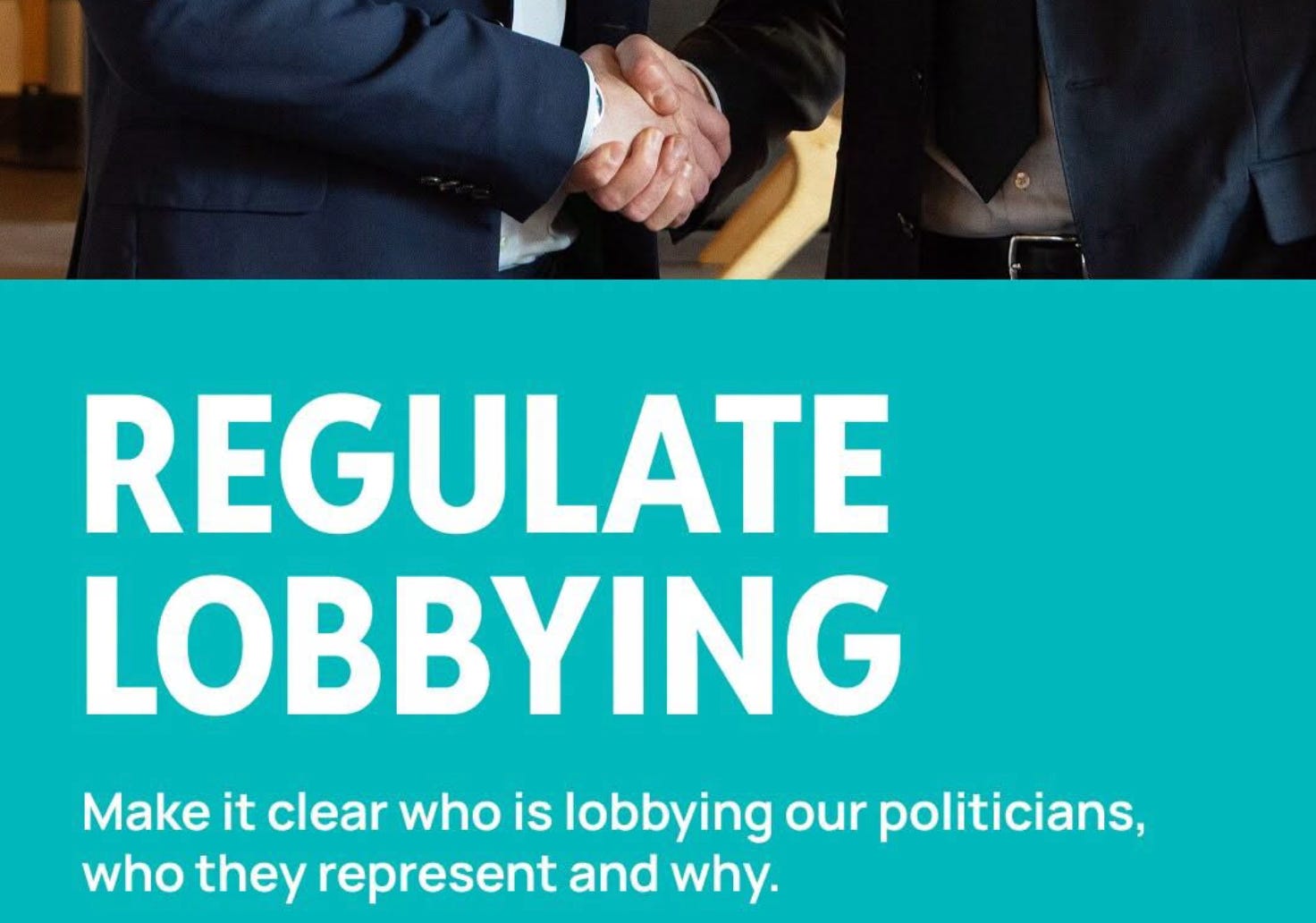
For the first time, the regulation of lobbying has become a condition for forming a government in New Zealand. Yesterday the Opportunity Party named five “non-negotiable” policies that any party wanting its support to form a government would have to accept, and one of them is regulating political lobbying. Leader Qiulae Wong said that “New Zealanders deserve to know who is trying to influence their government, and no one should be able to buy disproportionate political influence.” She was blunt on what the party would not compromise on: “We will require real reform of lobbying and political donations.”
The announcement comes after a fortnight in which the Greens published a detailed lobbying policy and draft legislation, Victoria University researchers released a major report on lobbying, and the Public Health Communication Centre tried to pin the political parties down on where they stand.
Lobbying reform is receiving more sustained attention in this election campaign than ever before. But the history of the issue provides plenty of reason for scepticism. New Zealand has never been short of politicians willing to criticise lobbying from opposition. What it has lacked is governments willing to impose significant restrictions on political access and the revolving door once those relationships become useful to them.
Opportunity’s announcement matters because the latest 1News-Verian poll has the party on 6%, or seven MPs. Under both seat scenarios calculated by 1News, neither the current governing bloc nor Labour, the Greens and Te Pāti Māori reaches a majority without Opportunity. So, on those numbers, lobbying reform has something it has rarely possessed in New Zealand politics: bargaining power.
The easiest promise to keep badly
Of all Opportunity’s bottom lines, lobbying reform may be one of the easiest for a major party to concede. It has little direct fiscal cost, there is substantial public support for greater transparency, and politicians on both left and right have previously endorsed variations on the usual reform package.
That also creates a risk: lobbying reform may be easy to satisfy in name while changing rather less in practice.
There is already some ambiguity in Opportunity’s position. Its full Clean Up Politics policy promises a one-year cooling-off period between senior government roles and lobbying, a mandatory public and searchable register, and a statutory code of conduct with “real consequences for misconduct, including deregistration and fines”. But its new bottom-line document is narrower. It says any governing partner must accept “a mandatory register and code of conduct for lobbyists”, along with its separate requirement on political donations. The one-year revolving-door restriction is not expressly included in the bottom-line wording, nor are the proposed fines.
That may simply be shorthand. But what would another party actually have to agree to? Would the complete lobbying package need to be enacted? Would a register and mandatory code be enough? Could the next government agree to the principle, send officials away for another year of policy design and declare the condition met?
There is plenty of history of lobbying reform going into the system and very little coming out. In 2023 Chris Hipkins responded to a series of lobbying controversies by backing the development of a voluntary code and announcing longer-term work on regulatory options. National was then in opposition, and Nicola Willis went further, supporting a transparent public register and a 12-month stand-down before former ministers could move directly into lobbying. Once National took office, however, the urgency drained away. Justice Minister Paul Goldsmith put lobbying reform alongside all the other competing demands on his portfolio and the regulatory project stalled. The pattern is bigger than National: lobbying reform always seems more urgent from the Opposition benches.
Max Rashbrooke put the political pattern rather neatly to Newsroom’s Fox Meyer last week. He said lobbying reform is something opposition parties can use to “embarrass” governments, only for it to become “suddenly not a priority” after they take power. Of National’s earlier commitments, he observed: “In practice, however, they have – strangely enough – not found it a matter of urgency to implement them.”
That is what makes Opportunity’s move potentially different. A manifesto promise can quietly drop down a ministerial work programme. A provision in the coalition agreement that establishes a government is harder to lose without somebody having to explain why. But that only works if the commitment is precise enough that another review, another code and another promise to look at the difficult bits cannot be presented as delivery.
Labour answers without answering
Yesterday the Public Health Communication Centre released a survey report on what the various parties will commit to on lobbying and democracy reforms. Apart from Opportunity and the Greens, no other parties were fully committed to reform of lobbying. On lobbying reform the report’s summary table labels Labour’s response as “Unclear”.
The full response explains why. Labour was asked a straightforward question: “Will your party introduce an online, public and searchable register of lobbyists…?” It replied: “Labour believes it’s important we have a sensible and transparent system that does not give the impression that lobbyists enjoy an unfair advantage over other New Zealanders.”
That is not a yes. The wording is also notable: it talks about the impression of unfair advantage rather than explicitly saying that an unfair advantage exists.
Labour can reasonably point out that it initiated the 2023 reform work and that health spokesperson Ayesha Verrall has lodged a Tobacco Transparency Bill. But the party has still not set out a clear general package covering a statutory lobby register, disclosure of lobbying activity and restrictions on the revolving door.
The other party responses are hardly conclusive either. Te Pāti Māori says it is “open to supporting specific policies which promote greater transparency over commercial lobbyists as a part of Coalition Agreement negotiations”. New Zealand First did not give a clear answer on a lobby register and warned that “for a lot of areas” its 2026 policies were yet to be finalised. National and Act did not respond to the Public Health survey at all. The authors find broad support for reform, but agreement on an actual statutory regime is much thinner.
The paywall now starts at halfway through all Democracy Project newsletters. Please take out a paid sub if you want to support this service and access the full content, including the following sections:
“Would the Greens really prioritise lobbying reform?”
“Reading the Greens’ lobbying fine print”
“Swimming in a sea of lobbying”
“The lobbyist who thinks the problem is overstated”
“The test after the election”