

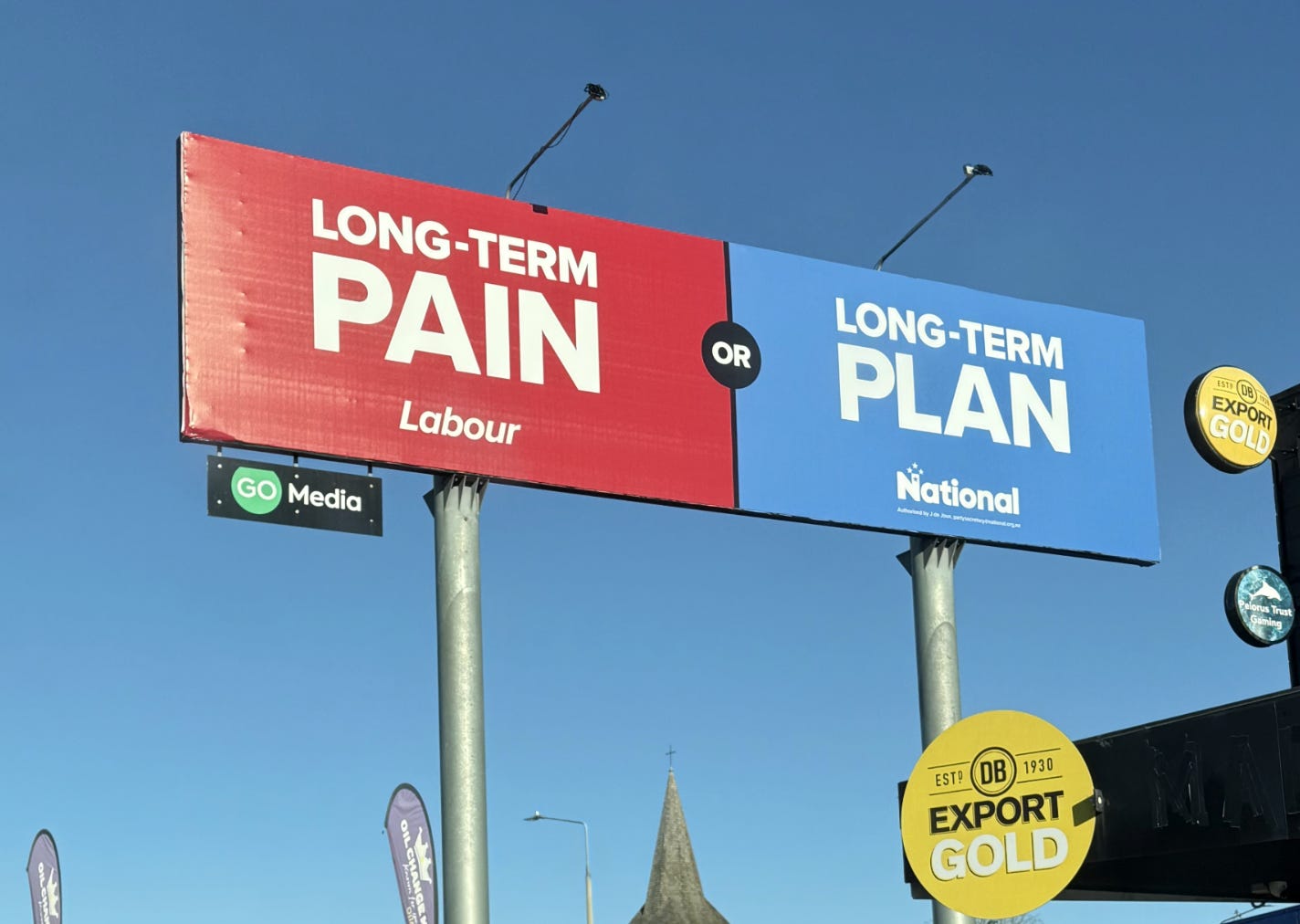
Drive around any New Zealand city at the moment and you will probably pass one of National’s new election billboards. It puts a blunt choice to voters: long-term pain under Labour, or a long-term plan under National. Putting aside the partisan framing for a moment, it is, I think, the best question National has asked all year.
It speaks to something real. A lot of New Zealanders do think the country is broken, or at least not working properly anymore. Living standards have gone backwards. Public services feel stretched and unreliable. Politics has become too much about the next announcement and not enough about the next decade. That is why I keep coming back to the phrase “Broken New Zealand”. People recognise it because they feel it.
The problem for the Government is that Budget 2026 does not answer the question its own party is asking. Admittedly, their rhetoric is all about a long-term plan. But what Nicola Willis actually delivered yesterday was something much closer to a long-term wait.
First, the credit where it is due
Willis resisted the election-year lolly scramble. There were no tax cuts, no household handout, no rabbit pulled from the hat. In fact, as Andrea Vance noted, the Finance Minister spent her pre-Budget interviews talking about dead rabbits, insisting Labour had already killed them all. Ministers had spent weeks “Cassandra-ing their way around the business circuit and lowering expectations to ankle height”.
In an election year, Willis’ restraint is genuinely unusual, and it is not nothing. Government debt is high and still rising, the cost of servicing it is real, and the ratings agencies are watching. There is a legitimate argument for rebuilding the buffers rather than spending money the country does not have. For this reason, Newstalk ZB’s Heather du Plessis-Allan even argued the Budget was not tight enough.
The 1News team summed up what the Budget does as “keeping the lights on”, and that is a fair description. There is real money in it, for hospitals, schools, roads, rail, police and defence, and Willis has been careful to set aside a contingency of around $450 million in case the fuel crisis gets worse.
None of this is reckless, and very little of it is cynical. But almost all of it is catch-up and maintenance, the basic upkeep of a country rather than an attempt to change its direction. Keeping the lights on is not the same thing as turning the country around. That is where the Government’s case starts to thin out: in the gap between “competent housekeeping” and a plan for the future.
The Budget the right and the left agree on
What was striking about the Budget reaction was not the disagreement, but the agreement. Luke Malpass, about as Establishment a press-gallery voice as we have, labelled it as: “modest consolidation, not economic reform”, or as he also put it, “dour, not daring”.
Pattrick Smellie, writing for a business audience, judged it fiscally prudent but politically neutral, and warnedit does nothing for the “national malaise” — the country’s need for “a credible turnaround in a widely perceived national decline”.
From the left, the Spinoff’s Joel MacManus described the Government as “shuffling the deck chairs on a drifting Interislander ferry”. Janet Wilson, a former National Party communications hand, heard the Budget as “the can being kicked down the road. Again.” Wilson also mocked the perpetually-promised recovery, saying the good times, “still a-coming, baby, just over that hill”.
When the business and leftwing commentariat are landing on the same verdict, that is worth paying attention to. Even the Budget’s defenders concede the underlying point. Liam Hehir, who thinks Willis has handed National a usable election line, makes his case on the basis that voters “need to believe the Government has found the road”. He says it gives National a line to campaign on: the books are improving, the ship is turning, and Labour would put it all at risk. That is an honest argument, but notice what it is conceding. That is revealing. Even the defence of the Budget rests less on a plan than on a forecast.
A surplus that depends on the future arriving
The surplus forecast is the number Willis wants voters to remember. Willis has pulled the return to surplus forward by a year, to 2028/29, with a headline figure of $2.6 billion. It’s a real political achievement, and the Government will milk it. But the surplus is doing more work as a story than as a number, and it rests on three things that may or may not hold. Andrea Vance, in The Post, called it “the real sleight of hand”. And Stuff political editor Jenna Lynch called it a kind of “fake surplus”.
Start with the measuring stick. The surplus is calculated on OBEGALx, the Government’s preferred yardstick, which strips out ACC and tends to run around $3 billion closer to the black than the traditional measure. On the old measure, the books balance a year later. Vernon Small called this “measurement cherry-picking”.
Then there is inflation. The same fuel-driven inflation Treasury treats as a temporary shock is also lifting the nominal tax take and helping float the Budget back towards surplus.
And then there are the savings. Many arrive late in the forecast period and depend, in Smellie’s words, on “heroic assumptions about the potential impact of artificial intelligence on productivity”. In other words, some of the repair has not happened yet, and some of it may never happen at all.
And the recovery itself keeps receding. MacManus pointed to a graph buried in the Budget documents showing the economic boom Treasury keeps predicting and the flat line the economy keeps delivering — the forecast recovery, in his refrain, is forever “tomorrow, tomorrow, tomorrow”, and Treasury’s whole effort is starting to look like “astrology with spreadsheets”. Vance put it more drily, observing that somewhere between Christmas and autumn Treasury appears to have suffered “an attack of the Pollyannas”.
The clincher is that Treasury itself rates the chance of actually reaching an OBEGAL surplus over the forecast period at no better than even. So the surplus is real on paper and fragile in practice. It assumes the oil shock fades, inflation behaves, and AI delivers productivity gains that nobody can yet point to. As Vance put it, “much of the repair happens on paper, and much of it happens later”.
The paywall now starts at halfway through all Democracy Project newsletters. Please take out a paid sub if you want to support this service and access the full content, including the following sections: “A settlement, not a plan”, “Where is the plan?”, “A broken economy, and a broken politics”, and “Long-term wait”.
