

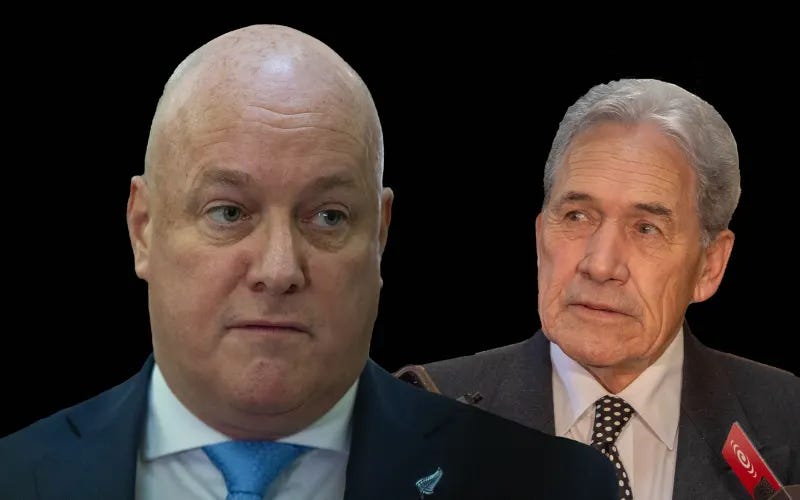
Christopher Luxon has now called the remarks made by his Foreign Minister “racist” and “offensive”. He says Winston Peters should apologise, but Peters has refused to do so. Luxon nevertheless retains confidence in him, will not remove him from the foreign affairs portfolio, will not say whether Peters has met the professional standards required by the Cabinet Manual, and will not reveal what happened when the two men finally discussed the matter. Instead, the Prime Minister has suggested that New Zealanders who are unhappy about Peters’ behaviour should respond by giving National their party vote on November 7. In effect, ministerial accountability has been deferred until the election.
The controversy is now about more than Peters telling Green MP Lawrence Xu-Nan to “go back to your own country”, where people supposedly “lie like a flatfish”. The racist nature of those comments has been well covered, and even Luxon accepts that description. Luxon can advise the Governor-General to remove Peters from ministerial office, but NZ First’s votes are essential to keeping Luxon’s Government in power. The Prime Minister’s authority is therefore worth much less than it looks on paper, and Peters understands this.
Why Luxon will not sack Peters
The Post’s editorial on the affair yesterday offered the strongest possible indictment of the PM, saying that “Christopher Luxon now holds his job in a de jure sense only”, and that “the charade is unveiled: it is Mr Peters who is the de facto prime minister and controls the government”.
The editorial goes too far. Peters does not run the entire Government, and National remains numerically dominant in Cabinet. But it is right about the weakness exposed by this affair. Peters appears to have acquired something close to an informal veto over the enforcement of ministerial standards against himself, because National believes dismissing him could bring down the Government.
Luxon plainly does not agree with Peters’ remarks. He has defended Xu-Nan as a full and equal New Zealander and condemned attempts to denigrate immigrants. “He may think he’s Nigel Farage and Marine Le Pen and Pauline Hanson and Donald Trump,” the Prime Minister said, “but we have legal immigration in this country.” Yet none of this has produced any consequence. Peters has not withdrawn his words or accepted that he did anything wrong. After meeting Luxon, he emerged to tell reporters that their discussion was private and that he would not be apologising. Whatever the PM said to him, it does not appear to have altered Peters’ position.
This was the central concern of The Post editorial. Because ministers serve at the Prime Minister’s pleasure, it argued, retaining Peters necessarily communicates that Luxon regards the behaviour as compatible with ministerial office, whatever his personal objections might be. The editorial then turned to National’s caucus, saying MPs needed to remind Luxon of his role as “the ultimate standard-setter in government”. If the caucus failed to do that, it said, it “can only be assumed” to accept such behaviour from the country’s most senior political leaders. The conclusion is harsh. The underlying issue is harder to dismiss. If ministerial conduct can be publicly denounced as racist and unacceptable, yet attract no sanction because imposing one would be politically inconvenient, the ministerial standard involved has very little practical meaning.
A minister is always a minister
Luxon’s central defence has been that Peters made his comments as leader of New Zealand First during a general debate in Parliament, rather than in his role as Foreign Minister. This is the so-called “two hats” argument, and it is not very convincing. Section 2.56 of the Cabinet Manual says that, in their ministerial, political and personal roles and “at all times”, ministers must uphold the highest ethical and behavioural standards and are ultimately accountable to the Prime Minister. The wording does not provide an exemption for speeches delivered as a party leader or comments made during an election campaign.
Former Speaker and Trade Minister Lockwood Smith expressed the point more directly when he said that Peters remained New Zealand’s Foreign Minister at all times while he held the warrant. Foreign governments will see it that way whatever Luxon says. The Chinese Embassy did not lodge its “solemn representations” with the New Zealand First organisation, it dealt with the Ministry of Foreign Affairs and Trade, which Peters leads. His ministerial office then issued a statement saying he stood by his comments, further undermining the claim that this was simply a private party-political intervention that had nothing to do with his position in the government.
The same difficulty was obvious in the international coverage. As Toby Manhire observed at The Spinoff, the overseas wire reports referred to Peters as New Zealand’s Foreign Minister or top diplomat. They did not pause to explain that, according to Luxon, he had temporarily become a different political personality when he entered the debating chamber. Helen Clark made the absurdity clear in comments to Joel MacManus at The Spinoff. What could the Prime Minister possibly tell other countries, “Don’t take any notice of the foreign minister, he doesn’t speak for the country”? Clark called that “a preposterous proposition”.
As Glenn McConnell noted at Stuff, Luxon’s first condemnation was issued specifically in his capacity as National Party leader rather than as Prime Minister. In other words, he initially used much the same distinction between his party and governmental roles that he later relied on to protect Peters. It allowed him to criticise a political competitor without immediately addressing what he intended to do about the conduct of one of his own senior ministers.
The realities of MMP
Nicola Willis has come closest to giving an honest explanation for National’s inaction. Asked how Peters could continue to sit around the Cabinet table when the Prime Minister and numerous National MPs regarded his comments as racist, she said: “These are the realities of MMP and coalition government, and our duty to New Zealanders is to provide the stable government needed to manage the country well during what are difficult times.” She added: “I don’t think anyone would thank us for breaking up the coalition.”
Ethnic Communities Minister Mark Mitchell also called Peters’ remarks racist and unacceptable, but explained that “Government stability is very, very important at the moment.” Maureen Pugh put the matter even more plainly: with only a few sitting weeks remaining, she thought the Government should simply see out the term.
Stability matters, and an early election caused by the collapse of a governing coalition would bring uncertainty at a difficult time. It is also not certain that sacking Peters would automatically end the Government. New Zealand First would still have to withdraw confidence and supply, and Peters has not publicly issued that threat. But National clearly believes that removing him would carry an unacceptable risk, and Peters benefits from that belief whether or not he has ever stated his intentions. The threat works because National assumes it is credible.
Nothing in MMP or the coalition agreements removes the Prime Minister’s power to recommend that a minister be dismissed. The problem is that using it could cost National office. The Government has decided that preserving the coalition is more important than applying a serious consequence to Peters, and it is a judgment that should be stated honestly rather than presented as an unavoidable constitutional feature of proportional representation.
Luxon also had options between dismissal and silence. He might have required a public apology or withdrawal, announced a formal reprimand, found that Peters had fallen below the standards expected of ministers, or obtained an undertaking that the conduct would not be repeated. He could also have said that, while National remained prepared to negotiate with New Zealand First after the election, Peters would not be reappointed as Foreign Minister. Political commentator Janet Wilson has suggested this would be a way for Luxon to draw a clearer line without immediately provoking a coalition collapse.
Instead, Luxon has kept the outcome of their conversation secret and left any apology entirely to Peters. Peters has suffered no identifiable penalty, while Luxon has been left to explain why behaviour he regards as racist is not serious enough to affect a ministerial warrant.
The paywall now starts partway through all Democracy Project newsletters. Please take out a paid sub if you want to support this service and access the full content, including the following sections: “Was Peters trying to get himself sacked?”, “Why the provocation works”, “It’s not my Cabinet”, and “What happens after the election?”.