

On the face of it, yesterday was Christopher Luxon’s best day in months. The Taxpayers’ Union-Curia poll had National up 0.5 points to 31%, Labour down 3.7 to 27.8%, its lowest result in that poll for more than 18 months and barely a point above its catastrophic 26.9% election defeat. The coalition bloc would win 61 seats to the opposition’s 59. And in the preferred prime minister stakes, Luxon rose 4.1 points to 23.2%, clear of Chris Hipkins on 19.8%.
RNZ’s Jo Moir reckoned the poll would have come as a considerable relief to National. After months of poor polling and repeated leadership speculation, the party can at least point to evidence that it remains competitive and that Labour has considerable problems of its own.
The poll was not all good news, however – the Post reports this afternoon that a leaked copy of the full Taxpayers’ Union–Curia poll “had Luxon with a net favourability score of -19%, behind Hipkins on -7% and Peters on -16%.” Furthermore, it showed “falling confidence in the country’s direction, indicating 36% of voters now think it is heading in the right direction and 54% the wrong direction.”
The timing of the poll also matters. Its fieldwork was completed before Thursday’s extraordinary MMP referendum episode and therefore before the worst part of Luxon’s week. More importantly, it arrived just as some of the country’s most influential political commentators were reaching much darker conclusions about the Prime Minister.
Coughlan’s brutal verdict
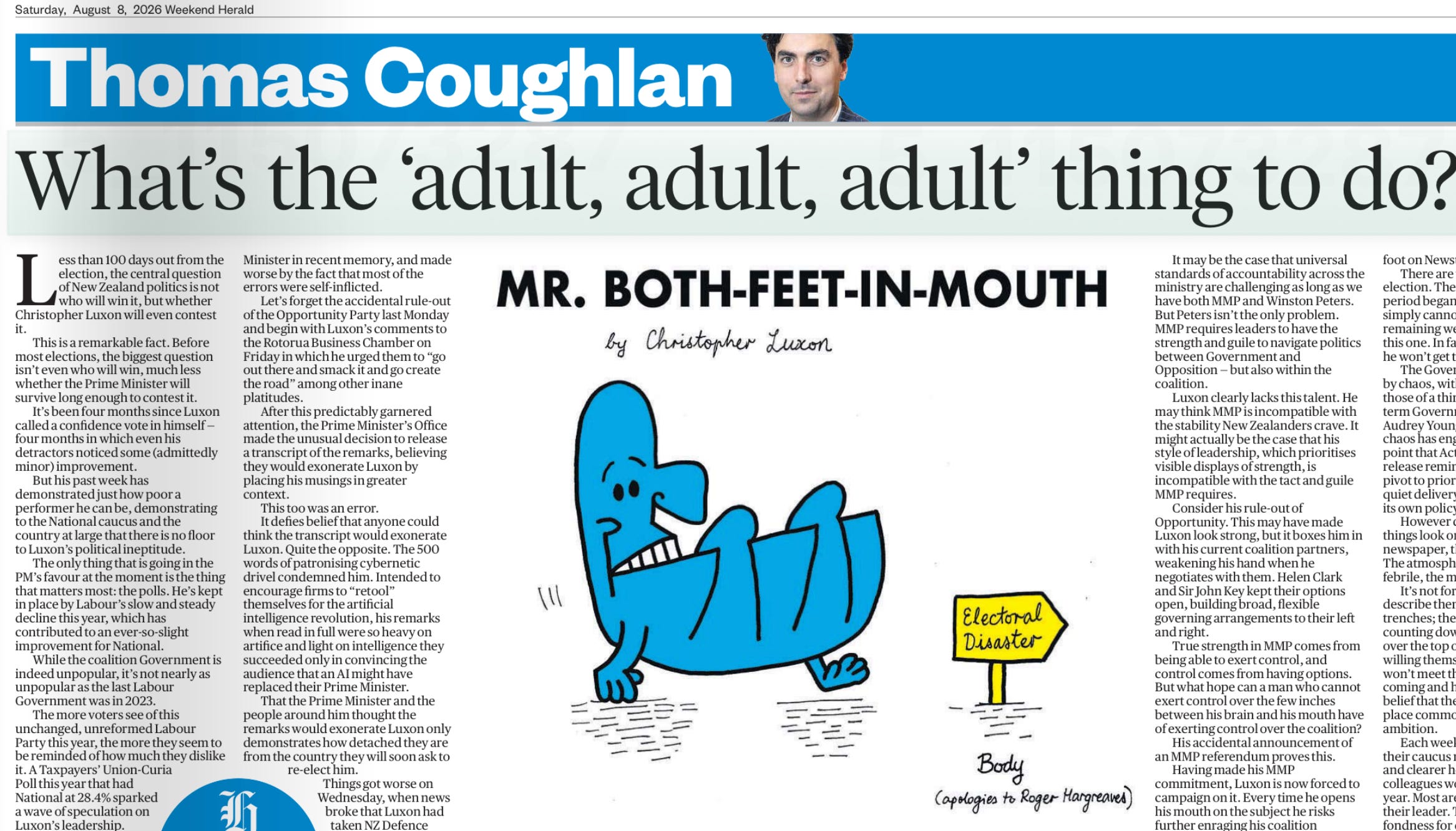
The most consequential assessment comes today from New Zealand Herald political editor Thomas Coughlan, whose opening proposition about the election is extraordinary: “the central question of New Zealand politics is not who will win it, but whether Christopher Luxon will even contest it”.
This is significant coming from the political editor of the country’s biggest newspaper. Coughlan’s judgement is that the past week has shown “just how poor a performer he can be”. His wider conclusion is even harsher: “there is no floor to Luxon’s political ineptitude.”
Coughlan’s assessment of Luxon’s week: “This has been a shocker of a week — one of the worst of any Prime Minister in recent memory, and made worse by the fact that most of the errors were self-inflicted.” On the now-infamous Rotorua transcript, which the Prime Minister’s own office released in the belief it would exonerate him: “The 500 words of patronising cybernetic drivel condemned him.” And on the mood inside Parliament: “However depressing and chaotic things look on television or read in the newspaper, they’re worse in real life. The atmosphere at Parliament is febrile, the mood is terrible.”
The last line of Coughlan’s column is particularly damaging. It plays on Luxon’s own favourite word, the one he used three times in Rotorua when he told struggling business owners to be “adult, adult, adult”: Coughlan concludes his column today with: “The ‘adult, adult, adult’ thing to do might be to go, go, go.”
Hooton says Luxon is the problem
Coughlan is far from alone. Matthew Hooton’s analysis in The Post yesterday is even more brutal.
He describes Luxon as “obviously out-of-touch, out-of-his-depth and profoundly unpopular”. Reporting on the mood in National, Hooton makes the remarkable claim that “almost no one believes Luxon will be prime minister by Waitangi Day”, even if the party manages to scrape together another coalition government after the election.
Picking on one of Luxon’s controversies this week, Hooton focuses on revelations that Luxon had taken Defence Force flights after attending a National Party fundraiser. His defence, as recorded by Hooton: “Look, I’m prime minister. I’ve got a busy job. I’ve got a big schedule. Where I can’t use a commercial flight, I’ll use military assets.” No previous prime minister, Hooton points out, has found it necessary “to so liberally use the defence forces to get around” — and this from a man who in opposition promised to fly commercial. One the same day, unemployment hit an 11-year high.
Hooton’s argument is not that National lacks possible replacements. Quite the opposite. He names Nicola Willis, Chris Bishop, Erica Stanford, Mark Mitchell and Simeon Brown as politicians who could do a better job. The problem is that National MPs cannot agree on which one they want.
Hooton says some National MPs know Luxon is leading them towards “catastrophe” but have concluded it may now be too late to change. Hooton notes in passing that if Brown wanted the job he would “have to do it by beating the record held by Ardern and Sir Edward Stafford to become the youngest person ever to take the top job”.
That is Hooton’s speculation rather than evidence that Brown is organising any challenge. But the fact that such scenarios are now being seriously canvassed by commentators close to the political right tells you how far the discussion has shifted.
The David Brent problem
The David Brent comparison has been around for a while. Hooton was making it as far back as 2024, comparing Luxon with Ricky Gervais’ painfully self-confident manager from TV’s The Office. Rotorua made the comparison difficult not to think about again, and the Herald’s Ryan Bridge ran a Herald NOW segment this week titled “Christopher Luxon strikes again ... as David Brent.”
Bridge called the Rotorua speech to businesspeople a “David Brent-Tony Robbins mashup”. Luxon was standing before business owners, many of whom have had a grim couple of years, delivering motivational advice with enormous confidence. The problem was not simply the jargon. It was the apparent failure to recognise how the message would land. After all, Luxon told business owners facing their sharpest confidence collapse in a decade to “go out there and smack it and go create the road”, to “retool”, and to stop behaving like children toward the government parent.
The business background that was once supposed to be Luxon’s great political advantage is now increasingly being used against him. When he entered politics, National presented the former Air New Zealand chief executive as a serious manager who understood performance, targets, delivery and leadership. Now those same credentials can easily be turned around. Critics hear the corporate language and wonder whether Luxon understands the very different business of politics.
That is where the David Brent comparison starts to become more than a cheap joke about mannerisms. Brent’s problem was never just that he used embarrassing management jargon. It was that he generally believed he was performing brilliantly while everyone else in the room was having a very different experience.
Duncan Garner takes this criticism in a somewhat different direction in The Listener today. His argument is about the gulf between the Prime Minister’s increasingly optimistic talk about the economy and what many people are experiencing. “You say one thing, Mr Luxon, but we feel another,” Garner writes.
At a Christchurch business conference this week Garner asked hundreds of small business owners whether they felt better off after the past three years: “No one put their hand up. Not one person.” His advice: “If you can’t see past this and sharpen up, then put the cause and the party first and stand aside for someone who can.”
The paywall now starts partway through all Democracy Project newsletters. Please take out a paid sub if you want to support this service and access the full content, including the following sections: “O’Sullivan’s question of power”, “The right is turning on Luxon”, and “Can National afford to keep Luxon?”.