

Prime Minister Christopher Luxon goes into his weekly National Party Caucus meeting tomorrow to try to put an end to the insurgent rebellion against his leadership. He will walk out either still leader, or not. There is no longer a third option where everyone pretends nothing is happening.
It’s become clearer that there is now a rebel group of National MPs pushing for a change of leadership, and they’re clearly willing to keep leaking to the media about Luxon. It’s therefore ceased being credible for Luxon and his supporters to pretend the caucus is rock solidly behind him or that leadership speculation is a media invention.
Hence Luxon has shifted his message today. In his various Monday morning media interviews he conceded the existence of the rebel MPs. He told Newstalk ZB’s Mike Hosking: “There’s probably five people that are, you know, moaning and frustrated”. On TVNZ’s Breakfast he also conceded there would be a “very small handful of understandably disgruntled backbench MPs,” treating this as an normal feature of any large caucus.
The National Party Rebels
Luxon won’t say who the five are. He doesn’t have to. The names circulating around National and Parliament are by now familiar: Barbara Kuriger, Sam Uffindell, Andrew Bayly, Tim van de Molen, and tellingly, the Chief Whip Stuart Smith. James Meager’s name keeps drifting in and out of the same sentence.
Richard Harman noted in Politik today that “the same small group of MPs who were thought to be behind the leadership speculation last November are under suspicion again,” singling out Meager and Uffindell. Both deny any involvement. They would.
The backbench mutterers are not the real danger. Backbenchers in marginal seats or bad list spots always grumble when their future is in doubt. The danger is above them.
The name that keeps surfacing, as it has for months, is Chris Bishop. Whether or not he is the actual source of Thomas Coughlan’s Herald scoop on Friday that lit the latest fire, National insiders assume he is (and in this kind of exercise assumption is almost as damaging as proof).
Heather du Plessis-Allan, who is very well connected with National Party insiders, has now more or less convicted him in print. In her Herald column yesterday she said that through his disloyalty Bishop has killed off his chances to become the new leader if there is a vacancy: “Bishop is out of the running. He most likely won’t be rewarded by the caucus for the destabilising they will blame him for.” Others under quiet suspicion include Nicola Willis and Erica Stanford, though nobody is yet willing to put their name to that.
Luxon helped build this
Commentators on the right are tempted to treat the rebels as the whole problem. Hosking went full throat this morning: “Worse than the media, though, are the stirrers inside his own party. The selfishness and bare knuckle self preservation on display is disgraceful… Right now, we have a few people who appear willing to put themselves and their own survival ahead of the collective.” It’s a useful column for Luxon. It is not a complete account.
Du Plessis-Allan, who is also sympathetic to Luxon, puts the other half of it plainly: “Some of it is Luxon’s own doing: he punished Chris Bishop too harshly and has added revenge into the mix.” The Easter reshuffle stripped Bishop of Leader of the House, the campaign chair role, and an associate sport portfolio. Rather than quieting him, it made him angry. And an angry senior minister with gallery contacts is a dangerous thing inside a caucus
The 1News poll as accelerant
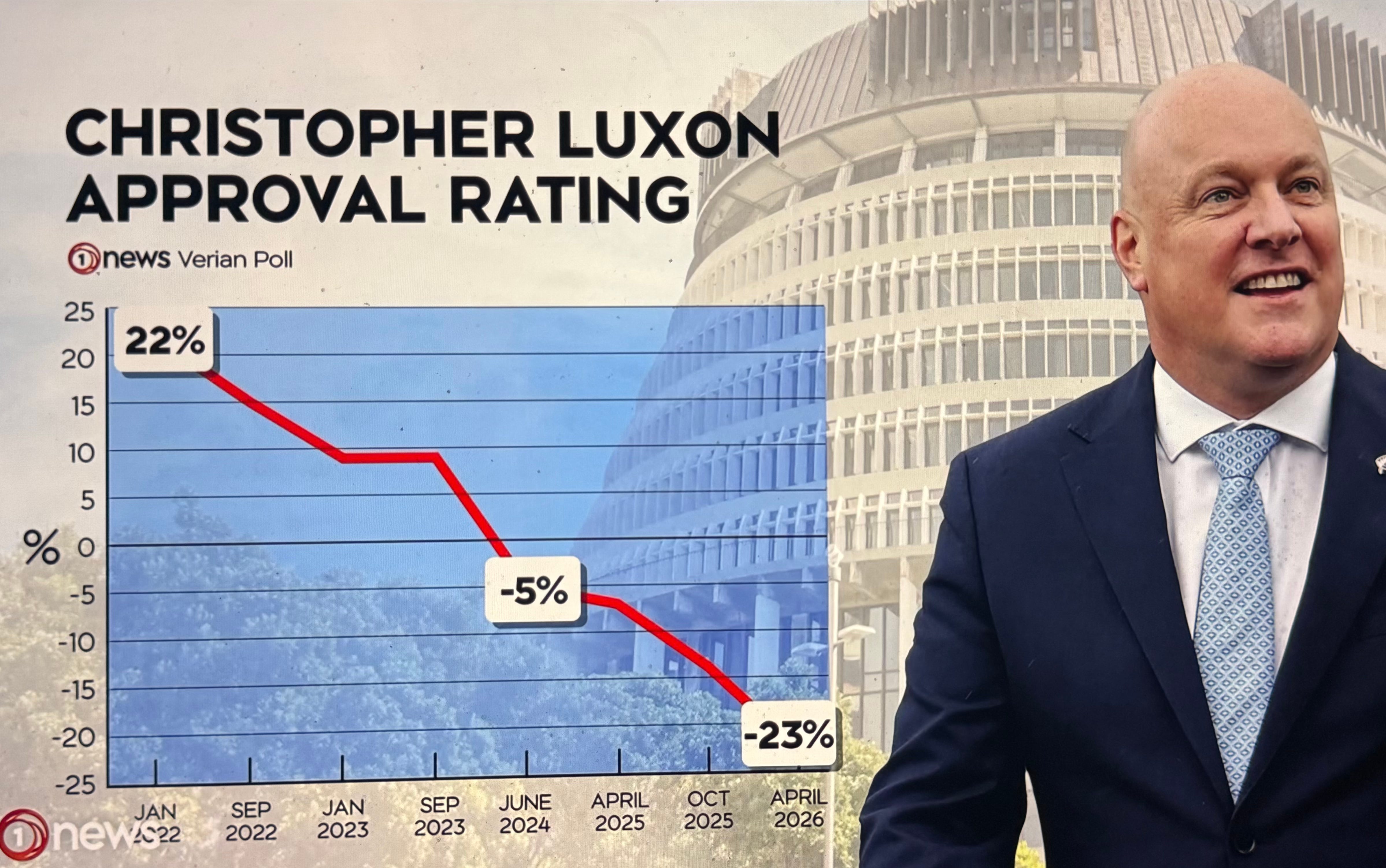
The latest fuel for the leadership instability is last night’s 1News Verian poll that put National at 29.7% (rounded up to 30%), down four points. Labour jumped five to 37%. It is the worst 1News National result since Luxon took the leadership in late 2021; Judith Collins’ final poll before she was rolled was 28%. Luxon’s own preferred-PM rating fell to 16%, below Chris Hipkins. On those numbers, as Justin Hu reported, “National would lose 12 seats in November.”
That projected loss of twelve seats is not an abstraction to the caucus — it translates directly into twelve MPs who can see their own survival on the line. Maiki Sherman, writing on 1News, put the human mechanics bluntly: the poll “will embolden parts of the caucus to act — either those who hold a grudge or those who believe their personal ambition is at risk due to Luxon’s weak support among voters. That is when the knives come out, or, to put it more politely, that is when the ultimatums are made and a select few start running the numbers.”
Maiki Sherman has also reported tonight on another element of the Verian poll result: the public’s approval rating of Luxon’s performance. The poll showed that 33% approved and 56% disapproved, giving a net score of -23%, a new low.
Should he go?
The most interesting argument of the week is Du Plessis-Allan’s, interesting because it’s reluctant. She likes Luxon personally, says so repeatedly, and still concludes that he is finished. Her reasoning is close to actuarial: the polling is sub-30 in multiple polls, not a rogue; the economy won’t rescue him before November; the leaks will keep flowing; therefore the rollover happens anyway, and the only question is whether it happens now, in daylight, or in the depths of winter with three months to go.
“Moving Luxon on is a huge risk,” she writes. “But leaving him in the job is a definite spanking waiting to happen. All options are less than ideal. It’s a case of picking the least bad.” Her preferred sequence is brutal: replace him, then call an early election while the new leader is still in honeymoon and before the Iran-related fuel shock and a hard winter bite any deeper.
The counter-case is put by Liam Hehir, and is worth quoting at some length, because nobody else has said it so cleanly: “Nobody seriously believes that elevating any of the names in circulation would constitute a renewal. Nobody is making that case because the case cannot be made. Leadership changes tend to succeed only when the replacement is already demonstrably more popular than the incumbent, or when the incumbent has become so irreparably toxic that almost anyone would do. Neither condition applies here.”
Hehir’s analogy is Liz Truss, not Jacinda Ardern. And his warning is that “a caucus that talked itself into believing that a change of personnel was a change of fortune, installed someone who had not been tested at the top and discovered very quickly that the problems did not leave with the old leader.”
The paywall now starts at halfway through all Democracy Project newsletters. Please take out a paid sub if you want to support this service and access the full content, including the following sections: “Who, then?”, “The Funders pushing Luxon must go”, “Backlash from the loyalists”, “What Tuesday looks like”.
