

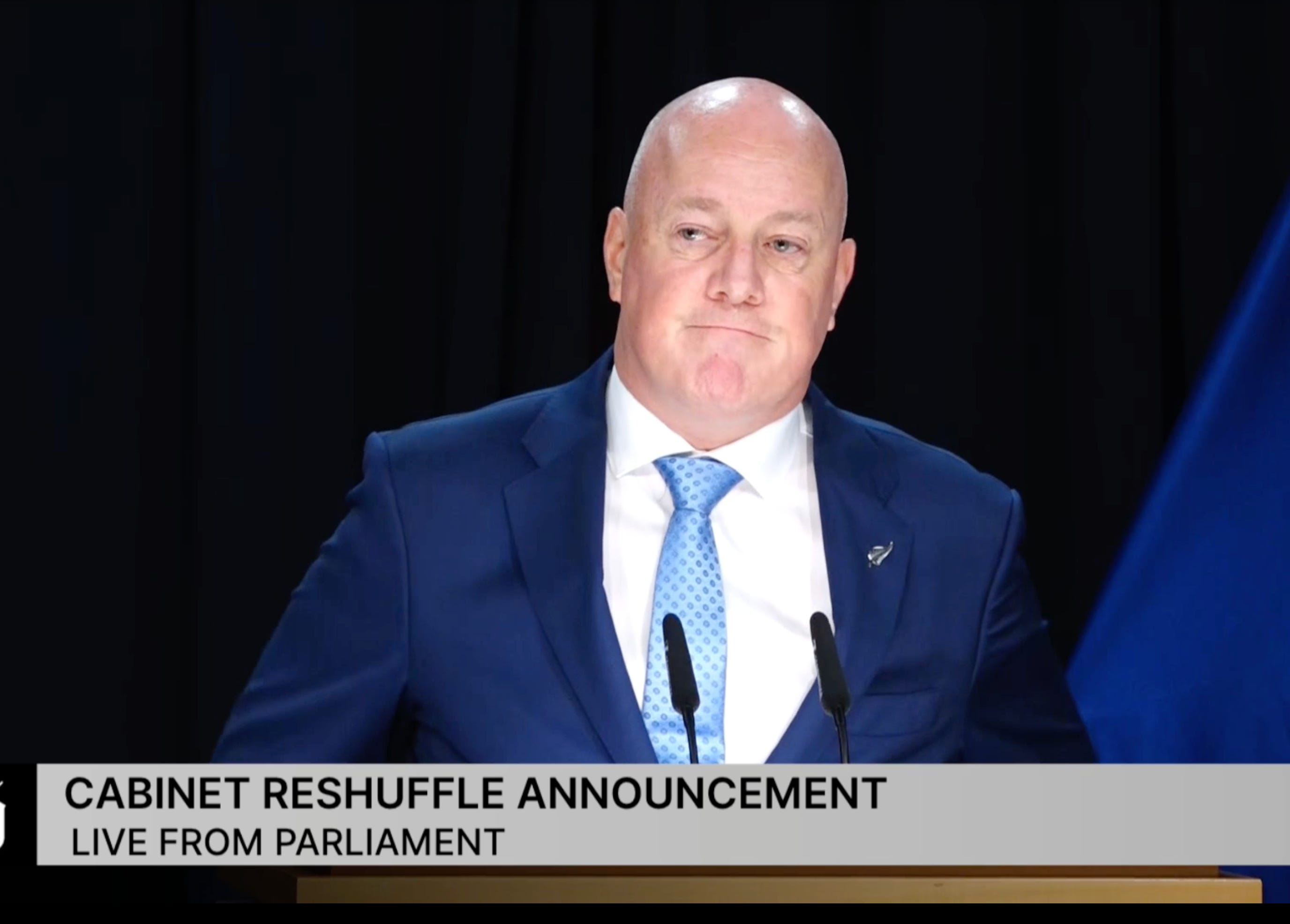
Christopher Luxon has announced his election-year Cabinet reshuffle. Chris Penk and Penny Simmonds enter Cabinet. Cameron Brewer and Mike Butterick become ministers outside Cabinet. Simeon Brown picks up energy. Paul Goldsmith gets the public service. Louise Upston becomes Leader of the House. The details matter. But the real story is what happened to Chris Bishop.
Bishop has been stripped of three roles: Leader of the House, associate sport, and most significantly, his position as chair of National’s election campaign. In return, he picks up the Attorney-General portfolio. On paper, you might call that a lateral move. In practice, it is a demotion dressed up as a promotion.
The pre-reshuffle commentary from the press gallery had been remarkably united on one point: the reshuffle would tell us more about Luxon’s leadership than about his ministers. They were right. The reshuffle says less about renewal than about insecurity.
What the insiders were saying
Before we get to what happened, it is worth dwelling on what was being said in the days leading up to the announcement. Because the pre-reshuffle commentary functioned as an extraordinary insider audit of National’s caucus: who is up, who is down, who is trusted and who is feared. Political journalists and well-connected insiders laid out their assessments of each minister. The picture they painted was of a Government and a Prime Minister in deep trouble.
Thomas Coughlan, writing in the Herald today, captured the shambolic feel of it all. The reshuffle had been talked about since January, he wrote, but “appears hastily arranged. As of last night, no one knows what time Luxon will unveil it, or how.” MPs who were directly affected had still not been told their fates on last night. When National’s caucus gathered for dinner (at KFC, apparently), Coughlan reported, “most were completely unaware of what awaits them today.”
This is supposed to be the Prime Minister who prides himself on people management. The former CEO of Air New Zealand, the man who talks constantly about putting his “aces in their places.” And yet his own MPs were eating in the dark, hours before the biggest personnel decision of election year.
Coughlan framed the stakes clearly: “For Luxon, whose leadership is currently under pressure, the reshuffle has the added complication of needing to draw a line under caucus instability.” Whether the actual reshuffle achieves that is debatable.
What happened to Bishop
Much of the pre-reshuffle commentary centred on whether Luxon would use the reshuffle to clip Bishop’s wings. The answer is now clear: he has.
Bishop was already carrying half the Beehive on his back: housing, transport, infrastructure, RMA reform, Leader of the House, and National’s campaign machine. Most important of all was the campaign chair role. That is not decorative, it is where internal power sits.
The campaign chair controls the machinery of the election effort: strategy, messaging, candidate selection support, resource allocation. Bishop chaired the successful 2023 campaign. Removing him from that position seven months before the next election is a dramatic act. It’s also quite odd to have an partisan electioneering role dealt with in a ministerial reshuffle – but this just reflects that contemporary politicians regard governing and campaigning as indistinct.
Coughlan had warned this demotion was coming. “With Bishop said to be behind last year’s embryonic coup,” he wrote, “Luxon may choose to make an example of him. The question then isn’t so much whether Bishop will lose a portfolio, but which ones.” Henry Cooke, writing in The Post today, reported that last night “one source close to the party suggested that the reshuffle might have angered senior Minister Chris Bishop.” The Post asked Bishop about the claim “and did not receive a response.”
Now we know. Bishop has not just lost portfolios – he has been removed from the two roles that gave him the most internal party power. Leader of the House controls the Government’s legislative programme. Campaign chair controls the election machine. Both have gone to Luxon loyalists: Louise Upston gets Leader of the House, Simeon Brown gets campaign chair.
Cooke had speculated that it could be housing that Bishop lost, noting that he “has stood apart from his party in openly calling for house prices to fall and his desire to allow far greater density in Auckland has been repeatedly cut down by his Cabinet colleagues.” In the event, Luxon left Bishop’s policy portfolios intact and instead stripped him of his structural power within the party. That is arguably a much more pointed punishment.
In Audrey Young’s half-term Cabinet report card last year, Bishop scored 9 out of 10 – one of only three ministers at that level. She described him as “a superman in terms of workload and achievement” who was “working through his agenda with great efficiency.” The Herald’s Mood of the Boardroom survey rated him as one of the Government’s top performers. He remains, by any serious measure, National’s most effective minister. And he has just been publicly cut down to size by a Prime Minister who looks more interested in containing Bishop than empowering him.
The consolation prize is Attorney-General. Audrey Young had actually recommended this in her column, noting that Bishop has a law degree and “the intellect to win respect in the role quickly.” But she also recognised that he could not take it on without shedding workload. Luxon has made that trade for him, but not kindly.
Simeon Brown: the new enforcer
The elevation of Simeon Brown to campaign chair is striking. Brown already held Health and SOEs. Now he adds Energy, taken from Simon Watts, with Luxon justifying the move by saying “the past few weeks have underlined how important energy security is.” Brown also picks up the campaign machinery.
Luxon is plainly betting on Brown. Brown scored 8 out of 10 in Young’s report card. She wrote that he had “made such light work of challenges in previous portfolios” that he was “the obvious choice to take on the hardest job in the cabinet.” He is widely regarded as Luxon’s most loyal senior minister. Giving him the campaign chair puts the election effort in the hands of someone the Prime Minister controls, rather than someone who might use the role to build an independent power base.
Whether Brown can actually run a winning campaign while simultaneously managing Health and Energy during a fuel crisis is a big question. It’s a colossal workload.
The paywall now starts at halfway through all Democracy Project newsletters. Please take out a paid sub if you want to access the full content and support this service. The second half of the column deals with: The Winners and the survivors; Why Meager missed out; The Polls behind the panic; The Leadership question that will not go away; The Staffing cost and the political risk; The Report card context; What it all means, and links to Further Reading.