

Christopher Luxon is back from holiday. And if his State of the Nation speech is anything to go by, it might actually be a very boring election year indeed.
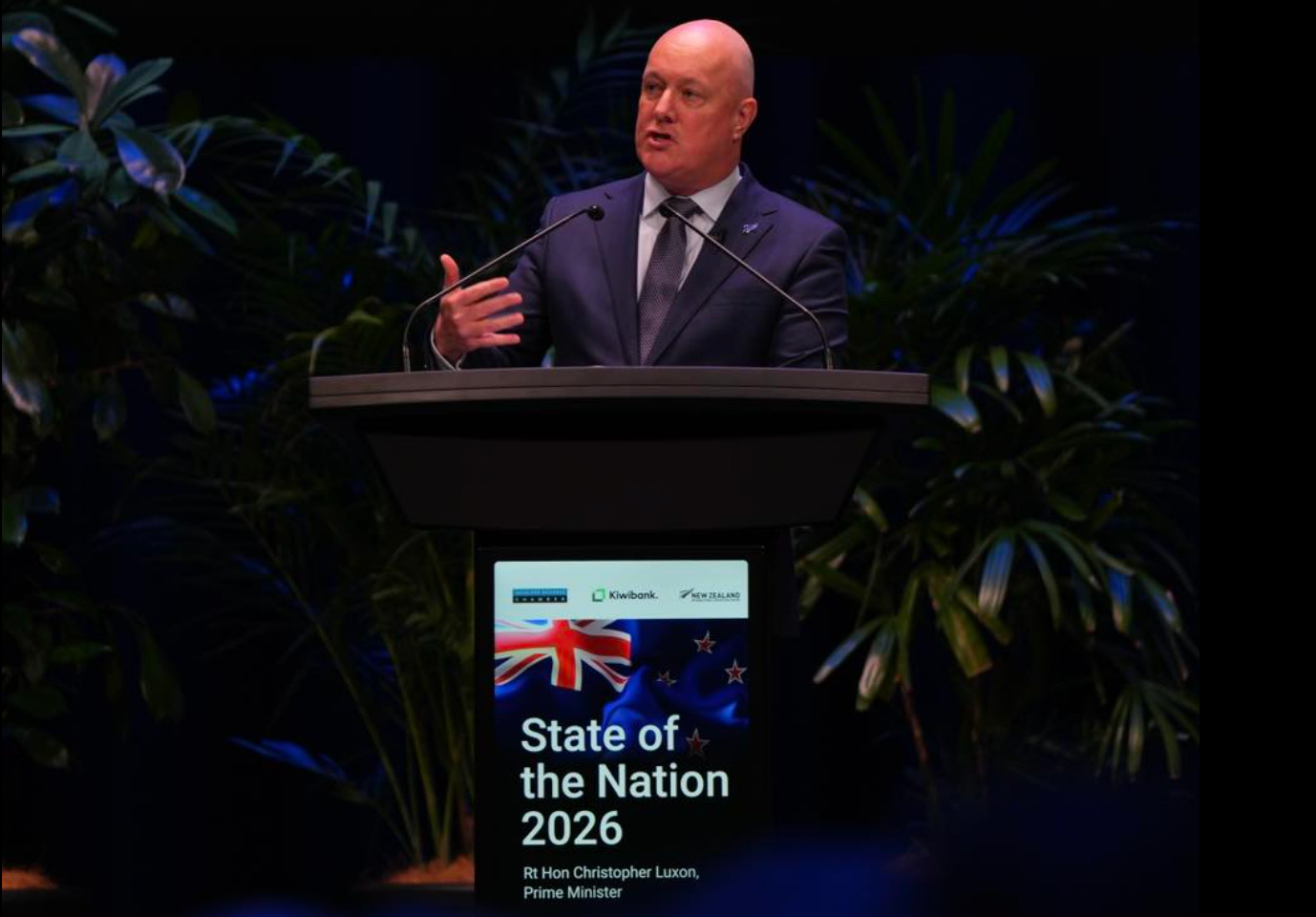
The Prime Minister delivered his first big set-piece address of 2026 on Monday to a 700-strong business audience at Auckland’s newly opened International Convention Centre. Hosted by the Auckland Business Chamber and former National leader Simon Bridges, the speech was long on slogans but remarkably short on substance. No new policies were announced. No election date revealed. And despite the global chaos that unfolded while Luxon was on his summer break, there was precious little engagement with the increasingly volatile international situation.
Joel MacManus at The Spinoff was blunt: the speech “failed to stir his own party faithful.” He described it as “hollow, soulless,” noting there was “no cheering, no laughter” from the audience — just “a smattering of claps” when Luxon mentioned the India free trade deal. MacManus observed that Luxon “seemed like a guy who had just got back from holiday and wasn’t quite back into the swing of things,” maintaining “a sober, subdued manner as he read from his autocue.”
This flatness was a recurring theme in the commentary. Henry Cooke at The Post described it as “a fairly muted reminder to the country that it can’t always get what it wants,” delivered with “the flatness of a man who knows his ritzy business audience would rather be networking.” Tim Murphy at Newsroom called it a “careful speech” that received a “largely polite if muted response.”
Reassurance without inspiration
Angus James offered perhaps the most incisive framing. State of the Nation speeches, he wrote, “usually try to do two things at once: reassure and inspire. This one did only the first, and it did so deliberately.” The address was “not framed around ambition, acceleration or transformation” but rather around “steadiness. Restraint. Caution.” The language was “managerial rather than visionary” with a clear subtext: “this is not a moment for grand promises.”
The new slogan is “Fixing the Basics, Building the Future” — a phrase Cooke counted being deployed eleven times throughout the address. MacManus was unimpressed, calling it “a slightly too-wordy line which he conspicuously inserted throughout.” Thomas Coughlan at the Herald noted the speech “borrowed heavily from a speech delivered in November last year” — itself a reset after the “going for growth” rhetoric failed to materialise. So we’re now getting a remix of the remix.
Murphy picked up on another recurring theme: Luxon’s invocation of “control what you can control,” a phrase he used repeatedly when discussing everything from KiwiSaver to Donald Trump. Murphy traced the philosophy to Stoic philosopher Epictetus, though in Luxon’s hands it served mostly to acknowledge economic struggles while deflecting responsibility. “We can’t control the international weather,” Cooke summarised, “and we certainly can’t control Donald Trump.”
What wasn’t said
Perhaps the most striking feature of the speech was its absences. Despite leading a three-party coalition, Luxon made zero mention of Act or New Zealand First. He didn’t use the word “coalition” once. Winston Peters and David Seymour were conspicuous by their complete omission. Instead, as Cooke observed, there were “seven mentions of National as a party and four mentions of the ‘National Government.’”
Lloyd Burr at Stuff put it well: the speech “said more in what it omitted than what it included.” Healthcare got precisely one mention, according to Justin Hu at 1News. Housing didn’t rate a discussion either — a rather glaring omission given the ongoing controversy over the Government’s apparent backtrack on Auckland housing intensification.
Labour leader Chris Hipkins seized on these gaps, calling the speech “a whole lot of management speak mumbo jumbo” and criticising Luxon for “not mentioning housing or healthcare in his speech, and focusing on slogans instead of substance.”
The Economic messaging problem
MacManus identified Luxon’s core dilemma: he is “stuck in limbo, unsure if he can start celebrating an economic recovery or if he needs to keep up the ‘we’re all doing it tough’ schtick for a few more months.” The Otago Daily Times editorial made a similar observation, noting the speech was “an uneasy mix of how bad things were and how much better things were going to get” — a framing that invites questions about “just how much progress National has actually made on its priorities in the past two years.”
Luxon tried to strike an optimistic note, declaring “I feel more confident than ever that the recovery has now arrived” and pointing to business confidence at its highest since 2014. But there’s a disconnect between macro indicators visible to the business crowd and what ordinary voters are feeling. Luxon acknowledged this tension himself, admitting that “I know many of you will be frustrated that this recovery, now starting to blossom nationwide, has taken so long to get traction.”
MacManus was sceptical about the path forward: “National’s path to victory is to hold on and hope that people start to feel richer by election day.” Luxon has indicated there is no big election bribe coming in the budget. The policy substance that did exist centred on three areas: KiwiSaver reform, NCEA replacement, and RMA changes. Murphy noted these are the policies Luxon believes “National can control the narrative on.” Worthy stuff, but hardly the vision for the future that the slogan promises.
Playing it safe
If there’s a consensus among the commentariat, it’s that this was a remarkably unambitious speech for an election year. Coughlan characterised it as “low risk, low reward,” arguing that by lowering expectations, Luxon “has painted a very small target on his back.” MacManus was harsher: “Luxon can be light on the details,” often settling for “canned lines” and “comfortable hyperbole.” The result is that “audiences switch off when they realise that most of his words mean nothing.”
Even Bridges, the host, seemed underwhelmed. In a post-speech interview, he said he’d “have liked more vision in the speech” — particularly around what a second term might look like. “I think that’s what the business community, the struggling middle, New Zealanders would want,” he told Newstalk ZB.
The CTU’s Sandra Grey was more scathing, describing the speech as “devoid of any plans, policies, or actions that will help people, their families, and communities.”
Looking ahead
The bigger question is whether this low-key, play-it-safe approach will work for National in election year. The party’s polling has been stuck around 30 percent, and while the coalition could theoretically be returned to power, National’s dominance within it is clearly waning.
Tracy Watkins argued in the weekend that with an economic recovery potentially underway, “Luxon has a window to reset public opinion on his leadership.” But she also warned: “If Luxon can’t ride the momentum of that recovery it would be a death knell for his leadership.”
Daniel Vernon offered perhaps the most telling verdict, noting the “tone-deaf pageantry” of delivering a speech about economic recovery in a lush Auckland business centre while parts of Northland were still battling floods. A better leader, Vernon suggested, might have postponed the event and put boots on the ground.
But that’s not Luxon’s style. He’s a corporate manager who gives polished speeches to rooms full of business people. Murphy noted that Luxon told his business audience the best way to give him control was to “vote to get a very big National Party.” The question for 2026 is whether that pitch (competent management, steady progress, no grand promises) is enough to win an election.
Burr, incidentally, counted Luxon saying “actually” at least 23 times during the speech. It’s the kind of verbal crutch that probably goes unnoticed by most voters but speaks to the defensive posture of the whole exercise.
Dr Bryce Edwards
Director of the Democracy Project
Further Reading:
