

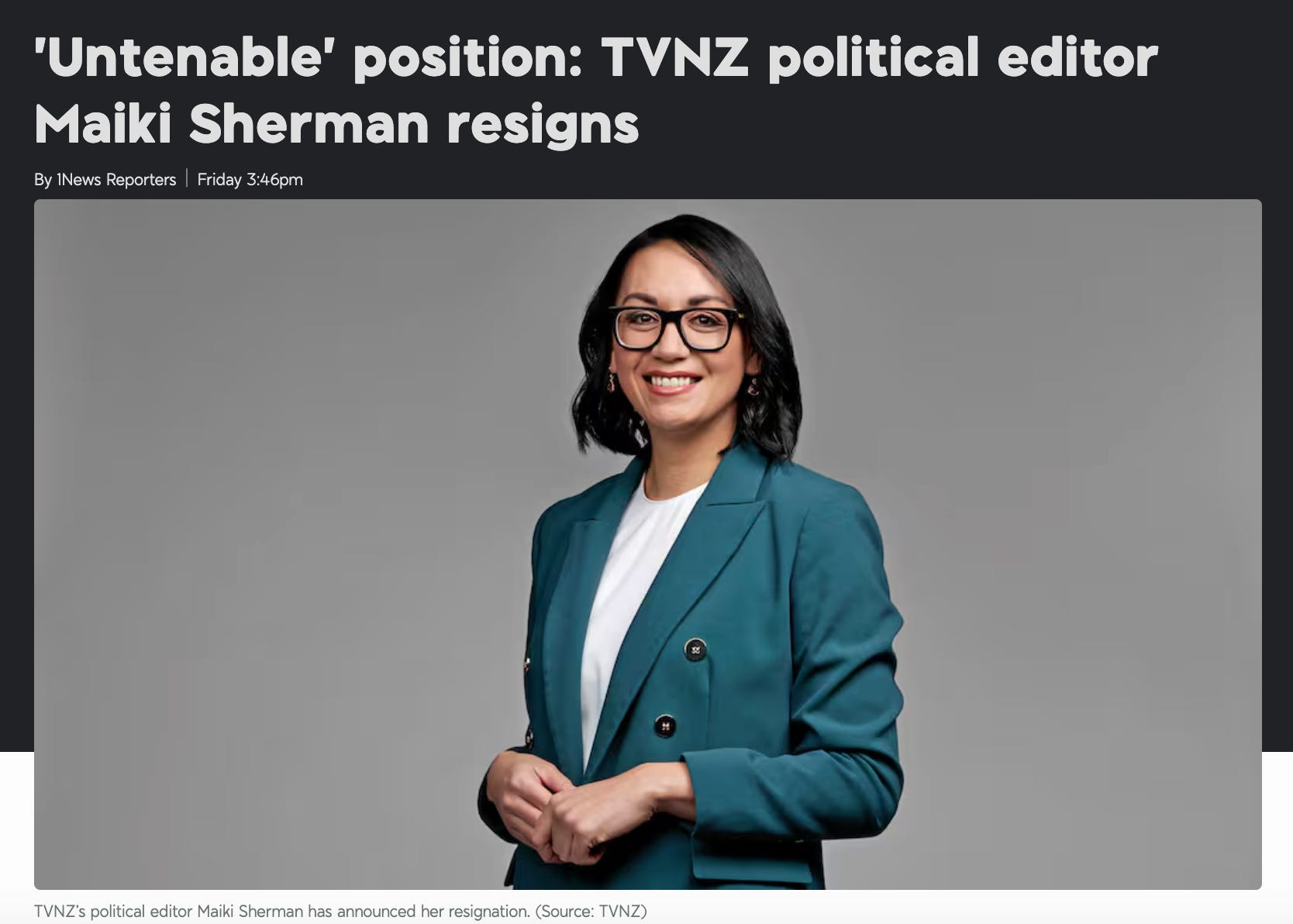
Maiki Sherman posted her resignation statement on X yesterday afternoon. It was both terse and dignified. The scrutiny had placed “enormous pressure” on her, her role had become “untenable,” she was finishing up with TVNZ that day. The first wahine Māori to lead a major broadcaster’s political team was gone — three weeks from Budget day and six months from the election.
It is tempting to treat this as a story about one journalist who made a bad error and eventually paid for it. That reading isn’t wrong, but it’s a long way short of the whole picture.
What Sherman actually did
The background was covered in an earlier column, but a brief summary is necessary. In May 2025, at pre-Budget drinks hosted by Finance Minister Nicola Willis, Sherman used a homophobic slur towards Stuff journalist Lloyd Burr. She apologised the following morning to both Burr and Willis, and informed her manager. Those apologies were accepted. Burr said he did not want to take the matter further. For eleven months, it sat there.
Sherman’s own account — in her resignation post — added something important. Her comment, she wrote, was made “in response to deeply personal and inappropriate remarks made to me that evening.” Burr has denied directing a slur at Sherman, and Stuff has stood by his account of the events. The factual dispute at the heart of the exchange has never really been resolved in public because it has barely been reported on. What got reported was Sherman’s conduct; what allegedly precipitated it has been treated as secondary.
That asymmetry matters. Not as an excuse — Sherman has said clearly, and more than once, that there is none — but as an observation about how the story was framed.
Two questions, not one
The most useful thing David Farrar wrote about all this was a distinction most commentators have since collapsed. Farrar was clear that the original incident was newsworthy — something serious enough, witnessed by enough people, in enough of a semi-public setting, to cross the line between private embarrassment and legitimate public interest. But he was also clear that reportable is not the same as career-ending: “I don’t think Maiki should lose her job over it”. He added: “People sometimes stuff up and do bad things. We should judge people over their entire contribution, not solely on the basis of the worst thing they have ever done.” And separately, when her resignation came, he said he was saddened. People should not be pushed out of their role because of one bad thing they said.
That’s a careful separation. The first question — was the original incident reportable? — should not have been seriously controversial. The second — did it warrant the end of her career? — is a different question, and one most of the commentary, on all sides, has refused to ask separately.
Stephen Parker, who edited the political team at 3 News from 2002 to 2007, made a similar point in the Spinoff’s roundtable of former TV political editors. “It’s a legitimate story,” Parker said. “I lean towards the opinion that it’s not something that should necessarily just be swept under a carpet or left unexamined. The political editor is a key, high-profile position, and a degree of transparency is important to trust in media organisations.” Parker also acknowledged, as Paddy Gower did more emotionally, that the “ingredients for elevated coverage” do not necessarily justify the temperature to which the story eventually climbed.
The press gallery’s comfortable silence
The gallery knew the story well. That is now not seriously disputed. Liam Hehir noted it on X, pushing back against the pile-on: Sherman “deserves more credit than people on here give her credit for,” he said, insisting she had been “quite willing to piss off left-wing political parties if she thought that was what the job required.” He went further, arguing that the Free Speech Union should defend her — that free speech is a cultural value, not simply a matter of government censorship.
Whatever one thinks of that argument, the gallery’s year-long silence became a genuine problem. Richard Harman was the most prominent defender of the principle involved — in his 55 years as a journalist, he said, these things happen at Parliament and have no political importance. “If I insult somebody at a private party in Parliament, then it’s got nothing to do with my journalism or that person’s political performance.” The press gallery functions in a pressure-cooker environment where social proximity to power is unavoidable, and ethically corrosive.
But Paddy Gower’s contribution to Henry Oliver’s Spinoff roundtable was more honest about what that actually means. “There but for the grace of God go I.” Gower spoke about the intensity of the role — the heat, the late nights, the changed relationship between politicians and media. “There’s a real constituency of people that don’t trust the media, and politicians can exploit that.”
He identified the golden rule: “Always back your political editor.” The implication, applied to this case, is hard to miss: TVNZ — through months of legal letters and institutional silence — has not been backing its political editor in any of the senses Gower describes.
That failure is not a small thing. A state broadcaster that suppresses a story about its own political editor — using lawyers from Russell McVeagh to warn off a commercial rival — is not protecting anyone. It is storing up the damage and ensuring it arrives at the worst possible moment. Mike Hosking described the letter his producer Sam Carran received when investigating the story as a “big broad-based fat letter from the lawyers… It had a chilling effect.” A state-owned broadcaster used a top-shelf commercial firm to discourage a competing newsroom from reporting on its own political editor.
The Free Speech Union, in its statement on Friday, put the institutional failure plainly: “A culture that responds to misconduct with legal threats while it can be hidden, and with a quiet exit once it cannot, rewards suppression and punishes disclosure.” That is exactly right. And it ended with the line that should have been TVNZ’s policy from the morning after the Willis drinks: “A healthy media tells the truth. A healthy society lets people apologise for it.”
Sherman apologised, promptly, to the people involved. But it appears that TVNZ then made that apology impossible to stand behind publicly by hiding it — and ultimately made it meaningless by letting Sherman go once hiding it became untenable.
The paywall now starts at halfway through all Democracy Project newsletters. Please take out a paid sub if you want to support this service and access the full content, including the following sections: “The O’Brien question”, “A culture war in real time”, “What Heather du Plessis-Allan said”, “What comes next”, and “The structural problem”.