

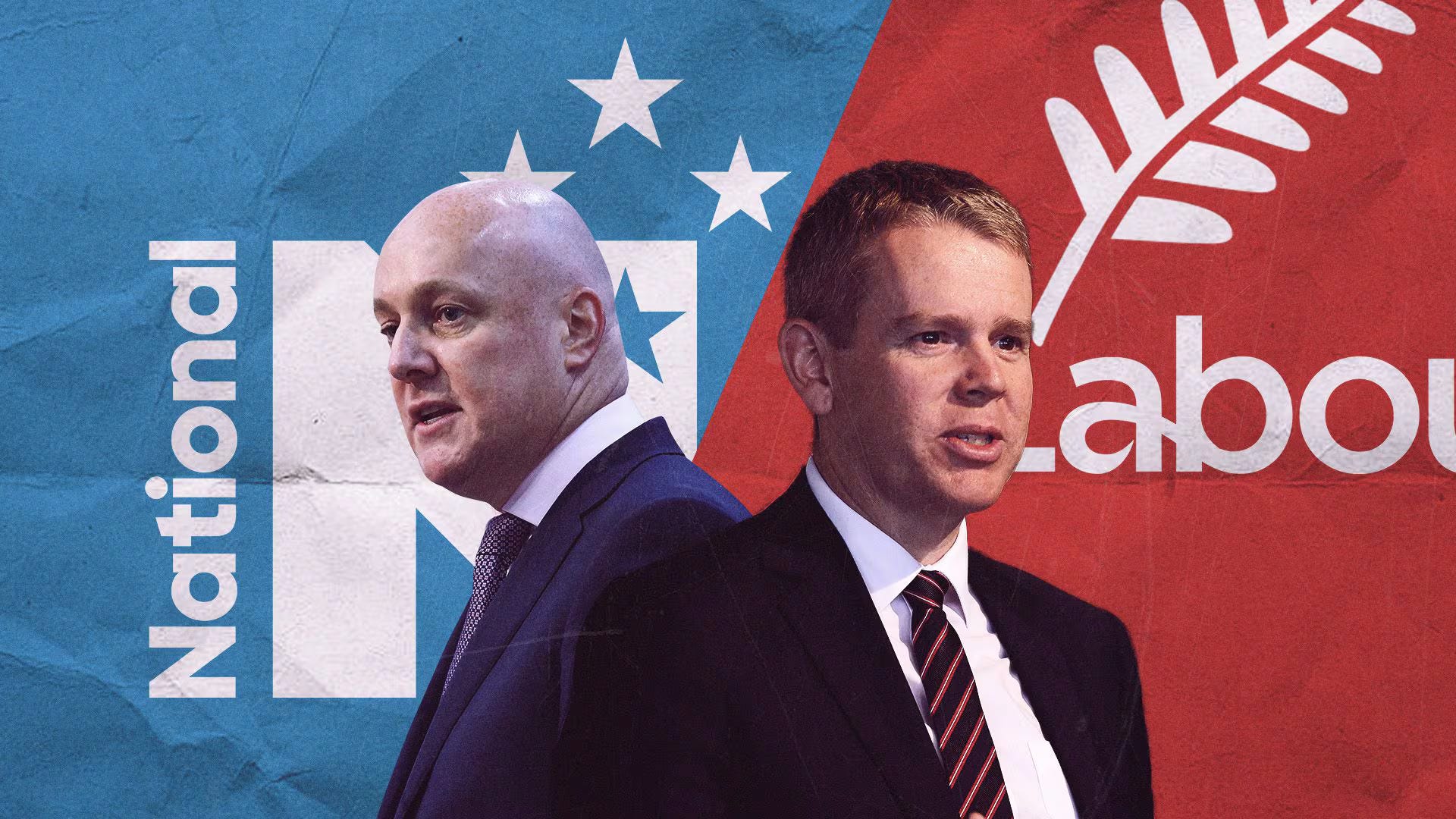
Labour and National are now on 28% each in the 1News-Verian poll released tonight, giving them just 56% of decided voters between them. Their leaders are doing even worse, with Christopher Luxon preferred as prime minister by 19% and Chris Hipkins by 14%.
The poll was taken between 23 and 27 September, mostly before the two parties launched their campaigns in Auckland on Sunday, so it shows the slump that the launches were supposed to turn around. Neither launch suggested the parties know how to do that.
Kerre Woodham’s verdict on Newstalk ZB this morning was that “For both parties, the launches pretty much reeked of desperation.” The description seems even more apt after tonight’s numbers. And neither launch exactly looked like a major political movement sweeping confidently towards election day.
Three weeks ago I wrote about the “politics of meh”, arguing that both major parties were struggling to offer much beyond warnings about what the other side might do – see: Democracy Briefing: The politics of meh. Their campaign launches were an obvious opportunity to move beyond that. Instead, Sunday largely confirmed the problem, albeit at much greater volume.
Short on hope and heavy on fear
With so little enthusiasm for either party, both major party leaders spent Sunday mostly talking about the other. Luxon told his audience “You can’t afford Chris Hipkins”, and a couple of hours later Hipkins was telling his that “I’ve never felt more strongly in my life that the National Party is a risk to the future of this country.”
Stuff’s Jenna Lynch captured the choice neatly: “National wants voters afraid of what a Labour-led government might tax. Labour wants them afraid of what another three years of a National-led government might cost them.”
In that sense, the politics of meh hasn’t disappeared. It has simply become louder and more negative, with much of the campaign increasingly built around fear of what the other lot might do. The Listener’s Danyl McLauchlan, who welcomes the absence of unaffordable promises this time, argued that if Labour and National “can’t resort to their usual gimmicks, they have next-to-nothing to offer other than their mutual loathing.”
No political party is entitled to anything
The two parties’ combined support in the 1News poll has gone from 67% in April to 61% in June, 59% in August and 56% now. Hipkins dismissed an August Taxpayers’ Union-Curia poll as “rogue”, but he can no longer do that. Two other polls this month had both parties below 30%. If tonight’s figures were repeated on 7 November, it would be the lowest combined vote for the two parties since National was formed in 1936. The lowest so far under MMP was 62% in 1996, and as recently as 2017 the pair took about 81% between them.
The voters leaving Labour and National are ending up with the smaller parties. The Greens are on 16%, their best result ever in the poll, with Act on 11%, NZ First on 9% and Opportunity on 6%.
Asked whether the Greens were taking Labour’s votes, Green co-leader Chlöe Swarbrick said: “No political party is entitled to anything.” Luxon fell back on the old standby that “The only poll that matters now is November the 7th.”
Mr No New Taxes
National made its central message impossible to miss yesterday. The strategy is straightforward: National wants tax to become the defining risk voters associate with changing government.
Newsroom’s Sam Sachdeva counted the word “tax”, or variants of it, about 64 times in 54 minutes of speeches — “an impressive, or horrifying, 1.2 taxes per minute”. Christopher Luxon was introduced as “Mr No New Taxes”. Nicola Willis described a possible alternative government as “a potpourri of half-baked socialists who seek to punish success, destroy wealth, and take what you’ve worked so hard to earn”. Sachdeva also noted that Simeon Brown invited the audience to imagine Chlöe Swarbrick as finance minister, Rawiri Waititi in Corrections and Opportunity leader Qiulae Wong imposing a land tax as revenue minister.
The “No New Taxes” slogan was “recited ad nauseam by supporters in the crowd”, according to the Herald’s Jamie Ensor and Adam Pearse. They explained that until the slogan arrived, “the party was lacking a central unifying narrative at a time when it felt like there was more momentum behind attempts to roll its leader than towards victory.” Beyond the absence of new taxes, “there also wasn’t much new of anything else”, and apart from a couple of policies, such as compulsory KiwiSaver, the pledge card read as if “someone had copy and pasted the 2023 pledges, and just changed them up a tad.”
The paywall now starts partway through all Democracy Project newsletters. Please take out a paid sub if you want to support this service and access the full content, including the following sections:
National’s loyalty problem
Hipkins finds his temper
What the major parties are missing in the campaign