

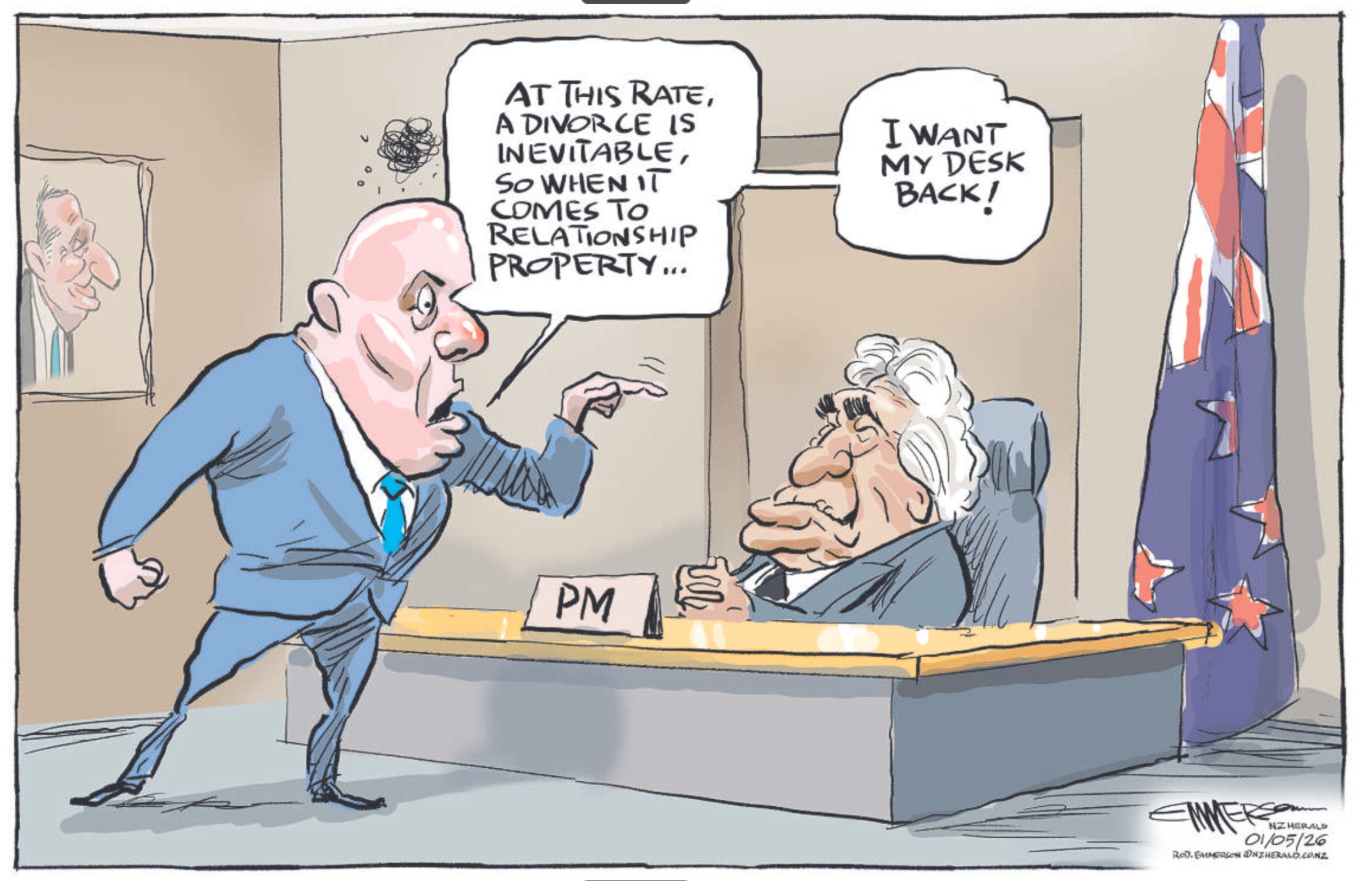
For two and a half years it has been just about possible to argue that the National–NZ First–Act coalition was outperforming the predictions of its critics. Stable, if not exactly harmonious. As Winston Peters likes to put it, the coalition is as stable as a “three-legged stool”. That argument is over.
Over the past fortnight the coalition has stopped pretending. The Prime Minister has publicly accused his own Foreign Minister of putting “politics ahead of the national interest”. The Foreign Minister has gone on Newstalk ZB to call the Prime Minister “imprudent”, a pointed contrast given Peters’ 40+ years in Parliament. The Finance Minister, who is also National’s deputy leader, has gone on the record describing the 81-year-old leader of NZ First as “very, very confused”. The Prime Minister has marched down two floors of the Beehive, in defiance of normal protocol, to give his Foreign Minister a dressing-down. None of this is normal coalition behaviour, and the people covering it are not pretending otherwise.
The proximate trigger was the Iran emails. On Thursday morning last week, Thomas Coughlan at the Herald revealed that Peters’ office had released, under the Official Information Act, internal correspondence showing that in the days after the US-Israeli strikes on Iran on 28 February the Prime Minister wanted to shift New Zealand’s official position from one of “acknowledgement” to one of “explicit public support”. The emails show that he was talked out of it by Peters and his staff. The substantive foreign policy issue here, whether Luxon’s instincts on the war were the right ones, what they say about his world-view, and how badly all of this is now hurting National’s election prospects, has been chewed over especially well by Josie Pagani and by Coughlan himself. I intend to write about that in a separate column. This one is about the coalition.
The release has detonated the polite fiction that this coalition operates on the basis of collective responsibility and “no surprises”. It has also exposed something more fundamental: that National and NZ First are now competing for the same voters, harder and more openly than the standard pre-election differentiation you expect under MMP.
“Feasting on each other”
Helen Clark’s line that the coalition partners are “feasting on each other” has been the most quoted phrase of the week, and deservedly so. She has been one of the most active commentators on the affair, with her remarks running across RNZ, 1News, the Spinoff and the Herald in the space of forty-eight hours, and she does not think the Government will run all the way to 7 November. “Right now,” she told the Herald, “I couldn’t look you in the eye and say I thought that the … Government would last till the 7th of November. They may stagger on, but it’s going to be increasingly fractious with less and less agreement internally.” On 1News Breakfast she put it more starkly still: the question, she said, is whether the coalition “can last much beyond the Budget”.
A “process mistake”?
The first question every gallery commentator has tried to answer is the obvious one: was the release of those emails the “process mistake” Peters has at points claimed it was, or a deliberate political attack?
Peters himself has cycled through several positions in the space of a day. Toby Manhire’s line on the Spinoff captured it best: “Peters was reported as saying he had been mistaken in saying it was a mistake, though by the afternoon he seemed to suggest it was a mistake to say he was mistaken to say it was a mistake.” He eventually settled on a kind of partial contrition: he made an “assumption”, he should have “checked”, a couple of his staff would now be attending an afternoon “training session”.
He has at no point retracted any of the substance of what was released.
Almost no one in the press gallery believes the staff-training-session story. Matthew Hooton put it bluntly in the Herald: “Don’t for one minute think Peters or his staff made some sort of mistake. This was another calculated attempt to undermine a Prime Minister for whom Peters acts like he has no respect.”
Phil Goff – sacked by Peters last year as High Commissioner to London – was even sharper on RNZ’s Midday Report: “There was no mistake about Winston Peters’ comments at all. He knew that exposing Luxon’s view would be damaging to Luxon and he wanted it to be.” On Luxon’s failure to sack him for it, Goff added, “shows his weakness in relation to his coalition partner”.
Stuff political editor Jenna Lynch did the most forensic work on the OIA mechanics. She got hold of both the request and the release, and her conclusion is hard to argue with: “It defies belief that these were the only two emails sent between offices on those dates which did not meet the test of prejudicing the security, defence of international relations of New Zealand.” Her sign-off line was characteristically blunt: “make no mistake; the damage has been done and it looks mighty intentional.”
David Farrar lands at the same place from the right. On Kiwiblog he allows that the OIA release was “clearly deliberate, and designed to make the Prime Minister look bad”, though he can’t decide whether it was tit-for-tat for Willis’ earlier attacks or a deliberate setting-up of an exit from the coalition.
Heather du Plessis-Allan offers a more contrarian reading, and even she calls Peters’ behaviour “out-and-out bad behaviour”, though she reads it as “a warning shot to National to pull its head in” rather than a genuine break.
The constitutional claim no one is dwelling on
Lost amid the coverage of the spat itself was the genuinely extraordinary moment in the House on Thursday afternoon. Asked by Labour’s Vanushi Walters about the Prime Minister’s experience to handle the Iran war, Peters skipped the question and instead claimed something more far-reaching: “I’ll say it slowly, the person in charge of foreign policy is the Foreign Minister. That’s me, not the Prime Minister.”
Helen Clark called the statement “extraordinary”, and Politik’s Richard Harman has been the most precise on why. Foreign policy in a Westminster system is not set by the Foreign Minister alone. It is set by Cabinet, chaired by the Prime Minister. The Foreign Minister implements it. Harman’s wording is restrained but unambiguous: “Constitutional experts would argue that he is ultimately responsible not for determining New Zealand’s foreign policy, but for implementing it, just as any Minister must implement policy formulated by the Government in Cabinet, chaired by the Prime Minister.”
Peters is asserting an authority he does not actually have. And he is so far getting away with it, because the Prime Minister cannot afford to push back hard enough to remove him.
Luke Malpass, in the Post, draws the awkward conclusion the National Party would prefer not to be drawn: “in this Government, foreign policy is being driven by the foreign minister more than the Prime Minister.” That is not partisan colour; it is a working description of how the Government is actually being run.
The paywall now starts at halfway through all Democracy Project newsletters. Please take out a paid sub if you want to support this service and access the full content, including the following sections: “Willis as attack dog”, “The transparency paradox”, “How long can this last?”.