

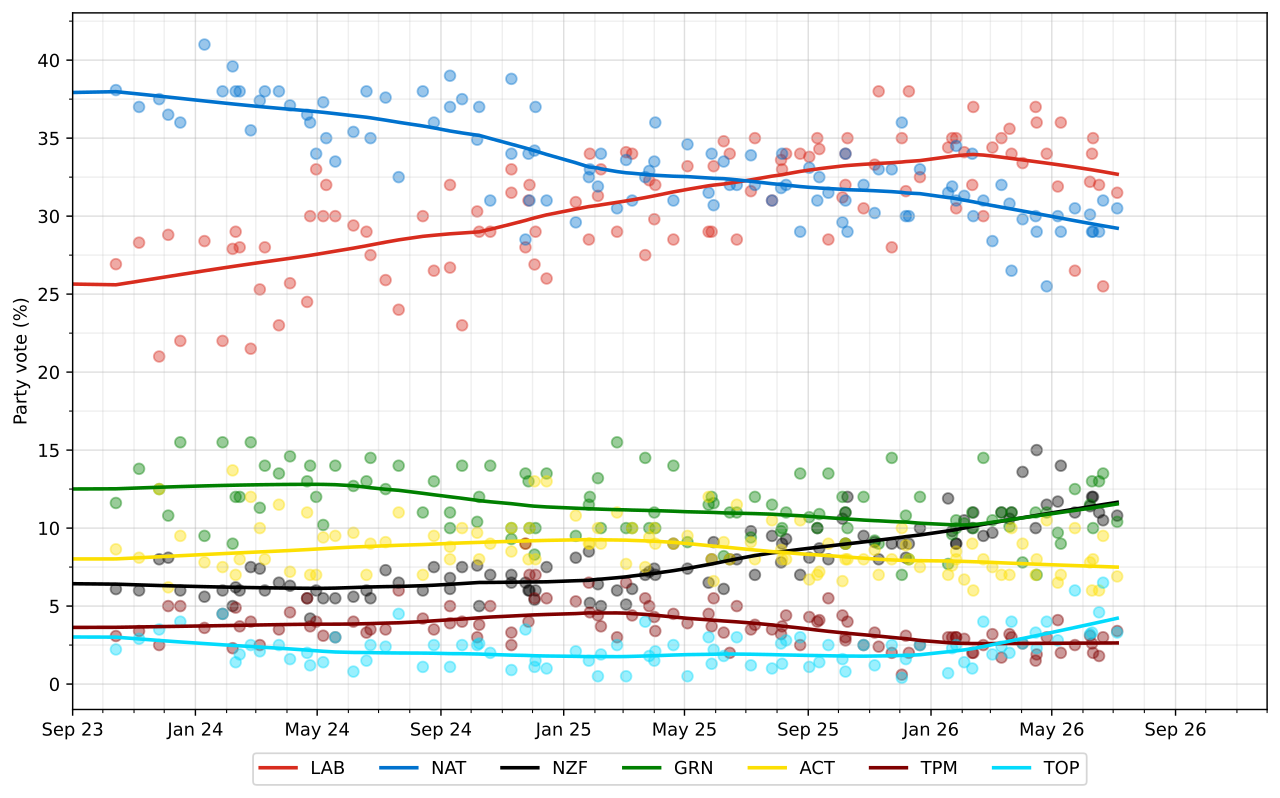
National is polling badly, and so is Christopher Luxon. Yet the National-led Government may still be re-elected in November.
The latest RNZ-Reid Research poll has National at just 28.7%, its lowest result since Luxon became leader. Labour is well ahead on 34%. National won 38.1% at the last election, so it has lost almost a quarter of its support.
But the same poll gives National, New Zealand First and Act 61 seats between them. Labour, the Greens and Te Pāti Māori get 59. On those numbers National is “losing” the electoral race while winning the contest to form the next Government.
Most polling and modelling still leaves the centre-right with a viable, or even favoured, path back to office. The latest BusinessDesk poll-of-polls average has Labour on 31% and National on 30%. The Herald-Motu Poll-of-Polls gives the current coalition a 62.9% chance of being returned.
That probability has fallen in recent weeks. And the June 1News-Verian poll produced a centre-left majority, although that projection depended heavily on Te Pāti Māori retaining six electorate seats and creating an overhang.
None of this is certain. National is weak; the right bloc as a whole is not.
All the shots have missed
Newsroom’s Tim Murphy has caught the mood now developing inside National. His verdict on National’s election-year efforts is blunt: “Shots fired. But, so far, all targets missed.”
The Government has delivered its Budget. Luxon has secured the India trade agreement. National held its annual conference and announced a major compulsory KiwiSaver policy. It has promised help with household solar panels. Ministers are travelling the country announcing projects, classrooms, medicines, housing developments and health targets. None of it has shifted National’s vote.
Murphy says the electorate does not seem furious with the party. The message is more that voters are “not angry, just disappointed”. He argues that may be harder for National MPs to accept. They believe they inherited an economic mess and then made the hard decisions to fix it: cutting waste, restoring discipline and pushing through reforms Labour had ducked.
Eventually, that can produce a sense of grievance towards the public. Murphy writes: “Governments all eventually feel under-appreciated, but usually in their third terms, politicians and voters having gradually tired of each other.” National has reached that point before completing its first.
Murphy expects the familiar excuses to follow: that voters do not understand the Government’s record, that the media has failed to explain its achievements, or that people would warm to Luxon if only they saw him up close.
He is unsparing about that argument: “But when you’ve had 32 of the 36 months handed to you by voters, when you have the monumental resources of incumbency, vast social media reach going beyond the mainstream media direct to your people, when you have seriously big money flowing in from high-net-worth donors, surely a late scramble for adequacy is a concern.”
It certainly is. National has had nearly three years to make its case. It cannot seriously blame its position on a lack of opportunities to communicate. The public has heard National. It just has not been persuaded.
No precedent and no playbook
The Herald’s Audrey Young argues that National should not panic. The party considered its leadership problem in April, when Luxon called a confidence vote on himself. The caucus backed him. Since National is polling at roughly the same level now, Young says the same logic should apply. A messy leadership challenge might make things worse.
There is no guarantee that replacing Luxon with Chris Bishop, Nicola Willis or Erica Stanford would lift National’s vote. And there isn’t any agreement about who the replacement should be.
But Young also makes the important point that National is in an unprecedented position. She looks back at the previous first-term MMP governments: “There is no parallel for the current situation National finds itself in as the largest party in a first-term MMP Government, just a few months out from the election.” She points out that Helen Clark’s Labour was polling above 50% before the 2002 election. John Key’s National was above 50% before the 2011 election. Jacinda Ardern’s Labour was polling well above 50% before the 2020 election, reaching 60% at one point. Yet National is now struggling to reach 30.
The Post’s Henry Cooke is even more pessimistic. He writes: “No main governing party has ever been this low at this point in the cycle.” He points out that the previous low point was Labour averaging 32.5% in the middle of 2008. Labour went on to lose.
Cooke also notes that governing parties have tended to lose support during the final months before an election rather than gain it. On average, the main party of government has finished election day 4.1 percentage points below where it was polling four months earlier. If National followed that pattern, it would be heading towards the mid-20s.
Cooke isn’t saying that will happen, arguing that elections are not governed by historical averages. Instead, campaigns matter, events intervene, and nearly four months remain. But National is relying on an unusually large late recovery.
Is Luxon the problem?
RNZ political editor Jo Moir says National now appears to be “baked in as a party of 30 or below”. The problem keeps leading back to the leader.
National has announced some reasonably popular policies, economic confidence has picked up, and Luxon has looked steadier since the unrest earlier this year. Yet none of it has lifted his party.
Moir puts the problem plainly: “Voters are even starting to feel less gloomy about the economic outlook, but National is just stuck in the mud. There’s a point where Luxon might need to consider whether he’s the problem.”
Anneke Smith reaches much the same conclusion in The Post. She says poor polling has followed Luxon “like a bad smell”. She recounts a conversation with a fund manager who had held senior positions in the investment world. He told her that “the moment he met Luxon he just knew he didn’t like him”. That is only one person’s reaction, but a telling one. This was someone you would expect to warm to a National leader with a strong business background. The fund manager also thought the economy was in fairly good shape, all things considered.
Still, it would be a mistake to make everything about Luxon. Janet Wilson argues in the Post that National is “like a lumbering SUV, stuck fast in the electoral mud and lucky to crest 30%”. But she thinks its problems may lie less with the driver than with the vehicle. National too often reaches into what Wilson calls its “Pandora’s Policy Box from Eras Past”, rather than developing new answers to the country’s problems.
She says that the severe scaling-back of the Roads of National Significance programme is a good example. Promising 13 roads and then only producing six is more of a delivery problem than simply a communications problem.
Wilson also describes tired voters being told by “some all-hair-oil-and-no-socks politician” that their lives are improving when they do not feel it, and warns that “an angry electorate is one that, for better but sometimes for worse, turns to other choices.”
The paywall now starts partway through all Democracy Project newsletters. Please take out a paid sub if you want to support this service and access the full content, including the following sections: “The recovery voters cannot feel”, “The coalition is carrying National”, “The coming reckoning”, “The Opportunity danger”, and “Weak, but still winning”.
