

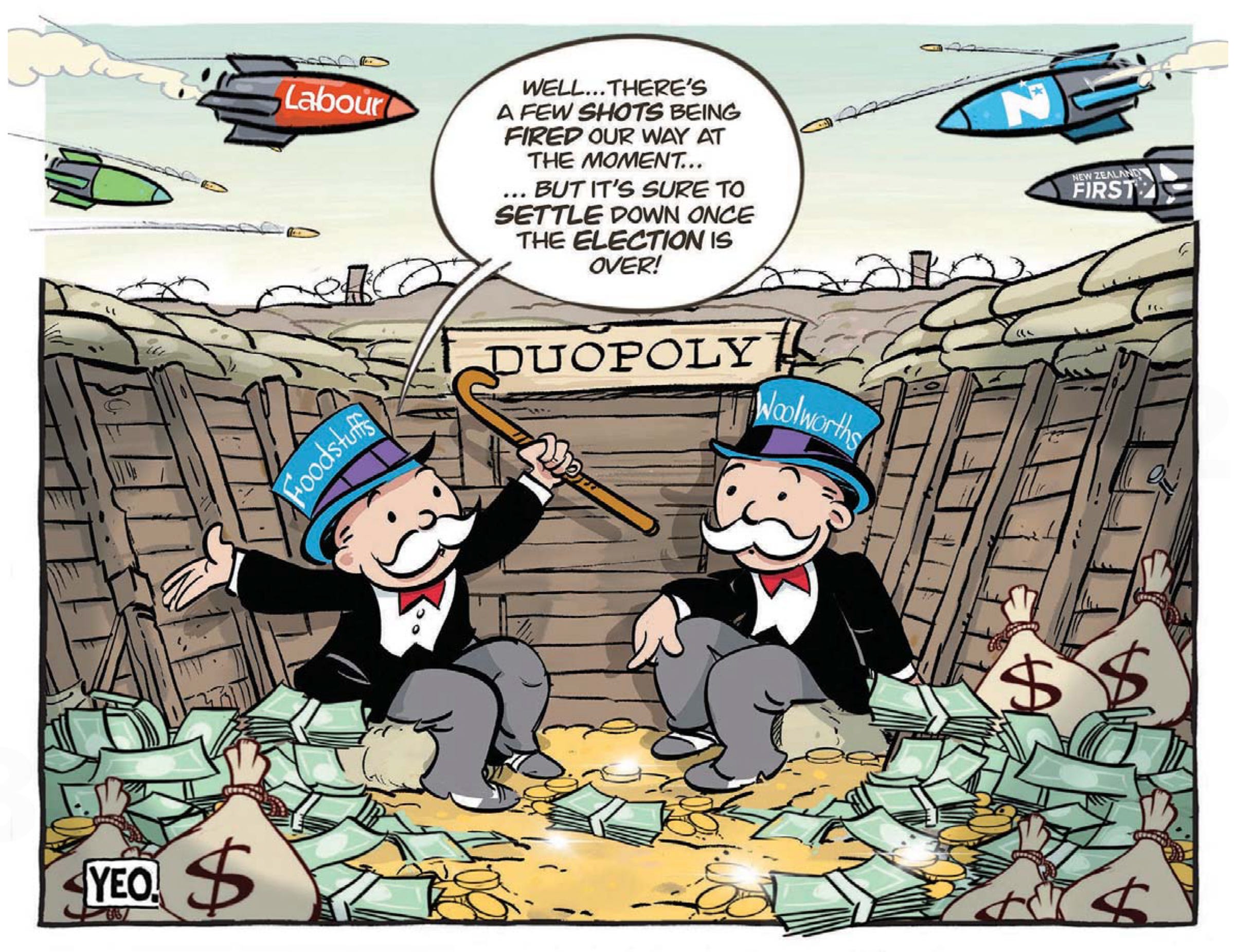
BusinessNZ’s Catherine Beard thinks New Zealand is starting to look like Venezuela. This morning when she was asked by broadcaster Ryan Bridge whether National’s supermarket policy was “banana republic” stuff, she replied: “It seriously is. You know, we’re starting to look a bit like Venezuela.”
What has produced this alarm is a proposal to restructure Foodstuffs so that Pak’nSave competes independently against New World and Four Square. Individual supermarket owners would keep their stores and their brands.
National deserves credit. The country’s main party of the right has accepted that fixing a broken market might require confronting the businesses benefiting from it. That is a significant departure for a party whose relationships with corporate New Zealand have so often discouraged action.
There are conditions. Within its first 100 days, a re-elected National government would change the law to authorise a Commerce Commission assessment of the proposed separation. The Commission would have six months from the directive taking effect to report. If it recommended separation, National would legislate to implement it.
There is a considerable distance between that promise and cheaper groceries. But Nicola Willis has finally said what years of incremental reform have made increasingly obvious: “after years of reviews and incremental reform, it’s clear the status quo isn’t working. It’s time for change.”
Making capitalism work
Some commentators seem unable to reconcile the proposal with National’s identity. Newstalk ZB’s Heather du Plessis-Allan responded with “WTF” and called it “completely bonkers”. Kerre Woodham declared herself perplexed by a policy she considered contrary to National’s political DNA. Yet any party that believes in competitive enterprise has good reason to challenge a market in which competition remains persistently weak. Businesses should have to win customers by offering them a better deal. Where entrenched advantages make that exceptionally difficult, governments have a legitimate role in changing the conditions.
Therefore Luxon is right to defend the policy by saying that National is a “party of competition”. The difficulty has been persuading the party to act on that principle when doing so upsets established businesses.
In a column titled “National’s crony capitalism problem”, published in October last year, I argued that National had an opportunity to champion consumers against powerful incumbents, including the supermarket duopoly. Its corporate relationships were an obstacle. Willis seemed the most plausible person within the leadership to push for something stronger. I doubted National would get this far. I’m pleased to have been too pessimistic.
The full force of the supermarket lobby
Willis is unusually frank about the resistance. She said today about Foodstuffs: “They are one of the most well-resourced entities in New Zealand when it comes to lobbying, they have expensive public relations spend, lobbying spend, advertising spend, and they deploy it with force.” Furthermore, she says “I have already seen them doing that whenever I have made suggestions about the unfairness of the current supermarket structure, I felt the full force of that, so have our MPs, and what I really don’t think is reasonable is for one group of lobbyists with a vested interest to determine what is best for the Kiwi shopper.”
She was blunter still when BusinessNZ came out against her, telling RNZ that its opposition was hardly surprising given Foodstuffs is one of its major members.
Richard Harman’s reporting in Politik shows how that influence works in practice. Foodstuffs has had its owner-operators develop close relationships with their local MPs. Food has been donated to political fundraisers and MPs hosted in stores. Two of the co-operative’s independent directors, former National finance minister Steven Joyce and Sir Henry van der Heyden, hold influential networks inside the party. None of this establishes wrongdoing and none of it is unlawful. What it establishes is access. An owner-operator is a significant local employer and a familiar community figure who can get an MP on the phone. The people struggling with their grocery bills have no comparable organisation, and never have.
Harman also reports that a senior National MP recently told a stakeholder lobby group that a breakup would be “bonkers” and would provoke a caucus backlash. Willis rejected the account, telling RNZ’s Russell Palmer that her caucus was “fully on board” and suggesting the story had probably come from “someone with a significant vested interest in the supermarket industry, rather than the MP themselves”. Asked what she based that on, she conceded it was “just because I think that it is highly unlikely that that would have occurred”. That is speculation. It is also the first time a senior figure in government has publicly accused the grocery industry of working her own caucus against her.
The lobbying will continue. The terms of the Commission’s assessment, its assumptions about costs, and any eventual coalition agreement will provide opportunities to weaken the proposal.
Business groups warn about investment confidence, saying National’s policy will have a “chilling effect”. Grocery Action Group chair Sue Chetwin offers an appropriate rejoinder: consumers have experienced their own “chilling effect” for decades.
The EMA’s Alan McDonald told the Herald’s Tom Raynel that the proposal is “not quite nationalising a private business but it’s too close for comfort”. Yet he suggests that “a better option might be to find a stronger regulator” with greater powers. Even this objection leaves room for stronger government intervention. The argument is about how far it should go.
The political tide has turned
NZ First proposed a similar Foodstuffs split in April. The Greens have raised the stakes with KiwiMart. Monopoly Watch, the Grocery Action Group and Consumer NZ have pressed for structural reform for years. National has now joined the argument. Consumer’s chief executive Jon Duffy, talking to RNZ’s Susan Edmunds, measured the movement: the debate had shifted further in six weeks than in the preceding four years, and every major party except Act now carries some form of structural reform or measure against excessive pricing. “It’s strange territory for the National Party but that’s how bad the problem is,” he said.
The No Right Turn blog, while questioning National’s willingness to follow through, captures the significance: “The fact that the party of protecting established economic interests has been forced to publicly support the breakup of one of the most established economic interests in the country shows how far the public mood has shifted, and how desperate National are to avoid being on the wrong side of that shift.”
This is the Overton window moving: a proposal once treated as politically outlandish has become something National thinks it can win votes with. And there is plainly electoral calculation involved. Harman suggests the timing may have been accelerated by Labour’s planned announcement proposing a law against price gouging. The Herald’s Audrey Young sees National positioning itself as a consumer champion even at the risk of damaging its relationship with business, on internal polling showing 60% support for a breakup.
Pattrick Smellie, who strongly doubts the policy’s economics, identifies the same opportunity in BusinessDesk: “A centre-right government could follow through on this policy, knowing it would likely be wildly popular among New Zealanders who want their governments to ‘stick it to the man’ occasionally.” Smellie’s “man”, in this case, is supermarkets, banks, power companies and petrol stations, “among other purveyors of grudge purchases and essentials”.
That is the opening created by “Broken New Zealand”. Voters meet these markets through bills they struggle to pay, and they have little reason to defend arrangements that politicians and business leaders keep assuring them are difficult to change. McDonald calls this a “populist policy for a grumpy electorate”. The electorate has had years in which to become grumpy. If National is chasing votes, it has at least chosen a worthwhile fight. It should also explain why it took so long.
That is the opening created by Broken New Zealand. Voters encounter these markets through bills they struggle to pay. They have little reason to defend arrangements that politicians and business leaders keep assuring them are difficult to change.
EMA’s Alan McDonald calls National’s proposal a “populist policy for a grumpy electorate”. The electorate has had years to become grumpy. If National is chasing votes, it has at least chosen a worthwhile fight. It should also explain why it took so long.
The paywall now starts partway through all Democracy Project newsletters. Please take out a paid sub if you want to support this service and access the full content, including the following sections: “Labour offers a smaller answer”, “Will it change the weekly shop?”, and “The fight after the election”.