

The annual AUT report on trust in New Zealand’s news media is out today, and the headlines reporting it are mostly positive. This is because trust is up. The decline has stopped, for now. Unsurprisingly, some media organisations are already taking a victory lap. Be sceptical.
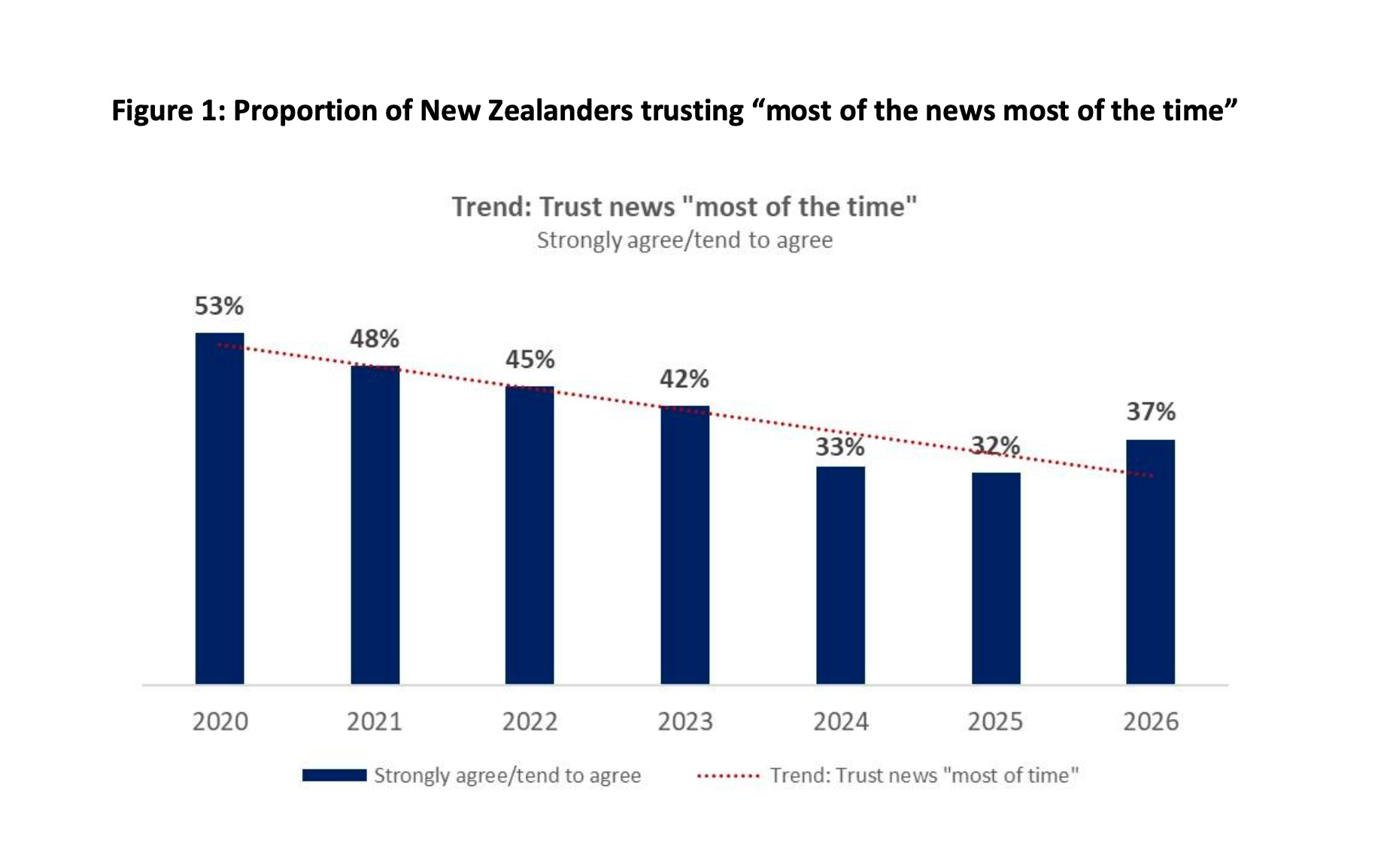
Yes, there has been a genuine improvement. For the first time since the survey began in 2020, the number of New Zealanders who say they trust the news in general has risen: from 32% last year to 37%. Trust in the news people personally consume also edged up to 50%, from 45% in 2025. The improvement is real. But the context matters enormously, and it’s easy to lose sight of it amid the cheerful framing.
Still dangerously low
In 2020, 53% of New Zealanders said they trusted the news. We are now at 37%. That’s still a 16 percentage point gap from where we started. And the survey’s own authors, AUT senior lecturer Greg Treadwell and Associate Professor Merja Myllylahti, are pretty clear about what that means. “Since we started publishing the report,” they write, “trust in news has been declining dangerously”. Treadwell described current trust levels in public statements today as “alarmingly low.”
To put the number in international perspective: the global average trust figure, as measured by the Reuters Institute for the Study of Journalism across 48 countries, is 40%. New Zealand, at 37%, remains below that global average. We’re closer to the US (which was at 32% last year) than to any model of a well-functioning media democracy. The trajectory has improved. The destination is still grim.
This context is awkward for a media that has been hurting and would very much like good news. Some outlets will cover today’s report as a turnaround story. Maybe it is. But a single-year uptick after years of freefall does not a recovery make.
The Avoidance number no one wants to talk about
Buried underneath the positive trust headline is a figure that should trouble anyone who cares about democracy. A record 78% of New Zealanders say they actively avoid the news to some degree. This is up five percentage points from 73% last year, and the highest figure since the survey began.
In contrast to New Zealand’s figure of 78% avoidance, the international average for news avoidance, recorded by Reuters, is 39%. So, in a country that ranks consistently high on democracy indices, where 91% of people say they’re interested in the news to some extent, nearly four in five of those same people are actively turning away from it, and this is double the global average.
The reasons are familiar, and quite predictable. About 53% say the news affects their mood. Another 34% say they’re simply worn out by it. These are not fringe views. They’re the dominant experience of the news for most New Zealanders.
That’s the number that should worry people, and it’s one that no marginal improvement in trust scores can mask. A media that nearly four in five people are trying to escape from? That’s a serious problem.
Social media trust is also rising
Then there’s the odd result that trust in news consumed on social media has jumped from 13% to 17%. At first glance, this seems counterintuitive. The report itself highlights that respondents are worried about misinformation on social media, that they distrust influencers, and that they see a flood of unreliable content online.
Myllylahti acknowledges the paradox but links it to the growing use of social media for news consumption, which the survey found is now nearly as common as television. Online still dominates at 38%, but TV and social media are now basically neck-and-neck: 20% and 19% respectively.
Facebook remains far and away the dominant social media news platform at 61%, followed by YouTube at 44% and Instagram at 28%. About 12% of respondents said they had used ChatGPT as a source of news.
It seems that a significant and growing slice of the population is getting its news through platforms that most people acknowledge are full of unreliable content. The rise of social media as a news source is happening alongside – not instead of – rising distrust. People use these platforms not because they trust them but because that is where the content finds them.
Who’s trusted — and who’s used
The rankings of individual outlets tell their own story. RNZ holds the top spot for trust, scoring 6.2 out of 10, ahead of the Otago Daily Times in second and TVNZ in third. Fourth equal includes The Listener, Newsroom, the Waikato Times, and interest.co.nz. The NZ Herald, BusinessDesk, NBR, Stuff, The Press, The Post, and ThreeNews make up the middle and lower rungs of the trust table — all improved, none spectacular.
RNZ, which is publicly funded and without advertising pressure, continues to lead on trust. The Otago Daily Times, a regional paper owned by the privately held Allied Press and operating relatively apart from the major corporate news groups, has consistently sat near the top. There’s a pattern here about what kinds of editorial environments tend to produce journalism that people actually trust.
Usage tells a different story. The NZ Herald is now the most-used news source in the country, with 52% of respondents saying they’d used it in the previous week — up from fourth spot in 2023. Stuff is close behind at 51%, then TVNZ at 50%. RNZ trails these at 35%. ThreeNews has more than halved since 2024, a terrible data point that reflects the ongoing disruption of commercial television news.
That mismatch is revealing. New Zealanders tend to trust RNZ more than they trust the Herald, but they use the Herald more. Some of that is simply reach and habit. But it also suggests the relationship between trust and consumption is more complicated than a simple virtuous cycle.
The paywall now starts at halfway through all Democracy Project newsletters. Please take out a paid sub if you want to support this service and access the full content, including the following sections: “A Warning about interference in newsrooms”, “Explaining the media-trust improvement”, “Not enough to declare a crisis over”, “An industry that can’t hear criticism”
