

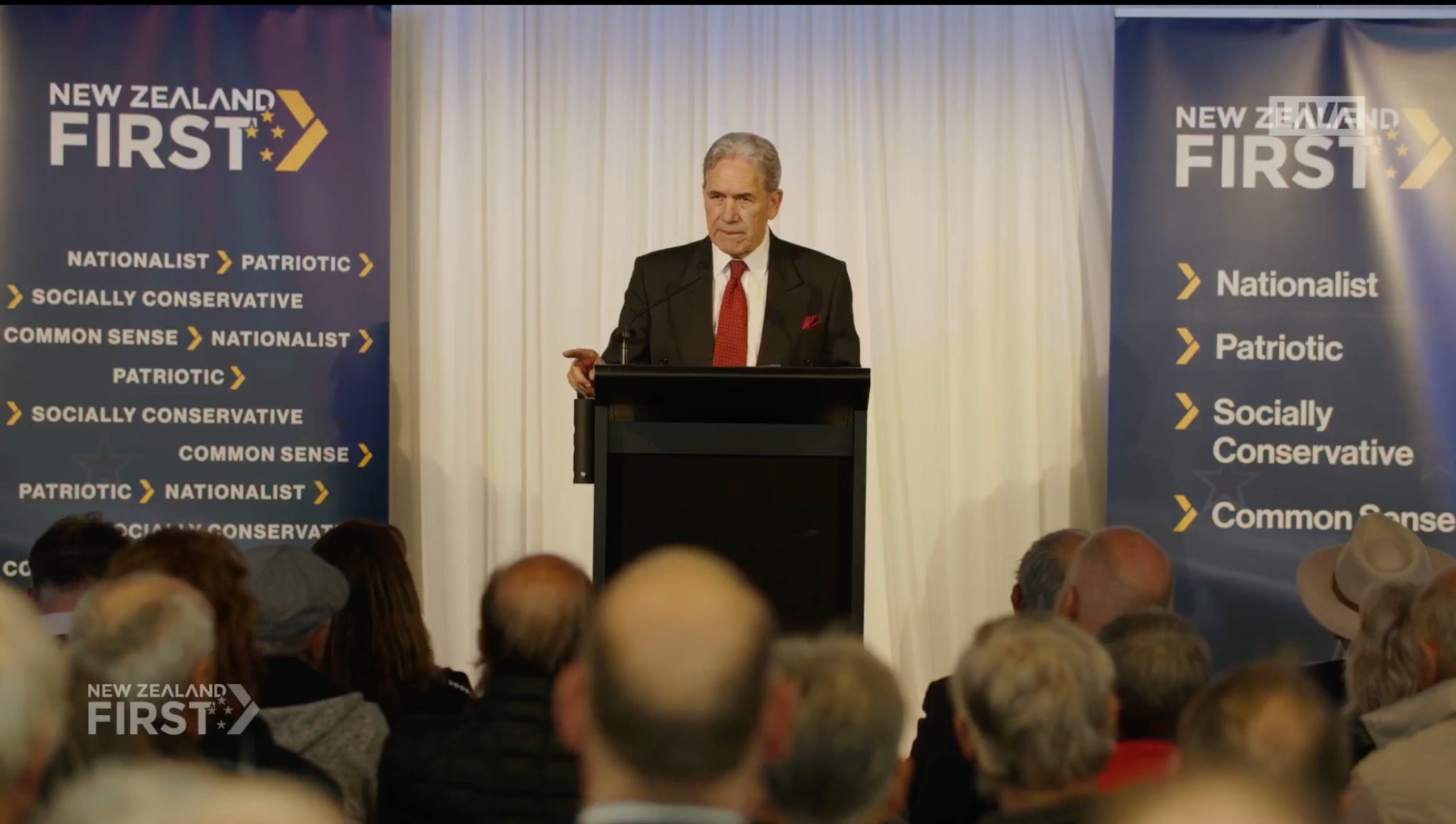
NZ First has announced today that it will campaign on creating a “Special Economic Zone” at Marsden Point in Northland. It sounds bold, and exactly the kind of decisive, industrial-policy thinking our stagnant economy supposedly needs.
But strip away the rhetoric and what you have is a proposal to carve out a patch of Northland where normal democratic rules don’t apply — where selected investors get tax breaks, looser environmental regulation, and immunity from local councils — in exchange for, the theory goes, jobs and growth. The evidence for that theory is thin. But the beneficiaries are already celebrating.
The beneficiary is already clear
When Shane Jones first floated the Special Economic Zone (SEZ) idea in February 2025, the Channel Infrastructure company did not wait for the detail to arrive. The NZX-listed business that owns the Marsden Point site fired off an immediate market statement through its chair, James Miller, calling the proposal “a resounding vote of confidence in the future of our company”.
Channel Infrastructure handles around 40% of New Zealand’s transport fuel and 80% of its jet fuel. Revenues last year were around $140 million, dividends have been steadily rising, and the company has its own ‘Energy Precinct’ plan already worked up — 120 hectares of unutilised land waiting for biofuel manufacturing, electricity firming, and storage opportunities. The company is not on its knees waiting for the state to throw it a rope. It is a profitable, listed business that has identified specific commercial opportunities at the site, and would very much like the public sector to underwrite the cost and reduce the regulatory friction.
The point is not that Channel is doing anything improper. They are doing what we should expect listed companies to do. The point is that NZ First’s flagship regional development policy is structured to deliver that benefit to that company and its named commercial partners — including the Seadra consortium of Qantas, ANZ, Renova Inc and Kent Plc, currently scoping a biorefinery on Channel’s land. They are not what most New Zealanders would picture when Peters speaks of Northland’s deliverance from neglect.
A lobbyist’s paradise
The economist Michael Reddell saw the obvious problem the moment Jones first floated the idea. If there were any substance to the SEZ concept, Reddell wrote, the policy seemed “likely to be a lobbyist’s paradise, and perhaps that of political party donors & recipients”. He recalled that the New Zealand Initiative had pitched something very similar a decade ago.
Reddell’s lobbyist point is the one that NZ First does not want to engage with. The moment you start designating discretionary zones with bespoke tax treatment and accelerated consenting, you create exactly the kind of high-value, low-transparency politics in which the lines between commercial interest and political access become blurred.
Who decides which company qualifies as being inside the zone? Who decides what activities “achieve the aims of the zone”? Who appoints the panel? On what criteria? Under what review process? These are not pedantic questions. They are the central governance questions, and they are conspicuously absent from anything Peters or Jones have said in public. NZ First, of all parties, used to have something to say about that sort of arrangement.
An economic nationalist selling a libertarian policy
For most of its political life, NZ First has positioned itself as the enemy of corporate New Zealand. Peters built large parts of his career on talking about the looting of the country by financial elites. The party currently wants to buy back BNZ, break up the gentailers, and break up the supermarket duopoly. And today in Whangārei, Peters paired the SEZ announcement with familiar attacks on the India free-trade deal and what he called a “Free Migration Deal”. The packaging is economic nationalism, with a strong populist accent.
Strip the nationalism off and what is left is lighter regulation, tax concessions, easier foreign investment, and a government-appointed panel sitting where local councils used to sit — selected firms operating under rules nobody else gets. None of that is an attack on corporate power. It is actually a vehicle for delivering benefits to particular corporates on a particular site.
Anne Salmond drew the connection earlier this year that I think really matters. In a column for Newsroom, drawing on the historian Quinn Slobodian’s book “Crack-Up Capitalism”, she traced a market-radical tradition that dreams of carving the world up into zones where capital can operate freed from democratic friction.
Slobodian outlines a whole tradition of market-radical thinking that dreams of creating zones beyond democratic oversight — places where capital can operate free from the friction of elections, regulations, and public accountability. The fantasy of Hong Kong as a “corporate free-for-all” precisely because its residents have no democratic say features prominently. The version being proposed at Marsden Point is considerably more modest. But the underlying instinct is the same: democracy is an obstacle to doing business, and the solution is to create spaces where it doesn’t apply.
Salmond’s framework, applied to the SEZ, exposes the same convergence — NZ First, supposedly devoted to economic nationalism, ends up proposing the kind of zone the libertarian right has been pushing for years.
The paywall now starts at halfway through all Democracy Project newsletters. Please take out a paid sub if you want to support this service and access the full content, including the following sections: “What the international evidence actually shows”, “Marsden Point is already on the dole”, “Who answers to whom”, “What Northland actually needs”, and “A word that gives the game away”.