

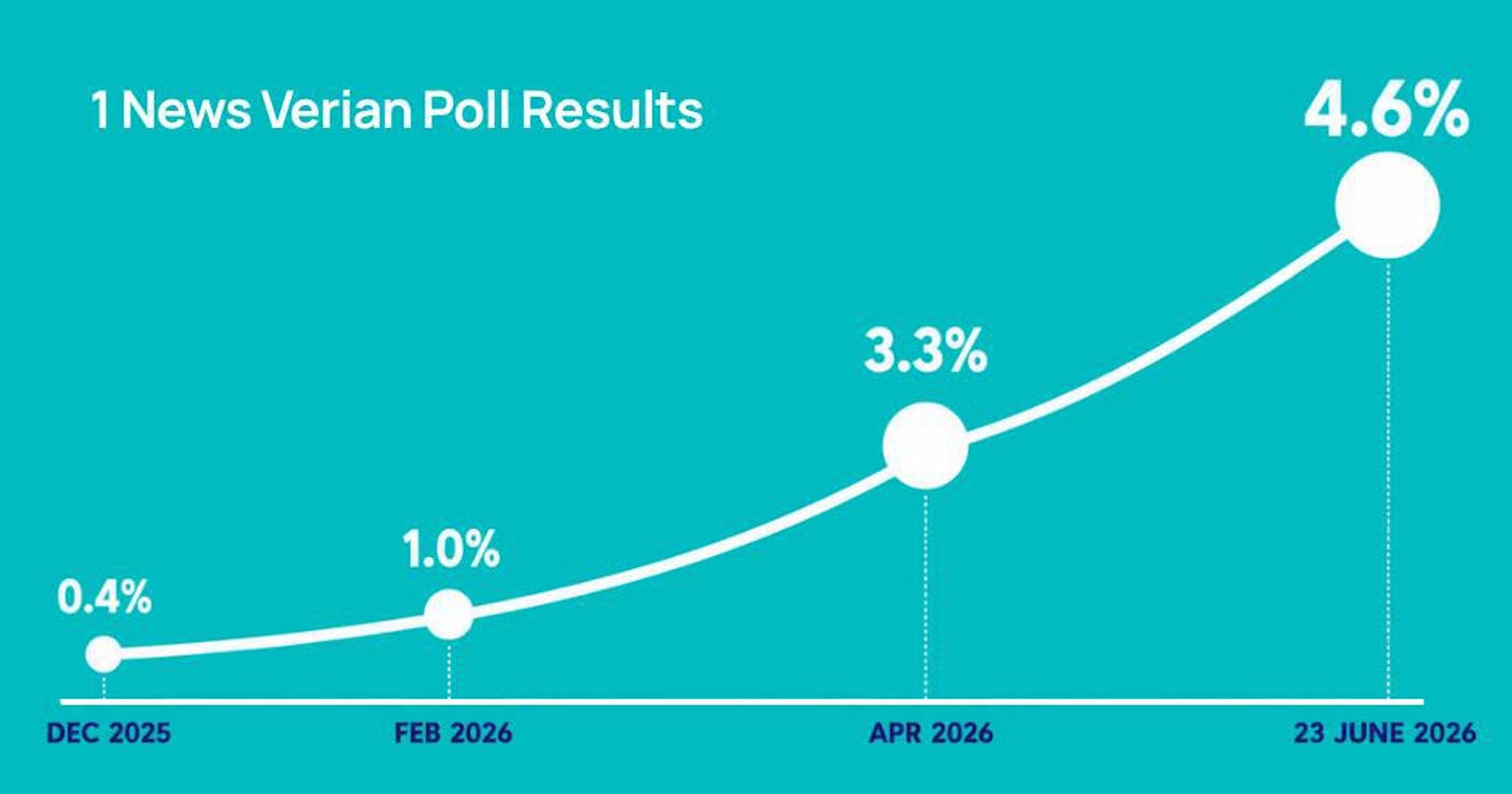
Something unusual has happened in the 2026 election campaign: a new party has started to matter. The Opportunity Party has moved from being a minor-party curiosity to being a possible parliamentary entrant.
This does not mean Opportunity will definitely make it into Parliament. It might not. It could still collapse back to 2-3%, as small parties often do. But it has now crossed the first and most important psychological line for a party outside Parliament: it has stopped looking like a wasted vote. The barrier it’s crossed is in voters’ heads, not yet at the ballot box.
The recent 1News-Verian poll put Opportunity on 4.6%, just under the 5% threshold. The latest Roy Morgan poll put the party even higher, on 6.5%, which would deliver it eight MPs. Roy Morgan can be more volatile than other polls, and no one should treat one poll as prophecy. But the pattern is no longer easy to dismiss.
Opportunity is no longer marooned in the world of 1-2%. Cross 5%, and the whole post-election arithmetic changes.
Which is why the knives are suddenly out from every direction.
The wasted-vote trap
Under MMP, a party needs either 5% of the party vote or an electorate seat to enter Parliament. For Opportunity, the electorate route has always been difficult. When he was leader, Gareth Morgan didn’t have one. Nor then did Geoff Simmons. Raf Manji tried hard in Ilam in 2023 but fell well short. New leader Qiulae Wong is now campaigning in Mt Albert, which is more interesting than previous efforts, but the party’s real path is still the party vote.
So the party has always been stuck in the classic minor-party bind. Voters won’t back it until they think it can get in, and it can’t get in until they back it.
Polling near the threshold changes the sum. The constitutional law academic Andrew Geddis has made the point directly. Once a party polls near “the magic 5 percent mark”, he argues, the voters who had dismissed it as a wasted vote “will have permission to consider them seriously”. The vote no longer feels like it is being thrown into the sea.
The only surprise in a stale campaign
Opportunity is getting the coverage because it is the only surprising thing in the entire campaign.
Most of the rest feels grimly familiar. National is trying to hold together a governing coalition while watching support leak to Winston Peters. Labour is trying to return to office without saying too much about what it would actually do. The Greens are fighting for influence while also fighting the perception that they have become too self-indulgent. Act is struggling to rediscover its insurgent energy from opposition. Te Pāti Māori is engulfed by internal conflict. NZ First is doing what NZ First does: creating leverage, grievance and theatre.
The party is not rising because New Zealanders have suddenly become disciples of land-value taxation or citizens’ assemblies. It is rising because the old parties look exhausted, the parliamentary minor parties look compromised, and a portion of the public is open to a new vehicle for dissatisfaction.
Voters are sick of a political class that talks about long-term problems while practising short-term managerialism. Housing, infrastructure, power prices, water, supermarket prices, banking profits, climate adaptation, the state of public services. Everyone knows the list. Everyone hears the speeches. Then the system carries on.
New Zealanders are used to hearing about broken economic markets: supermarkets, banks, building supplies, electricity. Election year is exposing another one: politics itself.
For the first time in years, a serious new entrant is at least knocking on the door.
Media coverage
Of course the media is covering it. It would be bizarre if they didn’t.
Some on the right complain that Opportunity is being inflated by favourable coverage. Journalist Chris Lynch says there is “something unhealthy happening” in the attention being lavished on a party that has never won a seat, and Ani O’Brien has argued much the same.
There is something to it. Coverage confers legitimacy, and a party that is ignored stays invisible. The New Conservatives are the obvious control case here: they polled in Opportunity’s range for years and got nothing like the same airtime. Journalists, like everyone else, find a socially liberal, urban, professional-class party more interesting than a provincial one with religious overtones. The people who staff the newsrooms and the people who front Opportunity tend to look, and think, alike.
But it’s more than this. Once a party is polling at 4.6%, the argument becomes much weaker. At that point, the media is not inventing a story. The story already exists. A party that could bring six or eight MPs into Parliament and potentially hold the balance of power is big news.
The real question is not whether Opportunity deserves coverage. It does. The question is whether the coverage will now become tougher. And of course it should.
Everyone suddenly hates Opportunity
One of the clearest signs that Opportunity has become relevant is that everyone is now finding reasons to attack it. Hayden Donnell caught the comedy of it in the Spinoff. Qiulae Wong had been calling for less bickering and more unity, and in a sense she got it: “in being hated by the left for being corporate shills and by the right for being communists in disguise, Opportunity has one aspect of centrism down pat”.
The leftwing critique is that Opportunity is stealing Green ideas, watering them down, and selling them back to voters in centrist packaging. Green co-leader Marama Davidson has dismissed Opportunity’s policies as recycled Green ideas, saying “there is nothing that they add to the solutions that we aren’t already offering”. Labour’s Chris Hipkins has suggested the party still needs to work out what it actually stands for.
From the right, the attack is the reverse. Opportunity is not centrist at all, they say, but a radical leftwing party with a nice Auckland businesswoman out front. Christopher Luxon dismissed the party as a vote for Labour and the Greens, pointing to its land tax and citizens’ income. Heather du Plessis-Allan has called it “a radical left-wing party with a land tax and a universal basic income, fronted by a nice lady from Auckland.”
Ashley Church ran a piece headlined “TOP is a Trojan horse for the left”, arguing that a vote for Opportunity is simply a vote for the Greens and Labour by other means.
Winston Peters has reached for the most cutting line available to him, calling it a “party of consultants”. Like most good insults, it lands because it carries enough truth to wound.
The paywall now starts partway through all Democracy Project newsletters. Please take out a paid sub if you want to support this service and access the full content, including the following sections: “What Opportunity is actually offering”, “A revolt of the competent classes”, “The integrity opening”, and “The real test of MMP”.