

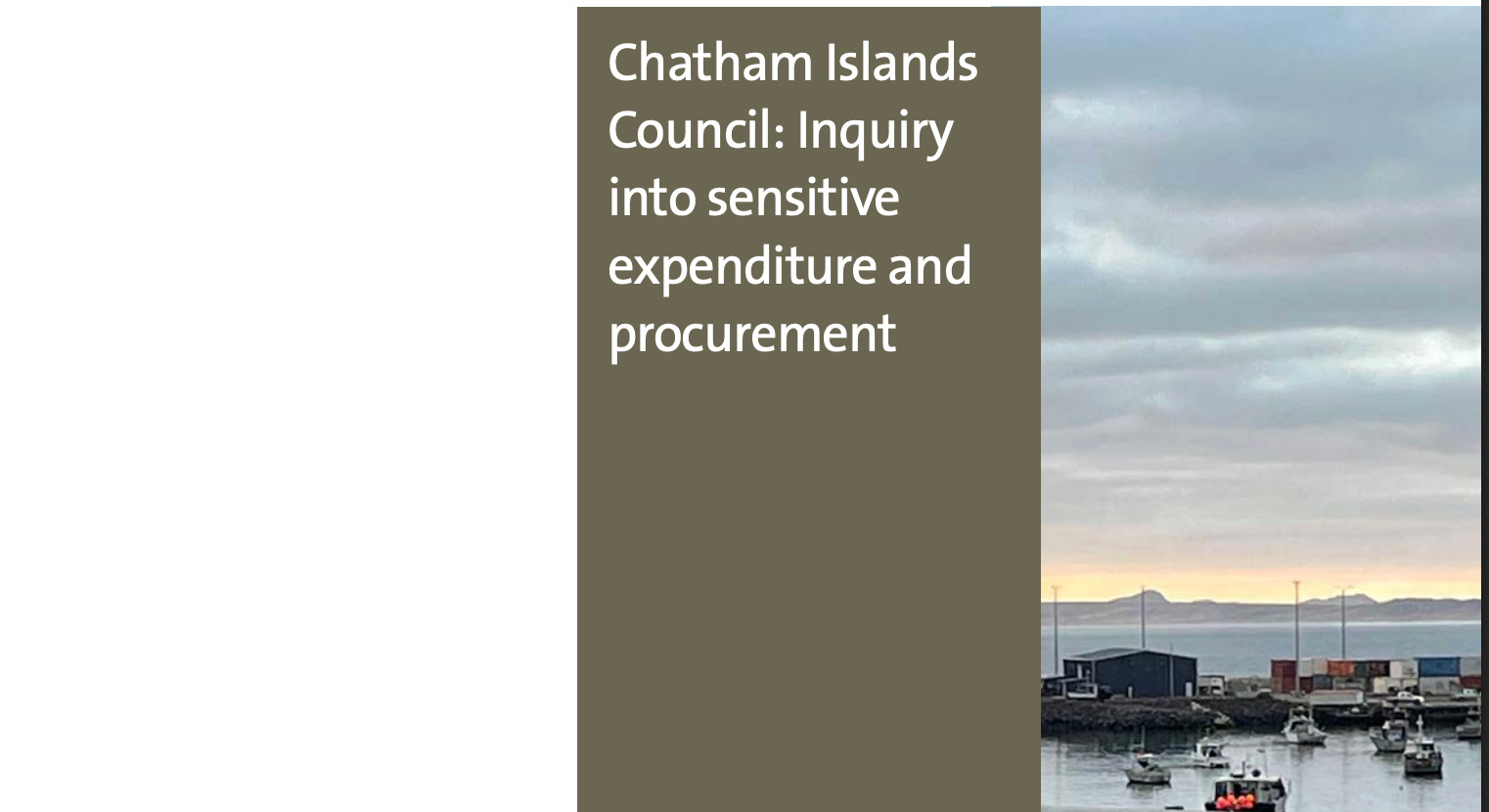
Paul Eagle has been found out. Not by the press, though journalists have been circling for months, but by the Auditor-General, whose inquiry report into the Chatham Islands Council was tabled in Parliament yesterday. It is one of the most damning official documents produced about a New Zealand public servant in years. And the man at the centre of it is not some anonymous council manager who got in over his head. He is a former Labour MP, a former deputy mayor of Wellington, and a political operator with decades of experience in public life.
The report lays out a pattern of conduct that goes well beyond poor judgement. Eagle oversaw a $460,000 renovation of the council-owned house he lived in. He hired consultants he already knew and arranged for his wife to be subcontracted. And when auditors came asking questions, he fabricated documents, copied a builder’s signature on contracts the builder had never seen, and denied it – before eventually admitting he had “panicked.”
Eagle resigned last month. But resignation is not accountability. The question now is whether anyone – the police, his former party, central government – will impose real consequences. Or whether, as happens so often in New Zealand public life, a quiet exit will be treated as punishment enough.
The House that Eagle gold-plated
The centrepiece of the scandal is a council-owned house on the Chatham Islands, rented to the chief executive as part of the job. The property needed work, and in 2022 the council budgeted $200,000 for it, funded from “Better Off Funding”, which was Crown money meant for community wellbeing projects.
Then Eagle arrived. Before he even started, he and his wife inspected the house and sent through a wishlist: new kitchen cabinetry, stainless steel benches, bathroom fittings, deck work, a garage conversion. The budget was bumped to $460,000. Eagle took sole control. He directed the builders, approved costs, managed contractors. No independent oversight. He was the tenant, the beneficiary, and the one signing the cheques.
The Auditor-General is blunt: the arrangement was “inappropriate.” Suppliers described the spending as “widely considered to be excessive.” One detail captures the tone of the whole affair. The original builder’s quote allowed $10,000 for Fisher & Paykel kitchen appliances. Eagle swapped in Miele – the premium German brand – at $18,102. He ordered them before the council had even approved the revised budget. He also continued work on the garage conversion after the council explicitly rejected it.
All of this on a council that is, by any honest accounting, broke. The Chatham Islands Council serves about 650 people. It runs at the edge of a $500,000 bank overdraft. It cannot fix potholes or connect houses to water. More than 90% of its revenue comes from the Crown. Auditors have raised “significant doubt” about whether it can continue as a going concern. This is the institution Paul Eagle was treating as a personal renovation fund.
Fabricated documents and a copied signature
If the house renovation were the only problem, it would be bad enough. But what lifts this affair into a different category of scandal is what Eagle did when investigators came knocking.
The NZ Herald’s Ethan Manera put it plainly: Eagle “misled an official probe into his ‘excessive’ spending… by creating his own financial records, including adding another person’s signature to documents.” He submitted quotes and contracts to auditors that appeared to come from the builder. They did not. Eagle had created or altered them himself. He obtained the builder’s signature separately and attached it to contracts the builder had never reviewed. He backdated procurement memorandums prepared in 2025, making them look as though they had been written in 2024.
Initially he denied it. Then he changed his story. His eventual explanation, offered in a letter published alongside the report, has already become notorious: “In hindsight, I recognise I panicked when I realised documentation was incomplete and I tried to fix this.”
That word “panicked” is doing extraordinary work. What Eagle describes as panicking, most people would call fabricating evidence during an official investigation.
The Auditor-General found the information Eagle provided was “misleading” and “created an incorrect picture about when certain events occurred (for example, when a contract was signed) or whether they had happened at all.” Eagle’s actions were “unacceptable and demonstrated exceptionally poor practice and judgement.”
Andrea Vance reported in The Post that the documents Eagle supplied “appeared to be from contractors but had actually been edited or created by him.” Catherine McGregor, writing in The Spinoff’s Bulletin today, noted the inquiry grew out of a 2024 annual audit that flagged spending “that could be seen to give private benefit to staff.”
Corruption, fraud, forgery?
The Auditor-General’s report stopped short of pronouncing on legality. It says it has “not reached a view on the legality of the chief executive’s actions” but considered it “sufficient to draw the Council, Parliament, and the public’s attention to the matter.”
That language is deliberately a signpost for someone else – the Police, the Serious Fraud Office – to pick up the trail.
The No Right Turn blog was characteristically direct. As the blogger wrote: “there are a number of names for it: corruption. Fraud. More specifically altering documents with intent to deceive, and using altered documents with intent to deceive. These are serious crimes, and Eagle needs to be prosecuted for them.” When a person in power abuses their position to enrich or advantage themselves, the blog argued, “that is corruption, and they need to be held to account.”
That seems true. Creating false documents, adding someone else’s signature without their consent, providing misleading information to statutory investigators, backdating procurement records. These are not administrative slip-ups. They sound a lot like offences under the Crimes Act.
The Wife, the consultants, and the conflicts
The house renovation is the headline. But the Auditor-General’s report reveals a broader pattern of behaviour that is just as troubling.
Eagle hired a consultancy firm he already knew, without following procurement processes. No formal contract was signed initially – they relied on a verbal agreement. Over time, the council paid this firm approximately $350,000 plus GST. Eagle’s wife, Miriam, was proposed as a subcontractor on a $109,600 contract variation to lead a 30-year strategy project. The Auditor-General found no evidence other councillors or staff were even told about the conflict of interest.
He also provided misleading information to the Department of Internal Affairs about how far the consultancy work had progressed, claiming it was “fully contracted and being delivered” when only a $20,000 contract existed. This matters because Better Off Funding – Crown money for community wellbeing – was being used to pay for some of this work.
RNZ’s Bill Hickman reported that staff told investigators of a “toxic” working environment and said concerns raised about spending had been “dismissed by senior leaders.” The Auditor-General confirmed: “There was a culture of blame that was set from the top.” When a former employee eventually made a protected disclosure, they weren’t raising an administrative red flag. They were sounding an alarm about the ethical collapse of their workplace.
A political animal, not a hapless bureaucrat
Eagle’s defence leans heavily on the excuse that he started three months early, that his predecessor fell ill, that he had no formal induction. These are mitigating circumstances for minor procedural slips. They do not explain ordering $18,000 of premium appliances before the budget was approved, managing a renovation you personally benefit from, hiring your wife as a subcontractor, or forging a builder’s signature on contracts you created yourself.
This is not a man who stumbled into a role he didn’t understand. Eagle was Wellington’s deputy mayor. He was a Labour MP for six years. He ran for mayor. He is a political operator with decades of experience in local and central government. The idea that he did not understand basic procurement obligations, conflict-of-interest rules, or the duty not to fabricate documents is not credible.
Jonathan Milne’s reporting in Newsroom has been particularly revealing. As far back as January, Milne flagged Eagle’s scrutiny over the “premium German-engineered fridge-freezer” and procurement questions. At that point, Eagle insisted he would not resign. Then in February, two hours after telling Milne he hadn’t heard the audit’s final conclusions, the mayor announced his “agreed” resignation. The timeline speaks for itself.
Should the Police investigate?
Yes. Obviously yes.
The Auditor-General’s deliberate refusal to opine on legality is a red flag, not a green light. Someone needs to pick it up. Creating false documents, adding a person’s signature without their informed consent, providing misleading information to investigators, backdating procurement records – in any other context, this behaviour would attract serious scrutiny from the Police.
The interim chief executive, Bob Penter, has declined to say whether the council is referring the matter to police. He should. Local Government Minister Simon Watts has described the situation as “a very serious matter” and said the community “deserves accountability.” He is right. But accountability means investigation, not just ministerial statements.
We cannot have a system where “I panicked” is a valid defence for the falsification of public records. If a low-level clerk in a government department had done this, they would be facing criminal charges. Why should a former MP be treated any differently?
Where is the Labour Party?
This is the question that will not go away. Eagle was Labour’s man in Rongotai for six years. He was the first Māori male to win a general electorate seat for the party in over a century. He ran for the Wellington mayoralty with Labour’s endorsement. He is, as far as anyone can tell, still a Labour Party member.
And yet: nothing. No statements or attempts to distance the party from Eagle. There hasn’t even been an expression of concern. The silence from the Labour benches has been deafening. They were happy to ride his coat-tails when he was winning electorate seats in Rongotai. They seem remarkably shy now that he has been caught creating fake contracts and forging signatures.
If Labour takes integrity seriously, it cannot stay silent. At what point does a former MP who fabricated official documents, misled a statutory watchdog, used public money to upgrade his own home, and funnelled contracts to his wife cross a line that triggers consequences from the party?
Labour should be asked directly: is Paul Eagle still a party member? Does the party condone his conduct? If Labour is serious about transparency, accountability, and service to communities, it should be putting clear distance between itself and Eagle. Expulsion from the party would be a proportionate response. Silence is not.
A Community left holding the bag
Into this fragile community stepped a politically connected former MP who gold-plated his kitchen, channelled public money to mates and family, created a toxic workplace, and then fabricated documents to cover his tracks. The community didn’t just lose a CEO. It lost time, trust, and scarce public resources it could not afford to waste.
Former mayor Monique Croon, who signed off much of Eagle’s spending, told Newsroom: “I live in a very small community, and I’ve got people looking at me as if I’m a criminal.” That is what happens when public officials treat public money as their own. It poisons a whole community.
Resignation is not accountability
Eagle’s offer to participate in a hui to apologise for his “shortcomings” should be seen for what it is: an attempt to frame a systemic integrity failure as a personal growth opportunity. The language of his response letter – “I accept and take ownership,” “I deeply regret,” “my confidence was misplaced” – is the polished vocabulary of a professional politician managing a scandal. It is not a reckoning.
New Zealand has a chronic problem with accountability in public life. Officials who breach the public trust resign and move on. Sometimes they resurface in new roles. Sometimes they run for Parliament again.
This case should be different. The police should examine whether the document fabrication and misleading of investigators constitute criminal offences. Labour should publicly address Eagle’s continued membership. And “I panicked” cannot be allowed to stand as a defence for the falsification of public records. For a community as vulnerable as the Chatham Islands, the damage done by Eagle’s tenure demands a full reckoning – from the police, from Labour, and from a political class that has tolerated this kind of conduct for far too long.
Dr Bryce Edwards
Director of the Democracy Project
Further Reading:
