

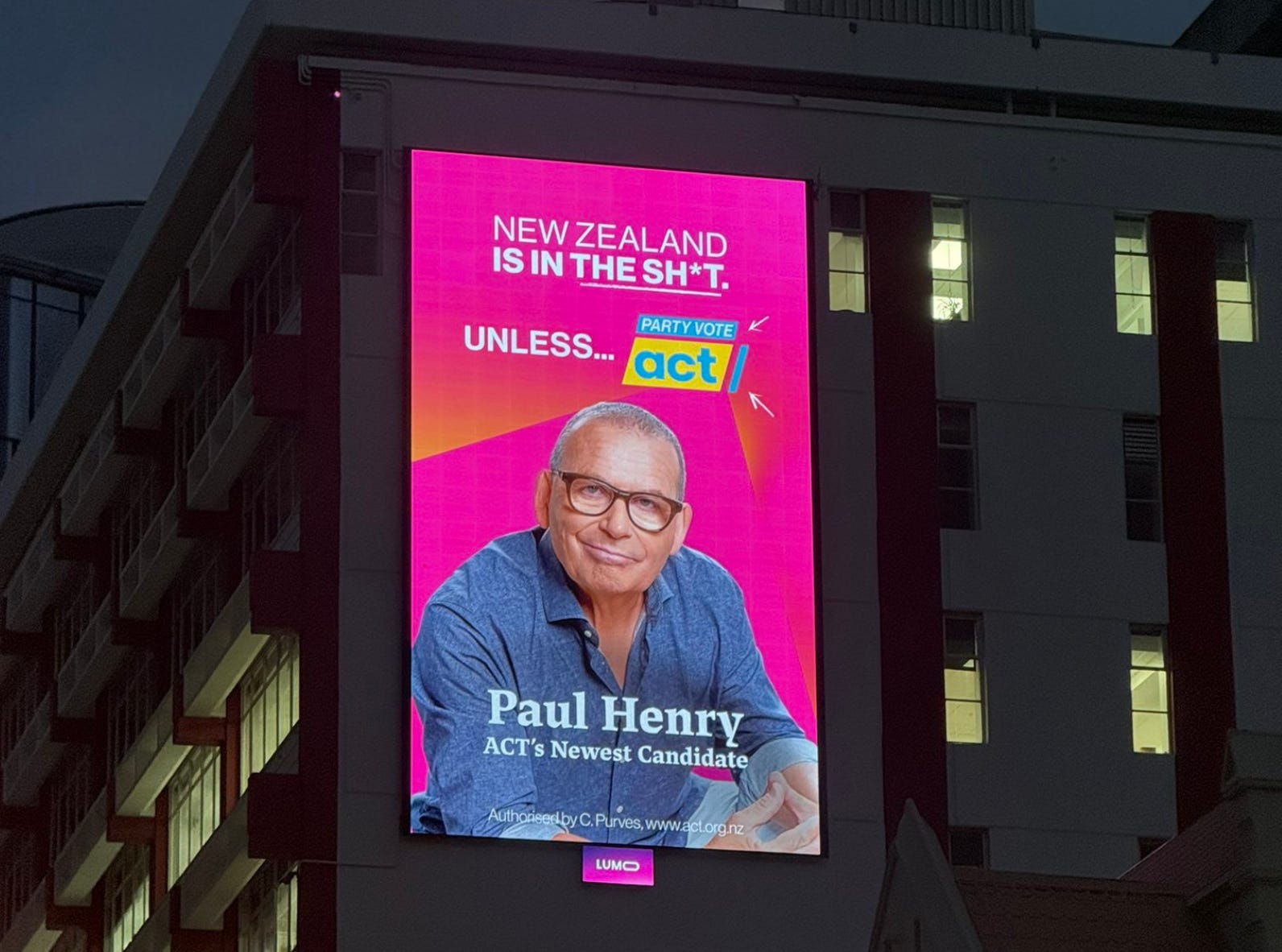
Paul Henry had only been an Act candidate for only a few minutes on Tuesday before he had insulted his future parliamentary colleagues, attacked most of the other parties and dreamed up a multibillion-dollar cancer hospital. It’s an early sign of the colour and chaos he will bring to the Act Party, the election campaign, and the next Parliament.
Henry’s rooftop unveiling was certainly among the most effective pieces of political theatre of the election campaign so far. He joked about his wealth and appearance, talked about the country’s “malaise”, declared his desire to become a minister and complained that too many MPs are “twats”. When asked what he might actually do in government, he suggested creating a world-class cancer hospital, perhaps with $10 billion contributed by wealthy New Zealanders and the rest borrowed.
It was loose, entertaining and occasionally absurd. That was rather the point. It showed that Act had acquired more than a candidate. In Henry, it has a professional generator of attention.
Act needed another showman
Act has been stuck. Polling around 7–8% this term, the party has been, as Stuff’s political editor Jenna Lynch put it, “in a polling rut as New Zealand First capitalises on voter disgruntlement.”
Lynch argues that Henry could be a genuine “gamechanger” for Act. She says the party has been struggling to command attention, losing momentum to coalition partner NZ First. In contrast to Seymour, Winston Peters has spent much of the term making all the noise and attacking the Government from inside the Government.
Seymour, meanwhile, has had to grow up in public. The insurgent who built his profile through dancing, provocation and online combat is now Deputy Prime Minister, with departments to oversee and decisions to defend. Office has made him more consequential but less free, and the job demands a restraint he once thrived on ignoring.
Henry restores the missing chutzpah in Act. Henry, in Lynch’s words, gives Act “an outspoken, media-savvy attack dog with enough name recognition to capture the public’s attention.”
That opens up a useful division of labour. Seymour plays the serious minister and ideological brain; Henry gets to be entertainer and salesman, free to say things about National and NZ First that would cause real trouble coming from the Act leader himself.
The reaction from the political commentariat was unusually enthusiastic. Heather du Plessis-Allan rated the announcement “ten out of ten” and called Henry “the candidate get of the election so far”. Mike Hosking described him as “just the shot in the arm” Act needed. Audrey Young went further, suggesting his candidacy “could be a seismic political event”.
Also in the Herald, political editor Thomas Coughlan compared the press conference to Jacinda Ardern’s 2017 debut as Labour leader — the launch that triggered “Jacindamania”. And political journalist Richard Harman also speaks today about having worked with Henry, and “can testify to his intelligence, affability and generosity of spirit”. He adds: “He will undoubtedly liven things up.”
A game-changer?
The term “game-changer” has been used in the last day by commentators such as Hosking, Lynch and Shayne Currie. So could Henry’s entry to the campaign have a big impact on the election result?
Celebrity candidates are often overhyped. They produce a burst of free publicity, appear on every programme for a week and then fail to shift much support.
Henry may turn out to be another sugar hit.
He does not have to transform Act into a major party. Moving it from roughly 7% or 8% to 10 or 11% would be a substantial achievement. Henry has already told Currie that anything below 10% would disappoint him.
The big loser could be the National Party
Under MMP, a few points moving between allied parties can alter the distribution of power even when the overall left-right balance barely changes. Although Henry is standing for Act, his most important opponent may not be Labour, but National.
Henry says he is “enormously disappointed” by the party. Christopher Luxon, he told Shayne Currie, “doesn’t seem to be clicking with the country and that’s a real problem”. Henry’s explanation is that large centrist parties become immobilised by their desire to be liked. They avoid offending anyone and end up achieving too little.
It is a familiar criticism of National from the right. The Government promised decisive change, but often looks managerial and defensive. Luxon talks endlessly about delivery and targets, yet has struggled to communicate a convincing idea of where the country is heading.
Henry’s assignment is to tell centre-right voters that National is not moving quickly enough because it is incapable of doing so without Act forcing it along. He will be trying to persuade a relatively small number of National supporters that the bolder vote is for the yellow and pink party. That could prove easier than enlarging the rightwing vote as a whole.
It is also where Henry becomes dangerous to Luxon. Every voter who moves from National to Act might remain in the governing bloc, but National becomes weaker within it. After the election, if the Government is re-elected, Luxon would have fewer MPs, fewer ministers and less authority over the next coalition.
Lynch is especially good on this: “While it’s questionable whether celebrity candidates can really shift the dial for voters, even boosting Act a couple of points at the expense of the Nats would be devastation stations for Christopher Luxon.” That is the real gamechanger argument. Henry may not bring many new voters into the rightwing bloc. But he could help Act take a larger share of it, mostly at National’s expense.
The paywall now starts partway through all Democracy Project newsletters. Please take out a paid sub if you want to support this service and access the full content, including the following sections: “The politics of unapologetic wealth”, “Can Henry tolerate Parliament?”, “A gift and a gamble”, and “The bigger picture”.
